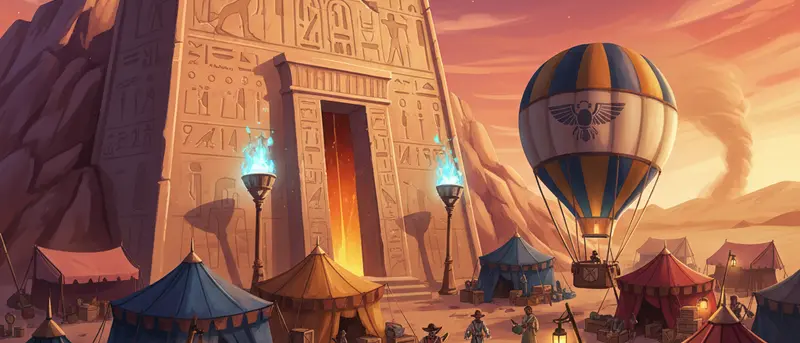
Find your name on a sealed door
Brush the sand off a buried lintel and read your name in hieroglyphs, then meet the rest of the 25-sign alphabet through real Egyptian words. Three short sections, about ten minutes each.
Why Learn Hieroglyphics? Seven Real Benefits
Why learn hieroglyphics? Seven real benefits, from reading 3,000 years of Egyptian texts in the original to rewiring how you think about writing itself.
Quick answer
Learning hieroglyphics lets you read 3,000 years of Egyptian history in the original (names on cartouches, temple inscriptions, the Book of the Dead) instead of relying on museum captions. It also trains visual memory and pattern recognition in a way alphabetic languages do not, and because the sign list is finite and the texts formulaic, beginners see results quickly: royal names within days, formulaic inscriptions within months.
Want to read this for yourself? Start the free first lesson: the 25-sign hieroglyphic alphabet in about 25 minutes. Free with a Google or email sign-in.
Why I Started (and Why I Stayed)
I'll admit it: when I first decided to learn hieroglyphics, part of me thought it was a novelty. Something fun to try for a few weeks before moving on to the next thing. But here I am, months later, still studying, still reading, and more motivated than ever. The reasons I started aren't the reasons I stayed.
If you're still weighing up whether to start at all, should I learn hieroglyphics? covers how hard it is and how long it takes. This post is about the payoff: seven things learning hieroglyphics has actually given me. If it convinces you, you can learn hieroglyphics here, starting with a free lesson.
Try it as you read: write your own name in hieroglyphs with the free translator, or take the free first lesson and learn all 25 alphabet signs on a sealed door.
1. You Get Direct Access to 3,000 Years of History
Learning hieroglyphics means reading Egyptian texts in the original rather than through someone else's translation. This is the big one. Ancient Egypt produced an extraordinary volume of written material: temple inscriptions, tomb texts, medical treatises, love poetry, legal contracts, royal decrees, philosophical dialogues, and funerary literature. Most people only ever encounter this material through translations, and translations always involve interpretation.
When I started reading hieroglyphic texts myself, even simple ones, I realised how much nuance gets lost in translation. The word choices, the visual puns, the way determinatives add layers of meaning that simply don't exist in English. Reading the original is a fundamentally different experience from reading a translation, and it gave me a much deeper appreciation for the sophistication of ancient Egyptian thought.
2. It Rewires How You Think About Writing
Hieroglyphic writing encodes sound, meaning and category in the same word, which no modern script does. Before I studied hieroglyphics, I took the alphabet for granted. Letters represent sounds. You string sounds together to make words. Simple.
Hieroglyphics shattered that assumption. In this system, a single inscription might contain:
- •Phonetic signs that represent one, two, or three consonants
- •Logograms that represent entire words
- •Determinatives that silently classify what kind of thing a word refers to
- •Phonetic complements that partially repeat a sign's sound value to aid reading
- •Honorific transposition, where a god's name is written first out of respect but spoken later
This layered approach to encoding meaning is unlike anything in modern writing. Learning it didn't just teach me about ancient Egypt. It fundamentally changed how I think about the relationship between symbols and meaning, between writing and language.
3. It's a Genuine Intellectual Challenge
I spend most of my time learning things that have immediate practical applications. Hieroglyphics is different. There's no shortcut. No way to skim. You have to build the knowledge methodically: memorise the signs, learn the grammar, practise reading real texts.
And honestly? That's what makes it so satisfying. Every inscription I can read, every new sign I recognise, every grammatical construction I understand feels like a real achievement. In a world full of quick wins and dopamine hits, hieroglyphics forces you to slow down and engage deeply with something. That process has been more rewarding than I expected.
4. It Connects You to Real People
One of the things that surprised me most about learning hieroglyphics is how human the texts feel. Ancient Egyptian writing isn't all grand religious declarations and royal propaganda. There are love poems, letters between friends, complaints about bad neighbours, and the attendance registers kept by scribes at Deir el-Medina recording why workers were absent ("bitten by a scorpion," "brewing beer," "drinking with Khonsu").
Reading these texts in the original script collapsed the distance between me and the people who wrote them. These weren't abstract historical figures. They were real people with real concerns, and their words have survived for thousands of years. Being able to read those words directly, without a translator in between, is an extraordinary experience.
5. It Makes History Physical
I used to walk through museum galleries full of Egyptian artefacts and see beautiful but mysterious objects. Now I can read (some of) what's written on them. That single change transformed how I experience museums, documentaries, and even travel.
When I visited the Egyptian collection at the British Museum after a few months of study, I could pick out royal names, identify offering formulae, and read fragments of funerary texts. I was no longer just looking at artefacts. I was reading them. That shift from observer to reader is hard to describe, but it's genuinely powerful.
6. It's a Gateway to Egyptology
If you've ever been curious about ancient Egypt but felt like the academic world of Egyptology was inaccessible, learning hieroglyphics is the key that opens the door. So much of the field is built on reading primary sources. Once you can engage with those sources yourself, even at a basic level, you can participate in the conversation rather than just observing it from the outside.
I've found myself reading academic papers, following debates about translations, and forming my own opinions about textual interpretations. That level of engagement simply wasn't possible before I learned the script.
7. The Payoff Comes Quickly
Unlike most languages, hieroglyphics reward you within days. The alphabet is 25 signs; foreign royal names such as Cleopatra's are spelled with those signs alone; and the offering formula that covers thousands of museum stelae follows one fixed pattern. You read something real almost immediately, and that early success is what carries you through the grammar later.
Which Reasons Matter Most?
If I had to boil it down, I'd say the real reasons to learn hieroglyphics are:
- •It gives you unmediated access to one of humanity's greatest civilisations. No translator, no interpretation layer. Just you and the original text.
- •It changes how you think. The writing system is so different from anything modern that it genuinely expands your cognitive framework.
- •It's deeply rewarding in a way that practical skills aren't. Not everything worth learning needs to be useful. Some things are worth learning because they're beautiful, challenging, and profound.
- •It connects you to real human beings across thousands of years. That connection is something no amount of reading about history can replicate.
How Do I Get Started?
If any of this resonates with you, my advice is simple: start. Learn the uniliteral signs. Try reading a cartouche or two. See if the spark catches. For me, it caught almost immediately, and it hasn't gone out since. When you're ready for a plan, how to learn hieroglyphics online sets out the order, and the first lesson here is free.
The ancient Egyptians believed that speaking someone's name kept them alive in the afterlife. When you learn to read hieroglyphics, you're doing exactly that. You're giving voice to people who lived thousands of years ago. I can't think of a better reason to learn.
Frequently Asked Questions
Related Articles
Should I Learn Hieroglyphics? An Honest Answer
Should you learn hieroglyphics? An honest look at how hard it is, how long it takes, what you can realistically read after a month or a year, and who it suits.
How to Learn Hieroglyphics Online: A Step-by-Step Guide
How to learn Egyptian hieroglyphics online in five steps: the 25 alphabet signs, the right course or book, grammar, real inscriptions and the mistakes to avoid.
Reading Your First Cartouche: A Step-by-Step Guide
How to read a royal cartouche step by step: find the reading direction, spot honorific transposition, then sound out Tutankhamun, Cleopatra and Ramesses II.
Ready to read hieroglyphics yourself?
Your first lesson starts with your own name: brush the sand off a sealed door and read it in hieroglyphs, then learn the rest of the alphabet through real Egyptian words.
Start Lesson 1 FreeNo sign-up to start, no payment. Lifetime access to all eight lessons is one payment later, if you want it.