Write Your Name in Hieroglyphics
Type your name below to see it transliterated into ancient Egyptian hieroglyphs using the same signs carved into temple walls over 3,000 years ago.
Teaching Ancient Egypt?
Get the free printable worksheet (alphabet chart, write-your-name cartouche, names to decode and an answer key) plus a ready-made 50-minute lesson. No pupil accounts needed.
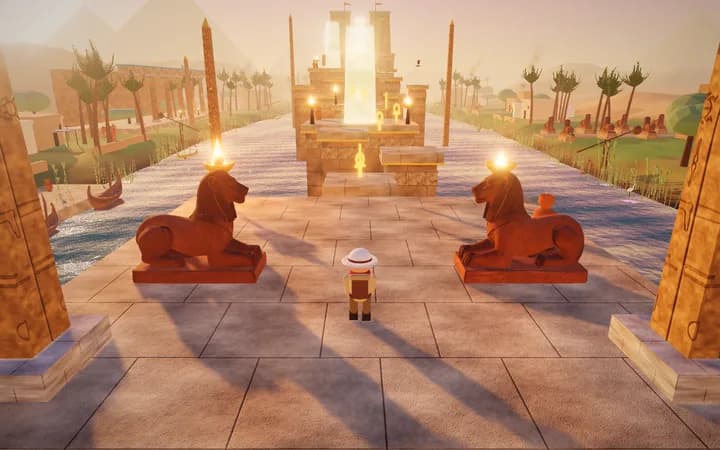
Cross the Causeway of Thoth
Walk the torch-lit path, answer the scribe at each station, and carve your name on the temple gate, one hieroglyph at a time. About 10 minutes, and you keep what you learn.
How Does Name Translation Work?
Egyptian Hieroglyphs Are Consonantal
Unlike English, ancient Egyptian hieroglyphic writing records only consonants; there are no true vowel signs. When Egyptologists need to pronounce Egyptian words, they insert an ‘e’ between consonants by convention. For example, the name nfr is pronounced “nefer” (meaning “beautiful”).
The 24 Uniliteral Signs
The core of the hieroglyphic writing system is a set of 24 single-consonant signs called uniliterals. These work like an alphabet: each sign represents one consonant sound. This translator uses these 24 signs to approximate your name, matching each letter to the closest Egyptian equivalent.
How We Handle Vowels
Since Egyptian has no vowel signs, we use standard Egyptological approximations. The vowels ‘a’ maps to the vulture sign (a glottal stop called aleph). The vowels ‘e’ and ‘i’ use the reed sign (the semi-vowel j/y). The vowels ‘o’ and ‘u’ use the quail chick (the semi-vowel w). These conventions are used by museums, universities, and Egyptologists worldwide.
The Cartouche
Your name is displayed inside a cartouche (Egyptian: shenu), an oval enclosure with a horizontal line at one end. In ancient Egypt, cartouches were reserved exclusively for royal names: the pharaoh's throne name and birth name. Ordinary Egyptians' names were written without cartouches. We use it here because it's the most recognisable hieroglyphic element and clearly marks the text as a name.
Why It's Not an Exact Translation
This tool produces a phonetic transliteration, not a translation. We're approximating the sounds of your name using ancient Egyptian signs, not translating the meaning. Some English sounds simply didn't exist in Egyptian. For example, ‘l’ and ‘r’ were the same sound, ‘v’ didn't exist (we use ‘f’), and vowels are only approximated. This is the same approach ancient Egyptian scribes used when writing foreign names: they did their best with the sounds available to them.
Academic Sources
The sign mappings in this translator follow the conventions established in Sir Alan Gardiner's Egyptian Grammar (3rd ed., 1957) and James P. Allen's Middle Egyptian: An Introduction to the Language and Culture of Hieroglyphs (3rd ed., 2014). The Gardiner Sign List codes (e.g. G1, D21, M17) are the international standard for referencing individual hieroglyphs.
The 25 Signs Behind Your Name
Every name the translator writes is built from these single-sound hieroglyphs, the “hieroglyphic alphabet”. Egyptian wrote consonants only, so several English letters share a sign (c and k, v and f) and the vowels borrow the weak consonants 𓄿 𓇋 𓅱. There was no native L: the lion 𓃭 was pressed into service for Greek and Roman names such as Cleopatra and Ptolemy.
| Sign | Sound | English | What it shows |
|---|---|---|---|
| 𓄿G1 | ꜣ (aleph)say “ah” | a | Egyptian vulture |
| 𓇋M17 | ꞽ (yod)say “ee” | i, e | Reed leaf |
| 𓇌M17A | ysay “y / ee” | y (ee) | Two reed leaves |
| 𓂝D36 | ꜥ (ayin)say “ah (guttural)” | a (deep) | Forearm |
| 𓅱G43 | wsay “oo / w” | w, u, o | Quail chick |
| 𓃀D58 | bsay “b as in boy” | b | Foot and lower leg |
| 𓊪Q3 | psay “p as in pen” | p | Reed mat or stool |
| 𓆑I9 | fsay “f as in fish” | f, v | Horned viper |
| 𓅓G17 | msay “m as in mother” | m | Owl |
| 𓈖N35 | nsay “n as in name” | n | Ripple of water |
| 𓂋D21 | rsay “r (lightly rolled)” | r, l | Mouth |
| 𓉔O4 | hsay “h as in hat” | h | Reed shelter |
| 𓎛V28 | ḥsay “h (breathy, from the throat)” | h (breathy) | Twisted wick |
| 𓐍Aa1 | ḫsay “kh as in Scottish loch” | kh (loch) | Placenta or sieve |
| 𓄡F32 | ẖsay “kh (softer, further forward)” | kh (soft) | Animal belly with teats |
| 𓋴S29 | ssay “s as in sun” | s | Folded cloth |
| 𓊃O34 | zsay “z / s” | z | Door bolt |
| 𓈙N37 | šsay “sh as in ship” | sh | Pool |
| 𓈎N29 | qsay “k (further back in the throat)” | q, c (hard) | Hill-slope |
| 𓎡V31 | ksay “k as in kite” | k | Basket with handle |
| 𓎼W11 | gsay “g as in go” | g | Jar-stand |
| 𓏏X1 | tsay “t as in top” | t | Bread loaf |
| 𓍿V13 | ṯsay “ch as in church” | ch (church) | Tethering rope |
| 𓂧D46 | dsay “d as in dog” | d | Hand |
| 𓆓I10 | ḏsay “j as in judge” | j (judge) | Cobra |
Full chart with origins and example words: the hieroglyphic alphabet.
Want to type more than a name? The hieroglyphics keyboard shows the sign for every key you press.
Want to learn to read real inscriptions?
Go beyond your name. Learn the full hieroglyphic writing system, from the alphabet to temple inscriptions and the Book of the Dead.
Get Lifetime Access for $19.99For teachers & bloggers
Put this translator on your own page
Paste the code below into a class page, blog post or school website and your readers can write their names in hieroglyphs without leaving it. Free to use; the credit line under the box is the only thing we ask you to keep.