Find your name on a sealed door
Brush the sand off a buried lintel and read your name in hieroglyphs, then meet the rest of the 25-sign alphabet through real Egyptian words. Three short sections, about ten minutes each.
Reading Your First Cartouche: A Step-by-Step Guide
How to read a royal cartouche step by step: find the reading direction, spot honorific transposition, then sound out Tutankhamun, Cleopatra and Ramesses II.
Quick answer
A cartouche is the oval rope loop with a bar at one end that surrounds a pharaoh's throne name and birth name. To read one, find the direction the animal and human signs face (they look towards the start of the text), then sound out the signs one by one, remembering that a god's name is written first out of respect (honorific transposition). Tutankhamun's cartouche, for instance, reads twt-ꜥnḫ-ꞽmn, 'living image of Amun', with Amun written first but spoken last.
Want to read this for yourself? Start the free first lesson: the 25-sign hieroglyphic alphabet in about 25 minutes. Free with a Google or email sign-in.
What Is a Cartouche?
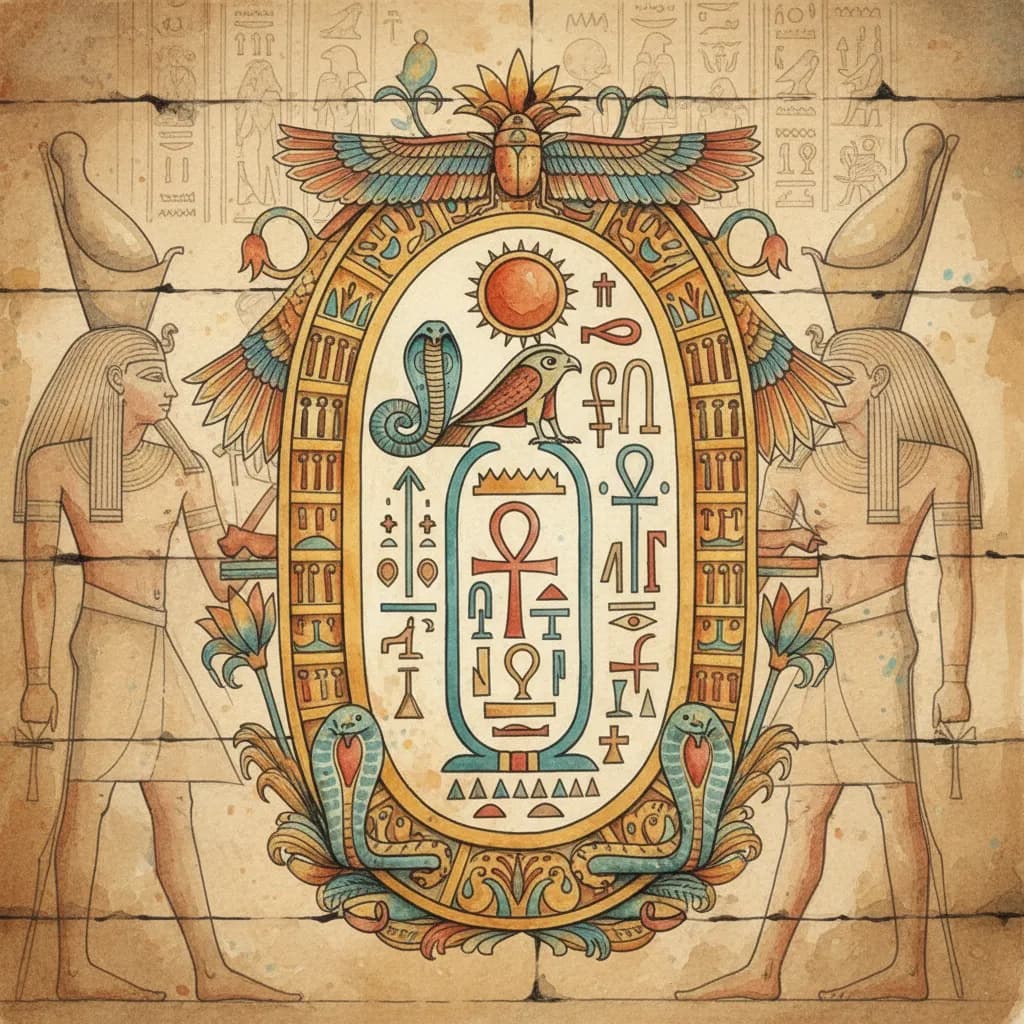
A cartouche is the elongated oval, with a horizontal bar at the base, that encloses a pharaoh's name in hieroglyphic inscriptions. If you've ever seen a photograph of an Egyptian temple or a display case in a museum, you've almost certainly noticed them. They are among the most recognisable features of Egyptian inscriptions, and they serve a very specific purpose: they mark royal names.
The word "cartouche" itself is French. Napoleon's soldiers in Egypt noticed that the oval shape resembled the paper cartridges (cartouches) they used in their muskets, and the name stuck. The Egyptians had their own term: shenu, derived from the verb sheni, meaning "to encircle." The cartouche was a protective ring, a magical boundary that encircled and safeguarded the pharaoh's name for eternity.
I think reading cartouches is one of the most practical skills to pick up when you learn hieroglyphics, because royal names appear on virtually every monument in Egypt. Once you can read them, you can identify who built a temple, when a tomb was constructed, and which dynasty left its mark on the landscape.
Try it as you read: write your own name in hieroglyphs with the free translator, or take the free first lesson and learn all 25 alphabet signs on a sealed door.
What Are the Five Royal Names?
From the Middle Kingdom onward every pharaoh held a formal titulary of five names, each introduced by a specific title (the full set developed gradually through the Old Kingdom):
- •Horus name, the oldest royal title, written inside a serekh (a rectangular frame representing the palace facade)
- •Nebty name (Two Ladies), invoking the protective goddesses Nekhbet (vulture) and Wadjet (cobra)
- •Golden Horus name, the least understood, possibly referring to the eternal nature of the king
- •Prenomen (throne name), enclosed in a cartouche, given at coronation, always containing the name of Ra
- •Nomen (birth name), enclosed in a cartouche, the personal name given at birth
The two cartouche names, the prenomen and nomen, are what you'll encounter most frequently on monuments. The prenomen typically precedes the title nswt-bjtj ("King of Upper and Lower Egypt"), while the nomen follows sꜣ Rꜥ ("Son of Ra").
Decoding Tutankhamun's Cartouche
Let's start with one of the most famous names in history. Tutankhamun's nomen (birth name) cartouche reads:
𓇋𓏠𓈖𓏏𓅱𓏏𓋹𓋾𓉺𓇗
Reading hieroglyphs in a cartouche requires knowing the direction of reading (signs face the beginning of the text) and understanding honorific transposition, where divine names are written first but spoken later.
Breaking it down step by step:
- •𓇋𓏠𓈖 these signs spell jmn (Amun), written first due to honorific transposition
- •𓏏𓅱𓏏 these spell twt, meaning "image" or "likeness"
- •𓋹 the ankh sign, meaning "living"
- •𓋾𓉺𓇗 ḥqꜣ ꞽwnw šmꜥ, "ruler of Southern Heliopolis" (that is, Thebes), an epithet Tutankhamun's scribes routinely wrote inside the cartouche after the name itself. On the golden mask and the shrines you will see it; on a museum label you usually won't.
Reassembled in spoken order: Tut-ankh-amun, "Living image of Amun," followed by the epithet. His other cartouche, the throne name Nebkheperure, and the story of how he was born Tutankhaten are covered sign by sign in Tutankhamun's cartouche explained.
Notice how the god's name (Amun) appears at the start of the cartouche out of respect, even though it is spoken last. This scribal convention is called honorific transposition, and it appears in almost every royal cartouche. Once you're aware of it, you'll spot it immediately.
Decoding Cleopatra's Cartouche
Cleopatra VII (the famous queen who allied with Julius Caesar and Mark Antony) was of Greek Ptolemaic origin, so her name is spelled purely phonetically, with no honorific transposition needed. This makes it an ideal beginner exercise.
Her cartouche reads: 𓈎𓃭𓇋𓅱𓊪𓄿𓂧𓂋𓄿𓏏
Reading each sign for its sound value:
- •𓈎 q (hill slope)
- •𓃭 l (lion)
- •𓇋 i (reed leaf)
- •𓅱 w/o (quail chick)
- •𓊪 p (stool)
- •𓄿 a (vulture)
- •𓂧 d (hand)
- •𓂋 r (mouth)
- •𓄿 a (vulture)
- •𓏏 t (bread loaf)
Sounding it out: Q-L-I-O-P-A-D-R-A-T, or as we know it, Cleopatra.
This is remarkably straightforward compared to native Egyptian names because it uses only uniliteral signs, the single-consonant hieroglyphs that function like an alphabet. Champollion used exactly this cartouche, along with Ptolemy's from the Rosetta Stone, as his initial key to the phonetic values of hieroglyphs.
Decoding Ramesses II's Cartouche
Now let's tackle a more complex example. Ramesses II, often called Ramesses the Great, left his cartouches on more monuments than any other pharaoh. His prenomen (throne name) reads:
𓇳𓄊𓁧𓍉𓈖
Only five signs, but they pack in a lot:
- •𓇳 Ra (sun disc), written first by honorific transposition, and read twice, once in wsr-mꜣꜥt-rꜥ and once in stp-n-rꜥ
- •𓄊 wsr (powerful): the head and neck of an animal, a single picture standing for a whole word
- •𓁧 mꜣꜥt: the goddess Maat herself, seated with her feather, standing for "truth, order"
- •𓍉 stp (chosen): a carpenter's adze
- •𓈖 n (by)
In spoken order: User-Maat-Ra Setep-en-Ra, "Powerful is the truth of Ra, chosen by Ra."
His birth-name cartouche is 𓇋𓏠𓈖𓌸𓇳𓄟𓋴𓇓, rꜥ-ms-sw mry-ꞽmn, "Ra has borne him, beloved of Amun." Both gods (Amun 𓇋𓏠𓈖 and Ra 𓇳) are pulled to the front; 𓌸 is mry (beloved), 𓄟 is ms (born), and 𓋴𓇓 spell sw (him).
These two cartouches demonstrate the features that make royal names harder than Cleopatra's: honorific transposition (a god's name written first, here twice in one ring), ideograms (one picture standing for the whole word wsr or mꜣꜥt rather than spelling it out), and a goddess folded into the king's title. Reading them correctly means recognising which signs are letters and which are whole words.
More Royal Cartouches to Practise On
Once you can manage the three names above, these are the cartouches you will meet most often in museums and on scarabs. Each is written the way it appears on the monuments, reading left to right:
- •Khufu (Cheops), builder of the Great Pyramid: 𓐍𓅱𓆑𓅱, ḫwfw, "he protects me" (short for Khnum-khuf, "Khnum protects me"). Four alphabet signs, no transposition: the easiest native Egyptian name to read.
- •Thutmose III, throne name: 𓇳𓏠𓆣, mn-ḫpr-rꜥ, "Lasting is the manifestation of Ra" (Menkheperre). This is the single most common cartouche on Egyptian scarabs; if you learn one throne name, learn this one.
- •Hatshepsut, throne name: 𓇳𓁧𓂓, mꜣꜥt-kꜣ-rꜥ, "Truth is the ka of Ra" (Maatkare). Ra first by transposition, then Maat, then the pair of upraised arms that write kꜣ.
- •Akhenaten: 𓇋𓏏𓈖𓇳𓅜𓈖, ꜣḫ-n-ꞽtn, "Effective for the Aten." The sun-disc god's name (ꞽtn, with the disc as its determinative) is written first; the crested ibis 𓅜 writes ꜣḫ.
- •Ptolemy (Ptolemaios): 𓊪𓏏𓍯𓃭𓐝𓇌𓋴, ptwlmys. A Greek name spelled sound by sound: p-t-w-l-m-y-s. This was the first cartouche Champollion cracked, using the Greek text of the Rosetta Stone.
- •Alexander the Great: 𓄿𓃭𓎡𓋴𓇋𓈖𓂧𓂋𓋴, ꜣlksꞽndrs. Nine alphabet signs, no gods, no surprises.
Notice the pattern: foreign rulers (Ptolemy, Cleopatra, Alexander) are spelled out with the 25 alphabet signs alone, while native pharaohs lean on ideograms and honorific transposition. That is why Champollion started with the foreigners, and why you should too.
How Do You Read a Cartouche in the Wild?
Five habits will get you through most cartouches you meet on a monument or in a museum.
1. Determine reading direction. Hieroglyphs face the beginning of the line. If the birds and people face left, read left to right. If they face right, read right to left. Inside cartouches, the same rule applies.
2. Look for honorific transposition. If you see a sun disc (𓇳) or the signs for Amun (𓇋𓏠𓈖) at the start, they are probably written first out of respect but spoken later in the name.
3. Identify the title before the cartouche. The signs nswt-bjtj (sedge plant and bee) before a cartouche indicate the prenomen. The signs sꜣ Rꜥ (duck and sun disc) indicate the nomen.
4. Start with Ptolemaic names. Greek and Roman names in cartouches (Ptolemy, Cleopatra, Alexander, Augustus) are spelled phonetically without honorific transposition. They are the easiest to decode and are how Champollion started too.
5. Use the uniliteral signs as your foundation. If you memorise the 25 single-consonant signs, you can sound out most foreign names and begin to recognise common phonetic patterns in Egyptian names.
Your Turn
Cartouches are everywhere, in museums, textbooks, documentaries, and on the walls of every major Egyptian monument. They are the most accessible entry point into reading real hieroglyphic inscriptions because they are clearly bounded, relatively short, and often well-documented.
Pick up any book on ancient Egypt, find a cartouche, and try to sound it out. You now have the tools to begin. The pharaohs wrote their names to last for eternity, and thanks to what you've just learned, their wish is being fulfilled.
Two ways to keep going:
- •Write your own cartouche. Type your name into the free hieroglyphics name translator and it will spell it with the same alphabet signs Cleopatra's scribes used. Then forge it into a 3D cartouche you can download.
- •Learn all 25 alphabet signs properly. The free first lesson teaches the full uniliteral alphabet in three sections of about ten minutes, with a quick check after every few signs, so that the next cartouche you meet reads itself. After that, how to learn hieroglyphics online covers what to tackle next.
Frequently Asked Questions
Related Articles
Tutankhamun's Cartouche Explained, Sign by Sign
Tutankhamun had two cartouches: the throne name Nebkheperure and the birth name Tutankhamun. Here is what each sign says, why Amun is written first, and how the boy king's name changed.
5 Egyptian Hieroglyphs You Already Know (and What They Mean)
Five Egyptian hieroglyphs you already recognise (ankh, Eye of Horus, scarab, djed, sun disc), what each actually meant and how it worked in the script.
How the Rosetta Stone Was Deciphered and Why It Mattered
What the Rosetta Stone is, what its 196 BCE decree says, how Young and Champollion used its Greek text to decipher hieroglyphs in 1822, and why it mattered.
Ready to read hieroglyphics yourself?
Your first lesson starts with your own name: brush the sand off a sealed door and read it in hieroglyphs, then learn the rest of the alphabet through real Egyptian words.
Start Lesson 1 FreeNo sign-up to start, no payment. Lifetime access to all eight lessons is one payment later, if you want it.