Find your name on a sealed door
Brush the sand off a buried lintel and read your name in hieroglyphs, then meet the rest of the 25-sign alphabet through real Egyptian words. Three short sections, about ten minutes each.
5 Egyptian Hieroglyphs You Already Know (and What They Mean)
Five Egyptian hieroglyphs you already recognise (ankh, Eye of Horus, scarab, djed, sun disc), what each actually meant and how it worked in the script.
Quick answer
Five hieroglyphs survive as everyday symbols: the ankh (life), the Eye of Horus or wedjat (protection and healing), the scarab beetle (the verb 'to come into being', and the sun god Khepri), the djed pillar (stability, the backbone of Osiris) and the sun disc (Ra, sun, day). Each was a working sign in the script with a real phonetic or ideographic value, not just a decorative symbol.
Want to read this for yourself? Start the free first lesson: the 25-sign hieroglyphic alphabet in about 25 minutes. Free with a Google or email sign-in.
Which Egyptian Hieroglyphs Do People Already Recognise?
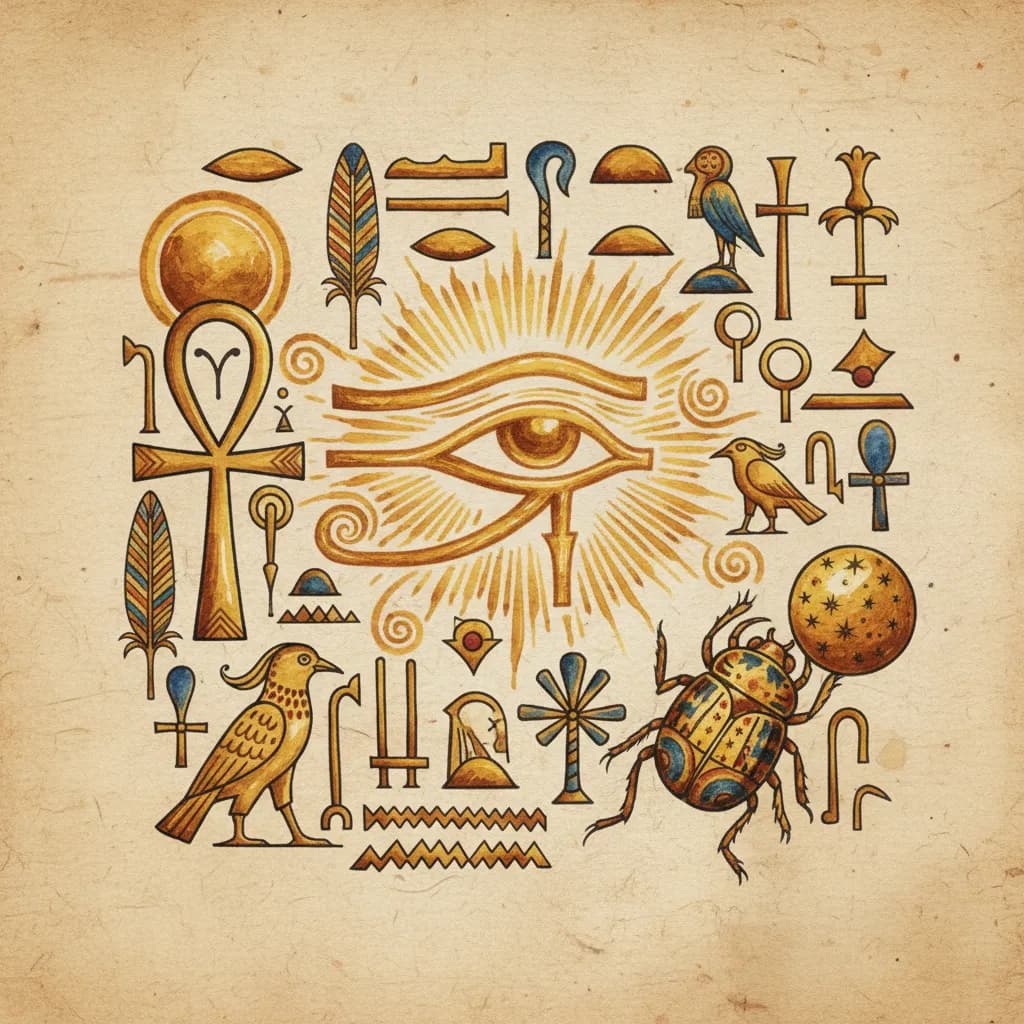
The ankh, the Eye of Horus, the scarab beetle, the djed pillar and the sun disc are the five hieroglyphs most people can recognise without ever having studied the script. You've already encountered them dozens of times: on jewellery, tattoos, film posters, video games, and even pharmaceutical packaging. These symbols have survived for over 5,000 years because they are visually striking and carry powerful meanings that still resonate today.
But how well do you really know them? The popular understanding of these symbols is often simplified or distorted. Here is what each one truly meant to the people who created it, and how it worked as a sign in the writing system. They make a good first step if you want to learn Egyptian hieroglyphs properly.
| Sign | Name | Gardiner code | Core meaning | Role in the script |
|---|---|---|---|---|
| 𓋹 | Ankh | S34 | Life | Logogram for ꜥnḫ; triliteral ꜥ-n-ḫ |
| 𓂀 | Eye of Horus (wedjat) | D10 | Protection, healing, wholeness | Logogram for wḏꜣt, the restored eye |
| 𓆣 | Scarab | L1 | To come into being; Khepri | Triliteral ḫ-p-r |
| 𓊽 | Djed pillar | R11 | Stability, endurance | Logogram for ḏd |
| 𓇳 | Sun disc | N5 | Ra, sun, day | Logogram and determinative |
Try it as you read: write your own name in hieroglyphs with the free translator, or take the free first lesson and learn all 25 alphabet signs on a sealed door.
1. The Ankh (𓋹) - The Key of Life
What you think it means: Life, or some vague spiritual energy.
What it actually means: The ankh is the hieroglyphic sign for the word ꜥnḫ, which translates simply as "life." But in ancient Egyptian context, its significance was profound and multifaceted; I've written a full guide to the ankh.
The ankh appears in virtually every temple and tomb in Egypt. Gods are shown holding it by the loop, often extending it towards the nose of a pharaoh, literally giving the breath of life. Osiris, Isis, Hathor, Amun, and Ra are all depicted carrying the ankh, marking it as an attribute of divine power.
In the hieroglyphic writing system, the ankh functions as both a logogram (representing the entire word "life") and as a sound-sign in other words. It appears in words like ꜥnḫ.w ("the living") and in the phrase dj ꜥnḫ ("given life"), which follows royal names in inscriptions.
The exact origin of the ankh's shape is debated. Theories include a sandal strap, a mirror, a knot of cloth, or a combined male-female symbol. Whatever its origin, it became Egypt's most powerful written symbol of life, vitality, and eternal existence.
2. The Eye of Horus (𓂀) - The Wedjat Eye
What you think it means: Protection, or a cool-looking eye symbol.
What it actually means: The wedjat (meaning "the whole one" or "the restored one") represents the left eye of the falcon god Horus. According to myth, Horus lost his eye in a fierce battle with his uncle Seth, who had murdered Horus's father Osiris. The god Thoth, patron of scribes and wisdom, magically restored the damaged eye, making it whole again.
This myth gave the wedjat its symbolic power: healing, restoration, and protection. Egyptians painted it on coffins, carved it into amulets, and inscribed it on temple walls as a protective ward against evil.
You will often read that the parts of the Eye of Horus were also the signs for the grain fractions 1/2, 1/4, 1/8, 1/16, 1/32 and 1/64, which add up to 63/64, with the missing 1/64 supplied by Thoth's magic. It is a lovely story, proposed by the Egyptologist Georg Möller in 1911, but recent work on the hieratic fraction signs has undermined it and most specialists now treat it as a modern myth. The same goes for the claim that the pharmacist's "Rx" descends from the wedjat: the standard explanation is that it abbreviates the Latin recipe, "take".
3. The Scarab Beetle (𓆣) - Symbol of Transformation
What you think it means: A lucky beetle, or rebirth.
What it actually means: The scarab beetle (Scarabaeus sacer) was one of the most important symbols in all of Egyptian religion and writing. The Egyptians observed how the dung beetle rolled balls of dung across the ground and saw a cosmic parallel: just as the beetle pushed its ball, the god Khepri pushed the sun across the sky each morning.
In the hieroglyphic script, the scarab is a triliteral sign, one of the most sophisticated types of hieroglyph. It represents three consonants: ḫ-p-r, spelling the verb ḫpr, meaning "to come into being" or "to transform." This single sign encodes an entire concept of creation and metamorphosis.
Khepri, the scarab-headed god, represented the rising sun and the idea of self-creation. The Egyptians believed the beetle spontaneously generated from its dung ball, just as the sun appeared to create itself anew each dawn. This made the scarab a symbol of rebirth, renewal, and resurrection.
Scarab amulets were placed over the hearts of mummies during the embalming process. These "heart scarabs" bore inscriptions from the Book of the Dead, specifically Spell 30B, which implored the heart not to testify against its owner during the judgement of the dead.
4. The Djed Pillar (𓊽) - The Backbone of Osiris
What you think it means: You might recognise this one from Egyptian artwork without knowing its name. It looks like a column with horizontal bars.
What it actually means: The djed pillar is one of the oldest symbols in Egyptian iconography, predating the unification of Egypt around 3100 BCE. It represents stability, endurance, and the backbone of the god Osiris.
According to myth, after Seth murdered Osiris and scattered his body parts across Egypt, Isis gathered them and reassembled her husband. The djed pillar symbolises Osiris's spine, and by extension, his resurrection and the promise of eternal life for all who followed proper funerary rites.
The "Raising of the Djed" was an important annual ceremony performed at Memphis, where the pharaoh and priests physically erected a large djed column as a ritual act of cosmic renewal. This ceremony symbolised the triumph of order (maat) over chaos (isfet) and Osiris's victory over death.
In hieroglyphic writing, the djed functions as a logogram for the word ḏd, meaning "stability" or "endurance." It appears in royal titles, temple inscriptions, and funerary texts as a powerful invocation of permanence.
5. The Sun Disc (𓇳) - Ra and the Cycle of Days
What you think it means: The sun.
What it actually means: The simple circle that represents the sun disc is far more nuanced than it first appears. In the hieroglyphic writing system, this sign works on multiple levels simultaneously.
As a logogram, it can mean "Ra" (the sun god), "sun," "day," or "time." As a determinative, it appears at the end of words related to the sun, light, and time to classify their meaning. A small stroke beneath it indicates when it should be read as the word itself rather than as part of a phonetic spelling.
The sun disc appears in some of the most important royal names in Egyptian history. It opens the cartouche of Ramesses II (Ra-mes-su, "Ra bore him") through a scribal convention called honorific transposition: the name of the god is written first out of respect, even though it is spoken later in the name.
Perhaps the most dramatic use of the sun disc came during the reign of Akhenaten (c. 1353-1336 BCE), who elevated the sun disc, called the Aten, to the status of sole god. Akhenaten's religious revolution, sometimes called the world's first monotheism, placed this simple hieroglyph at the centre of an entirely new theology.
How Do You Start Reading These Symbols in Context?
Knowing these five symbols gives you a head start, but none of them is a letter. In the hieroglyphic system, every sign has multiple functions. It might be a sound, a word, or a silent classifier depending on its position and context. The ankh can spell the sound ꜥnḫ in other words. The scarab writes the sounds ḫ-p-r in verbs that have nothing to do with beetles.
That layered complexity is what makes hieroglyphics such a rewarding script to learn. You're not just memorising an alphabet. You're entering a system of writing that encodes sound, meaning, and classification simultaneously, in ways that no modern writing system attempts.
These five symbols are your first steps. The next is the actual alphabet: the 25 single-consonant signs that spell out names. Try writing your own name in hieroglyphs to see them in action, then learn them properly in the free first lesson.
Frequently Asked Questions
Related Articles
What Does the Ankh Symbol Mean in Egyptian Hieroglyphics?
The ankh (𓋹) is the Egyptian hieroglyph for 'life'. What it meant, why gods hold it to the pharaoh's nose, what it depicts and how it became the Coptic cross.
Reading Your First Cartouche: A Step-by-Step Guide
How to read a royal cartouche step by step: find the reading direction, spot honorific transposition, then sound out Tutankhamun, Cleopatra and Ramesses II.
The Egyptian Book of the Dead: A Reader's Guide
What the Egyptian Book of the Dead really is: around 190 funerary spells chosen per owner, the weighing of the heart, the Papyrus of Ani and how to read it.
Ready to read hieroglyphics yourself?
Your first lesson starts with your own name: brush the sand off a sealed door and read it in hieroglyphs, then learn the rest of the alphabet through real Egyptian words.
Start Lesson 1 FreeNo sign-up to start, no payment. Lifetime access to all eight lessons is one payment later, if you want it.