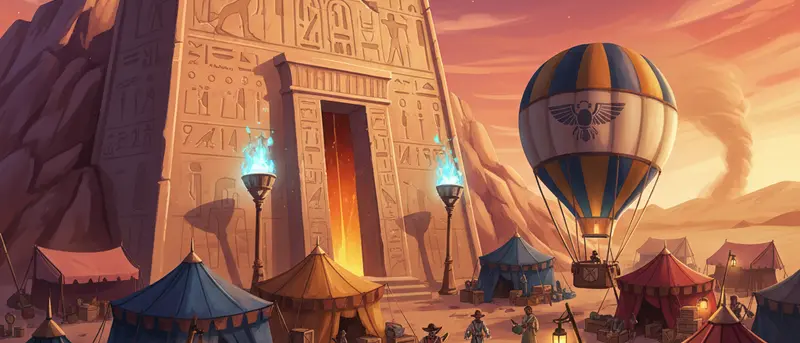
Find your name on a sealed door
Brush the sand off a buried lintel and read your name in hieroglyphs, then meet the rest of the 25-sign alphabet through real Egyptian words. Three short sections, about ten minutes each.
Should I Learn Hieroglyphics? An Honest Answer
Should you learn hieroglyphics? An honest look at how hard it is, how long it takes, what you can realistically read after a month or a year, and who it suits.
Quick answer
Yes, if you enjoy ancient Egypt, puzzles or languages: hieroglyphics are far more learnable than their reputation suggests, because the core alphabet is only 25 signs and most museum inscriptions use a small, repetitive vocabulary. You will not become fluent in Middle Egyptian quickly, but reading names, titles and offering formulae on real monuments is a realistic goal within a few weeks of casual study. It is not a career skill unless you are heading into Egyptology.
Want to read this for yourself? Start the free first lesson: the 25-sign hieroglyphic alphabet in about 25 minutes. Free with a Google or email sign-in.
Is Learning Hieroglyphics Worth It?
For most people who enjoy ancient Egypt, puzzles or languages, yes. That is my honest answer after months of learning the script, though not for the reasons you might expect. If you just want to try it, you can learn hieroglyphics here, starting with a free first lesson.
When I first started looking into hieroglyphics, I had one question on repeat: is this actually worth my time? It's a dead language. Nobody speaks ancient Egyptian at the coffee shop. There's no "Business Hieroglyphics" course on LinkedIn Learning. So why bother?
Try it as you read: write your own name in hieroglyphs with the free translator, or take the free first lesson and learn all 25 alphabet signs on a sealed door.
Will It Help My Career?
Almost certainly not, unless you're planning a career in Egyptology. Let me be upfront about that. I didn't learn it for practical reasons. I learned it because I was genuinely curious, and that curiosity turned into one of the most rewarding intellectual experiences of my life.
There's something deeply satisfying about looking at symbols that have been carved into stone for over 4,000 years and being able to read them. The first time I decoded a cartouche on my own, I felt a connection to the ancient world that no documentary or museum visit had ever given me.
Is Hieroglyphics Hard to Learn?
Hieroglyphics are easier to start than their reputation suggests and harder to finish than most people expect. One thing that held me back at first was the assumption that they would be impossibly difficult. I pictured thousands of mysterious symbols with no logic behind them. The reality is quite different.
The core of the system is built on 25 single-consonant signs that work like an alphabet. Once you memorise those, you can start sounding out words almost immediately. Yes, there are hundreds of additional signs (logograms, biliterals, triliterals, determinatives), but you build up to those gradually. It's like learning any language: you start with the basics and layer on complexity over time.
I found the learning curve steep at the beginning but surprisingly manageable after the first few weeks. The writing system has an internal logic that starts to click once you get past the initial overwhelm. What slows people down later is the grammar, not the signs. For a layer-by-layer breakdown, see is it hard to learn hieroglyphics?
What Can You Realistically Read, and How Soon?
Here is roughly what regular, light study (15–20 minutes a day) gets you:
| After | You can read | Example |
|---|---|---|
| A weekend | Names spelled with the alphabet signs | Cleopatra's and Ptolemy's cartouches |
| A month | Common royal names, titles and epithets | Tutankhamun, Ramesses II, "Son of Ra", "given life" |
| Three months | Formulaic monumental text | The offering formula on a museum stela |
| A year or more | Continuous Middle Egyptian with a grammar and dictionary | Tomb autobiographies, the Tale of Sinuhe |
If the first three rows are all you want, a short course and one good book will get you there. The fourth row needs a proper grammar and, ideally, a tutor or study group; see the best courses to learn hieroglyphics.
What Do You Actually Gain?
Here's what learning hieroglyphics has given me that I didn't expect:
A new way of thinking about language. Hieroglyphics combine sound, meaning, and classification in ways that no modern writing system does. A single word might include phonetic signs (spelling out sounds), a logogram (representing the whole concept), and a determinative (a silent sign that tells you what category the word belongs to). Wrapping my head around this system completely changed how I think about writing and communication.
Real access to ancient texts. Before I learned hieroglyphics, ancient Egypt was something I experienced through other people's translations and interpretations. Now I can read inscriptions directly. It's the difference between hearing someone describe a song and actually listening to it yourself.
A genuine sense of accomplishment. In a world where most of what I learn is immediately practical (a new framework, a productivity hack), learning hieroglyphics felt like a pure intellectual challenge. There's no shortcut, no AI tool that does it for you. You just have to sit down, study, and build the knowledge piece by piece. That process has been incredibly rewarding.
Better museum visits. This one sounds small, but it's been one of my favourite side effects. Walking through the Egyptian galleries at a museum and being able to read even fragments of the inscriptions transforms the experience entirely.
I go into these in more depth in why learn hieroglyphics; this post is about deciding, that one is about the payoff.
Who Should Learn Hieroglyphics?
Hieroglyphics suit curious people with patience and no need for a quick practical return. It's a great fit if you:
- •Have a genuine interest in ancient Egypt (even a casual one)
- •Enjoy puzzles and pattern recognition
- •Want an intellectual challenge that's completely different from your day job
- •Like the idea of reading primary sources from one of history's greatest civilisations
- •Are patient enough to stick with something that takes time to master
It's probably not for you if you need immediate practical returns on every hour you invest. But if you have room in your life for something that's purely enriching, I can't recommend it enough.
How Do I Decide? Start Small
Start small. Learn the 25 uniliteral signs (the free first lesson covers them in three sections of about ten minutes). Try to read a cartouche or two; Cleopatra's name is a great first exercise because it's spelled purely phonetically. Or type your own name into the name translator and see how the sound-signs work. You'll know pretty quickly whether this is something that excites you or not.
For me, the moment I realised I could read "Tutankhamun" in the original script, I was hooked. That single moment of recognition turned a casual curiosity into a genuine passion. If you decide to go on, how to learn hieroglyphics online lays out the order to do things in.
So should you learn hieroglyphics? If the question keeps nagging at you, that's probably your answer right there.
Frequently Asked Questions
Related Articles
Is It Hard to Learn Hieroglyphics? An Honest Difficulty Guide
Is it hard to learn hieroglyphics? The alphabet takes a weekend, the sign system takes a few months and the grammar takes a year or more. Here is what is easy, what is hard, and how it compares to Latin, Chinese and Japanese.
Why Learn Hieroglyphics? Seven Real Benefits
Why learn hieroglyphics? Seven real benefits, from reading 3,000 years of Egyptian texts in the original to rewiring how you think about writing itself.
How to Learn Hieroglyphics Online: A Step-by-Step Guide
How to learn Egyptian hieroglyphics online in five steps: the 25 alphabet signs, the right course or book, grammar, real inscriptions and the mistakes to avoid.
Ready to read hieroglyphics yourself?
Your first lesson starts with your own name: brush the sand off a sealed door and read it in hieroglyphs, then learn the rest of the alphabet through real Egyptian words.
Start Lesson 1 FreeNo sign-up to start, no payment. Lifetime access to all eight lessons is one payment later, if you want it.