Find your name on a sealed door
Brush the sand off a buried lintel and read your name in hieroglyphs, then meet the rest of the 25-sign alphabet through real Egyptian words. Three short sections, about ten minutes each.
The Egyptian Book of the Dead: A Reader's Guide
What the Egyptian Book of the Dead really is: around 190 funerary spells chosen per owner, the weighing of the heart, the Papyrus of Ani and how to read it.
Quick answer
The Egyptian Book of the Dead (its Egyptian title means the Book of Going Forth by Day) is not a single book but a collection of around 190 funerary spells, from which each owner's scribe chose a personal selection to be buried with them. Its spells guided the dead through the underworld and the weighing of the heart; the best-known copy is the Papyrus of Ani (c. 1250 BCE) in the British Museum.
Want to read this for yourself? Start the free first lesson: the 25-sign hieroglyphic alphabet in about 25 minutes. Free with a Google or email sign-in.
What Is the Book of the Dead?
The Book of the Dead is a modern name for the collection of ancient Egyptian funerary spells written on papyrus and buried with the dead from about 1550 BCE onward, to see them safely into the afterlife. It is one of the most widely known yet deeply misunderstood texts from the ancient world. Its modern name, coined by the German Egyptologist Karl Richard Lepsius in 1842, is misleading on both counts. It is not a single, unified book, and its subject is not death but survival after death.
The ancient Egyptians called it pert em heru (𓊪𓂋𓏏𓅓𓉔𓂋𓅱), which translates as "Coming Forth by Day", a title that reveals its true purpose. These were spells, prayers, and instructions designed to help the deceased navigate the dangers of the underworld and emerge into the eternal sunlight of the afterlife. Far from being a morbid text, it was essentially a survival manual for eternity. Many copies were written in cursive hieroglyphs, so once you learn hieroglyphics you can start picking out the gods' names and the spell titles yourself.
Try it as you read: write your own name in hieroglyphs with the free translator, or take the free first lesson and learn all 25 alphabet signs on a sealed door.
Where Did the Book of the Dead Come From?
The Book of the Dead descends from the Pyramid Texts and the Coffin Texts, a funerary tradition stretching back over a thousand years before the first papyrus copies:
The Pyramid Texts (c. 2400-2300 BCE) are the oldest religious texts in the world. Carved inside the burial chambers of Old Kingdom pyramids at Saqqara, beginning with the pyramid of Unas, these spells were exclusively for pharaohs. They describe the king's ascent to the sky, his transformation into a star, and his reception among the gods.
The Coffin Texts (c. 2100-1650 BCE) democratised the afterlife. During the Middle Kingdom, funerary spells began appearing on the coffins of non-royal officials and nobles. The exclusivity of the Pyramid Texts had been broken. Now wealthy commoners could also hope for eternal life.
The Book of the Dead (c. 1550-50 BCE) took this process further. Written on papyrus scrolls and placed in the burial chamber, these collections of spells became available to anyone who could afford to commission one. The "democratisation of the afterlife" was complete: eternal life was no longer a royal prerogative but an aspiration open to all Egyptians.
What Does the Book of the Dead Contain?
The Book of the Dead is a collection of approximately 192 individual spells (scholars number them from Spell 1 to Spell 192, though no single papyrus contains all of them). Each spell served a specific purpose in the afterlife journey. Some of the most important include:
Spell 1: The Procession to the Necropolis. This opening spell describes the funeral procession and the deceased's arrival at the tomb. It sets the scene for the journey to come.
Spell 6: The Shabti Spell. One of the most practically minded spells, this text commands shabti figurines (small servant statues placed in the tomb) to perform manual labour in the afterlife on behalf of the deceased. When the gods called for workers to tend the fields of the underworld, the shabti would answer: "Here I am!"
Spell 17: The Declaration of Knowledge. A complex theological text in which the deceased demonstrates knowledge of the gods, creation, and the cosmic order. Correct answers prove worthiness to enter the afterlife.
Spell 30B: The Heart Scarab Spell. Perhaps the most anxious spell in the entire collection. Inscribed on a scarab amulet placed over the mummy's heart, it implores the heart not to betray its owner during the judgement: "O my heart of my mother, O my heart of my being! Do not stand against me as a witness! Do not oppose me in the tribunal!"
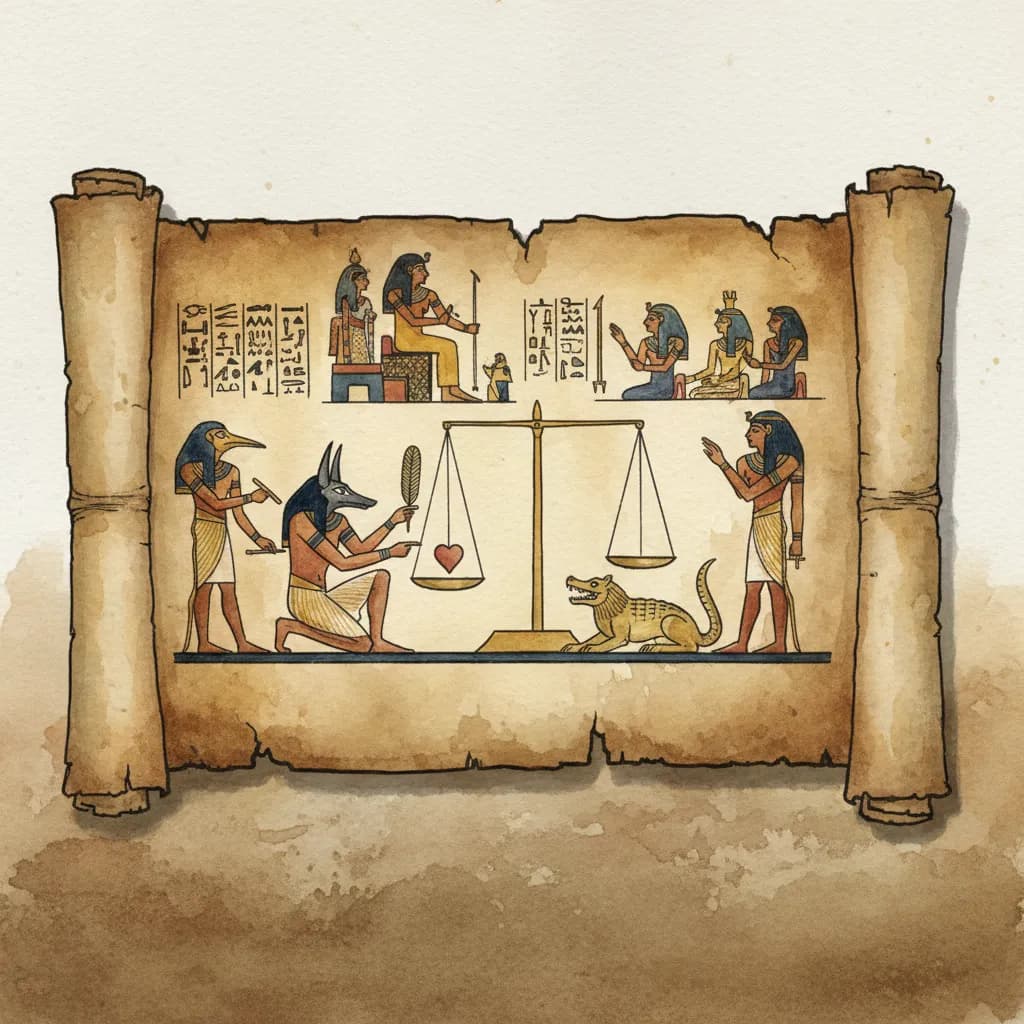
Spell 125: The Weighing of the Heart. The most famous and most illustrated spell. The deceased enters the Hall of Two Truths and makes the Negative Confession, a declaration of 42 sins they have not committed ("I have not stolen," "I have not killed," "I have not told lies"). Their heart is then weighed on a scale against the feather of Maat (truth and cosmic order).
If the heart is lighter than or equal to the feather, the deceased is declared maa kheru ("true of voice" or "justified") and admitted to the paradise of the Field of Reeds. If the heart is heavier, weighed down by sin, it is devoured by Ammit, a terrifying hybrid creature with the head of a crocodile, the body of a lion, and the hindquarters of a hippopotamus. The sinner ceases to exist entirely, a fate the Egyptians considered far worse than any concept of hell.
Spell 137: The Spell of the Four Torches. Placed at the four cardinal points around the burial, this spell created a protective ring of magical fire to ward off hostile forces in the underworld.
Spell 175: The Dialogue with Atum. A surprisingly philosophical text in which the deceased speaks with Atum, the creator god, about the nature of existence. Atum reveals that one day, even the gods will die, and the created world will return to the primordial waters. Only Atum and Osiris will survive, transformed into serpents. It is one of the most profound meditations on mortality in all of ancient literature.
Why Is Every Copy Different?
Every copy is different because each was a custom commission. One of the most important things to understand about the Book of the Dead is that no two copies are identical. Each papyrus was a custom commission. Wealthy Egyptians would visit a scribal workshop and select which spells to include based on their personal concerns, their budget, and the advice of priests.
A wealthy official might commission a scroll 20 metres long, lavishly illustrated with coloured vignettes (illustrations) accompanying each spell. A person of modest means might afford only a few essential spells on a shorter roll, with minimal illustration. Some budget versions left the owner's name blank, a fill-in-the-blank template to be personalised after purchase.
The quality of the calligraphy varied enormously. The finest examples, such as the Papyrus of Ani (now in the British Museum) or the Papyrus of Hunefer, are masterpieces of ancient art, with elaborate painted scenes and flawless hieroglyphic text. Others are riddled with scribal errors, suggesting they were mass-produced by scribal workshops more interested in quantity than accuracy.
What Does the Weighing of the Heart Reveal About Egyptian Morality?
Spell 125, the Weighing of the Heart, deserves special attention because it reveals the moral framework of ancient Egyptian society. The 42 Negative Confessions provide a detailed catalogue of what the Egyptians considered sinful or antisocial behaviour. Selected confessions include:
- •"I have not committed robbery."
- •"I have not been greedy."
- •"I have not stolen the offerings in the temples."
- •"I have not committed adultery."
- •"I have not made anyone weep."
- •"I have not polluted the water."
- •"I have not raised my voice in anger."
- •"I have not turned a deaf ear to words of truth."
This list reveals a society that valued honesty, generosity, respect for sacred spaces, emotional restraint, environmental responsibility, and justice. Many of these moral principles are strikingly modern in their concerns.
How Do You Start Reading the Book of the Dead?
Start with a well-published papyrus, ideally the Papyrus of Ani, alongside a scholarly translation, once you can already read formulaic monumental text. For students of hieroglyphics, the Book of the Dead is simultaneously one of the most rewarding and most challenging texts to read.
Why it's rewarding: The vocabulary is rich, the subject matter is fascinating, and the illustrations provide visual context that aids comprehension. Many spells use formulaic language that becomes recognisable with practice, building your reading confidence.
Why it's challenging: The texts span nearly 1,500 years, so spelling conventions and grammar vary between copies. Religious vocabulary is dense and allusive. Some passages are deliberately obscure; their power was believed to lie partly in their mystery.
The best approach for beginners is to start with well-published papyri that include scholarly translations and commentaries. The Papyrus of Ani, available in numerous editions, is the standard starting point. Raymond Faulkner's The Ancient Egyptian Book of the Dead provides a complete translation with hieroglyphic text. Before any of that, you need the alphabet signs, the ankh and the other common signs, and the offering formula, which is roughly what the first lessons here cover.
Why Does the Book of the Dead Still Matter?
The Book of the Dead endures because it addresses questions that every civilisation grapples with: What happens after we die? How should we live? What does it mean to be judged?
The ancient Egyptians answered these questions with a document of extraordinary imagination, theological sophistication, and human vulnerability. The heart scarab spell, "Do not stand against me as a witness!", is the voice of someone genuinely afraid that their flaws might be exposed. The Negative Confessions are an attempt to codify a moral life. The paradise of the Field of Reeds is a vision of eternal peace.
When you learn to read these texts in the original hieroglyphs, you are hearing those voices without a translator standing between you. That directness, across 3,500 years, is what makes learning hieroglyphics worth the effort.
Frequently Asked Questions
Related Articles
5 Egyptian Hieroglyphs You Already Know (and What They Mean)
Five Egyptian hieroglyphs you already recognise (ankh, Eye of Horus, scarab, djed, sun disc), what each actually meant and how it worked in the script.
What Does the Ankh Symbol Mean in Egyptian Hieroglyphics?
The ankh (𓋹) is the Egyptian hieroglyph for 'life'. What it meant, why gods hold it to the pharaoh's nose, what it depicts and how it became the Coptic cross.
Scribes in Ancient Egypt: The Most Powerful Class
Who the scribes of ancient Egypt were, how they trained, what they did all day, the tools they used and why, with so few literate, writing meant power.
Ready to read hieroglyphics yourself?
Your first lesson starts with your own name: brush the sand off a sealed door and read it in hieroglyphs, then learn the rest of the alphabet through real Egyptian words.
Start Lesson 1 FreeNo sign-up to start, no payment. Lifetime access to all eight lessons is one payment later, if you want it.