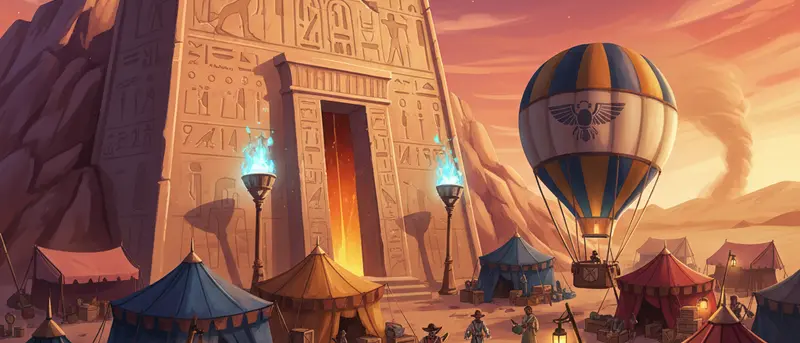
Find your name on a sealed door
Brush the sand off a buried lintel and read your name in hieroglyphs, then meet the rest of the 25-sign alphabet through real Egyptian words. Three short sections, about ten minutes each.
Best Hieroglyphics Courses 2026: Online, Books, Uni & Free
Best courses to learn Egyptian hieroglyphs in 2026, honestly compared: the standard textbooks, tutored online classes, a university certificate, free groups and apps.
Quick answer
For most people the best way to learn hieroglyphics is Collier & Manley's How to Read Egyptian Hieroglyphs, a book written for evening classes that teaches you to read real British Museum objects; James P. Allen's Middle Egyptian is the university grammar to move on to. If you want a tutor and marked work, City Lit and the Egypt Exploration Society run live online classes for roughly £100–£200, and the University of Manchester offers a three-year online Certificate in Egyptology. GlyphStudy runs free, volunteer-led study groups. Interactive courses, including our own, are a useful supplement for learning the signs but are not a substitute for a grammar.
Want to read this for yourself? Start the free first lesson: the 25-sign hieroglyphic alphabet in about 25 minutes. Free with a Google or email sign-in.
Key Takeaways
- •There is no single "best" course; the right one depends on whether you want to read names on a museum visit, work through real inscriptions, or study Middle Egyptian grammar properly
- •For most beginners the best route is still one good book (Collier & Manley), read with a pencil, plus something that drills the signs
- •James P. Allen's Middle Egyptian is the serious grammar; treat it as the second step, not the first
- •Tutored classes (City Lit, the Egypt Exploration Society, Bloomsbury Summer School) give you a teacher and marked work for £100–£200 a course; Manchester's Certificate in Egyptology is the accredited, three-year route
- •Free options exist (GlyphStudy, open text corpora, free first lessons) but they trade structure for price
- •Interactive courses and apps, including our own way to learn hieroglyphics online, are good at the sign-learning stage and weak on grammar; use them as a supplement, not the whole plan
- •Whatever you pick, the thing that predicts success is the same: you read and write signs every week, rather than watch someone else do it
Try it as you read: write your own name in hieroglyphs with the free translator, or take the free first lesson and learn all 25 alphabet signs on a sealed door.
How Did I Judge These Courses?
Each course is rated on whether it makes you read, whether it starts with the right signs, whether it uses real inscriptions early, and what it costs in money and time.
I've been through most of what's on this list as a learner, and I built one of the entries, so read the whole thing knowing that. I wasn't looking for the most comprehensive option; I was looking for the one most likely to get you from zero to reading something real. Each course below is rated on four things:
- •Does it make you read? Reading hieroglyphs is a skill, not a body of facts. Courses that only show you signs teach recognition, not reading.
- •Does it start with the right signs? The 25 uniliteral signs (one sign, one sound) unlock names and most of what you'll meet on a monument. Courses that begin with the Gardiner sign list's 700+ signs lose people in a week.
- •Does it use real inscriptions early? Made-up sentences are demoralising because they never look like the wall in front of you.
- •What does it cost, in money and in time? Some of these are £12; some are a year of evenings.
The list runs roughly in the order I'd recommend for an adult beginner working towards reading real texts. The children's option sits at the end because it answers a different question.
1. Collier & Manley, How to Read Egyptian Hieroglyphs: best overall
Format: Book (British Museum Press, 1998; still in print) Cost: Around £15–20 Best for: Almost everyone starting out: it is the book that Egyptologists, evening-class tutors and study groups all point beginners to
If you only buy one thing, buy this. Mark Collier and Bill Manley wrote it for British Museum evening classes, and it shows: every chapter works from real objects in the museum's collection (stelae, coffins, statues) and teaches only the grammar you need to read that object. By the end you can read a standard Middle Kingdom funerary stela, which is a genuinely useful skill in any museum in the world. It has been the default recommendation for over twenty-five years for a reason.
Where it wins: real inscriptions from page one; the right amount of grammar; exercises with answers; cheap.
Where it doesn't: it is a book, so nothing corrects your mistakes in real time, and the pace can feel steep around chapter four when the verb forms arrive. The sign-learning stage is dull on paper; most people do better pairing the first two chapters with something that drills the alphabet for them (an app, flashcards or an interactive course).
2. James P. Allen, Middle Egyptian: the university textbook
Format: Textbook (Cambridge University Press, 3rd ed. 2014) Cost: Around £35–45 Best for: Anyone who wants to read Middle Egyptian literature properly, or is heading for formal study
Allen's Middle Egyptian is what universities teach from. It is comprehensive, rigorous and beautifully organised: 26 lessons, each with an essay on Egyptian culture, followed by exercises drawn from real texts, plus a sign list and dictionary.
Where it wins: everything is here. If you finish it, you can read Middle Egyptian.
Where it doesn't: it's designed for a classroom with a tutor and a cohort. Working alone, most people stall between chapters 12 and 18, where the verbal system arrives in force. Do Collier & Manley first, then Allen, ideally with a study group (see GlyphStudy below) or a tutored class.
3. City Lit and the Egypt Exploration Society: best tutored online classes
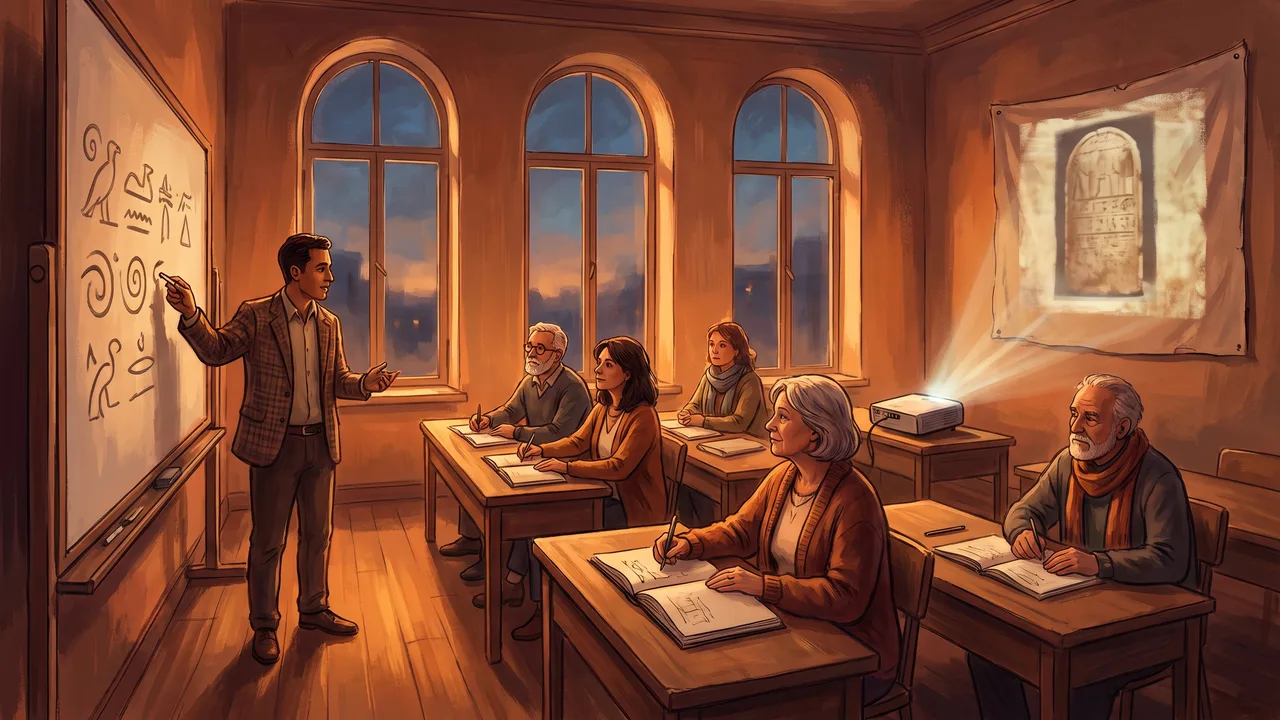
Format: Live online classes over Zoom, five or six weekly sessions, taught by working Egyptologists Cost: Roughly £100–£200 per course (City Lit's introduction is £169 at the time of writing, with concessions) Best for: Learners who want a real tutor, questions answered live and a timetable
Two London institutions run the tutored online classes I'd point a beginner to. City Lit's Ancient Egyptian Hieroglyphs: An Introduction is six live sessions built around British Museum objects, with the stated goal of reading simple texts in any museum. The Egypt Exploration Society runs five-session Zoom courses at beginner, beyond-beginner and intermediate level several times a year, with a discount for members. The feedback loop of a tutor is exactly what books and apps can't give you, and it's why people who've bounced off self-study twice often succeed here. Courses run on fixed dates and fill up, so book a term ahead.
4. Bloomsbury Summer School & Academy: best intensive
Format: Five-day intensive courses at UCL in London each summer (late June to July), plus online courses and one-day tasters through the year Cost: Course fee plus, for the in-person weeks, a week in London Best for: People who learn best in a room with others and want a concentrated push
Bloomsbury Summer School & Academy has run since 1990 and is the UK's long-standing Egyptology summer school. Its 2026 programme includes a one-day online Taste of Hieroglyphs, the five-day Beginning Hieroglyphs (Stage I) and Hieroglyphs: The Next Step (Stage II), and an advanced reading class, taught by working Egyptologists. A week of daily classes will move you further than three months of occasional evenings, and you meet the people who become your study group afterwards.
5. University of Manchester: Certificate in Egyptology (online)
Format: Part-time online certificate over three years, with hieroglyphs taught throughout alongside history and archaeology Cost: University tuition, paid per year; check the current fee Best for: Committed learners who want a recognised qualification and the full picture of Egyptology, not just the language
Manchester's Certificate in Egyptology is delivered entirely online with pre-recorded lectures, draws on the Manchester Museum's collection, and asks for about ten hours a week in term time. The study of hieroglyphs is described as integral to the course, but it sits within a wider programme, so this is the choice if you want context (religion, chronology, archaeology) as well as reading skill. It's also the longest and most expensive commitment on this list, so it's not where I'd start.
6. GlyphStudy: best free option (with a catch)
Format: Free, student-led online study groups that work through a standard textbook (Allen, Hoch, or Collier & Manley) over a year or more Cost: Free, apart from the book Best for: Self-motivated learners who want a cohort and a schedule without paying for a tutor
GlyphStudy is a remarkable thing: a free, student-led group, running since the Yahoo Groups era and now on Groups.io, whose sections go through a grammar chapter by chapter with homework and discussion. There are no teachers, only more experienced students acting as moderators, and it now covers Middle Egyptian, Late Egyptian and Coptic. The catch is pace and drop-out: groups move slowly by design, start only a few times a year, and rely on your own discipline to keep up. If you can, it's the cheapest way to get the "study group" that makes Allen workable.
Free resources worth bookmarking alongside it: the Thesaurus Linguae Aegyptiae (the Berlin-Brandenburg Academy's searchable corpus of Egyptian texts, essential once you're reading real inscriptions), and a good sign chart for the alphabet.
7. Bill Manley, Egyptian Hieroglyphs for Complete Beginners: gentlest book
Format: Book (Thames & Hudson, 2012) Cost: Around £12–15 Best for: People who found Collier & Manley too brisk, or who want to read monuments rather than study language
Manley's solo follow-up is slower and more visual than the 1998 book, again built entirely around real museum objects. It spends longer on the signs themselves and on how monumental inscriptions are laid out, which makes it the friendlier starting point for anyone who's nervous about grammar. It stops earlier than Collier & Manley, so treat it as a stepping stone rather than a destination. It sits this low only because most people can go straight to Collier & Manley.
8. Interactive online courses and apps (including this one)
Format: Self-paced, browser or phone, with exercises that mark themselves Cost: Free to about £15 Best for: The sign-learning stage, and for people who need something to make them practise
Declaration of interest first: I built Learn Hieroglyphics, the site you are reading. It is a small, new course: eight browser lessons of 20–35 minutes covering the 25 alphabet signs, common animal and plant signs, determinatives, numerals, royal cartouches, the offering formula, a monumental temple text and how multi-sound signs combine into words, with 3D practice games. The first lesson is free and the rest is a one-off $19.99 / £15.99. It does not teach the verbal system or take you through a full grammar, and it is not a substitute for Collier & Manley. What it and the better apps do well is the part a book does badly: making you produce signs, correcting you immediately, and keeping you practising until the alphabet is automatic.
Flashcard apps are fine for drilling signs, and Bob Brier's Decoding the Secrets of Egyptian Hieroglyphs (The Great Courses, 24 lectures, subscription) is an enjoyable overview. But an app that only asks you to match signs to meanings is teaching letter recognition, not reading, and a video series you watch on the sofa won't teach you to read any more than watching a pianist teaches you the piano. Use any of this category, ours included, as a supplement to something that makes you read real texts.
9. For children and schools: best classroom starting point
Format: Name translator, printable worksheet, museum resources Cost: Free Best for: Key Stage 2 Ancient Egypt units (ages 7–11), home educators, and museum-trip preparation
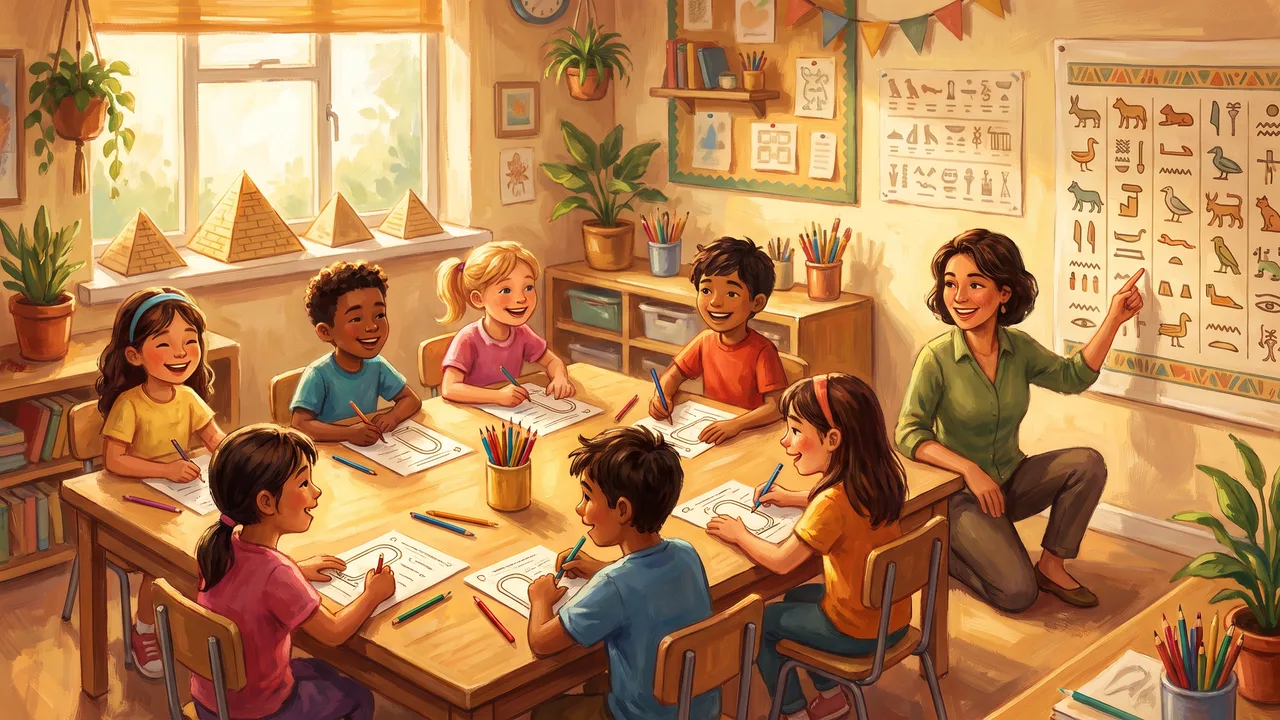
Children don't need grammar; they need to discover that the signs stand for sounds and that they can write their own name in a cartouche. That single realisation carries a whole lesson. Our teachers' page has a print-ready three-page alphabet worksheet and a lesson outline mapped to the KS2 unit, and the name translator works on the classroom whiteboard. The British Museum's Egyptian galleries and their online collection give you the real objects to show alongside.
Comparison at a Glance
| Course | Format | Cost | Best for | Gets you to |
|---|---|---|---|---|
| Collier & Manley | Book | ~£15–20 | Almost every beginner | Reading a Middle Kingdom stela |
| Allen, Middle Egyptian | Textbook | ~£35–45 | Serious grammar | Reading Middle Egyptian literature |
| City Lit / EES | Live online, 5–6 sessions | ~£100–£200 | A tutor, live questions, a timetable | Reading simple museum texts with feedback |
| Bloomsbury Summer School & Academy | 5-day intensive (London or online) | ££ (+ London) | Intensive push, meeting people | A big jump at whatever level you enter |
| Manchester Certificate | Online, 3 years | University tuition | A qualification + full Egyptology | Accredited reading competence |
| GlyphStudy | Free cohort | Free | Disciplined self-learners | Allen, slowly, with company |
| Manley, Complete Beginners | Book | ~£12–15 | Nervous beginners | Signs and monument layout |
| Interactive courses & apps (incl. ours) | Self-paced online | Free–£15 | Drilling signs, staying motivated | Alphabet, names, short formulae |
| Kids: translator + worksheet | Free | Free | KS2 classes, families | Names in cartouches, sound-sign idea |
Which Hieroglyphics Course Should You Choose?
Pick by what you want to be able to read, then by how much correction you need.
"I want to read the names and captions on my next museum visit." Collier & Manley, chapters one to three, plus an app or free lesson to drill the alphabet. A few weeks of light practice is enough to read cartouches and titles.
"I want to properly learn the language." Collier & Manley for the first two or three months, then Allen, with a GlyphStudy group or a tutored class so someone marks your work. Plan on a year or more.
"I want a teacher." City Lit or the EES for a first course; Bloomsbury for an intensive week; Manchester if you want the qualification.
"I want a qualification." Manchester. Read Collier & Manley first so you arrive already knowing the alphabet; it makes the first year far less bruising.
"I'm teaching a class." Worksheet plus translator for the lesson, and the British Museum's online collection for real objects.
"I have no money to spend." GlyphStudy, a library copy of Collier & Manley, and the Thesaurus Linguae Aegyptiae as your reading corpus. Free first lessons (ours and others') will get the alphabet into your head.
The Bottom Line
The course that will teach you hieroglyphs is the one that makes you read and write signs this week and next week and the week after. Everything above can do that; they differ in how much structure and correction they give you and what they cost. For most people the honest answer is a £15 book and a pencil, with something interactive to make the sign-learning less of a grind, and a tutor or study group when the grammar gets hard. Still unsure whether it's for you? Read should I learn hieroglyphics? first, or how to learn hieroglyphics online for the order to tackle things in.
Frequently Asked Questions
Related Articles
How to Learn Hieroglyphics Online: A Step-by-Step Guide
How to learn Egyptian hieroglyphics online in five steps: the 25 alphabet signs, the right course or book, grammar, real inscriptions and the mistakes to avoid.
Should I Learn Hieroglyphics? An Honest Answer
Should you learn hieroglyphics? An honest look at how hard it is, how long it takes, what you can realistically read after a month or a year, and who it suits.
Reading Your First Cartouche: A Step-by-Step Guide
How to read a royal cartouche step by step: find the reading direction, spot honorific transposition, then sound out Tutankhamun, Cleopatra and Ramesses II.
Ready to read hieroglyphics yourself?
Your first lesson starts with your own name: brush the sand off a sealed door and read it in hieroglyphs, then learn the rest of the alphabet through real Egyptian words.
Start Lesson 1 FreeNo sign-up to start, no payment. Lifetime access to all eight lessons is one payment later, if you want it.