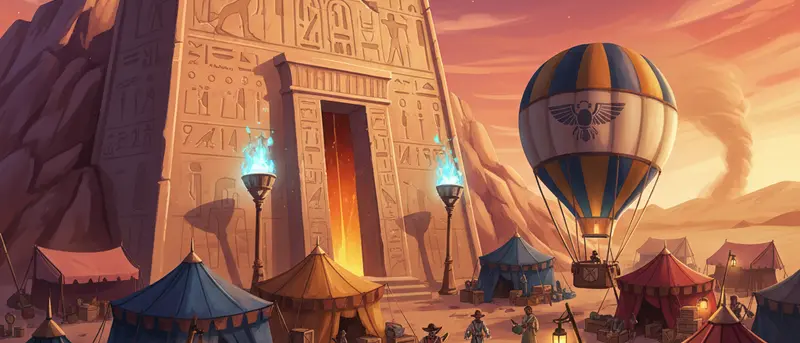
Find your name on a sealed door
Brush the sand off a buried lintel and read your name in hieroglyphs, then meet the rest of the 25-sign alphabet through real Egyptian words. Three short sections, about ten minutes each.
How to Learn Hieroglyphics Online: A Step-by-Step Guide
How to learn Egyptian hieroglyphics online in five steps: the 25 alphabet signs, the right course or book, grammar, real inscriptions and the mistakes to avoid.
Quick answer
To learn hieroglyphics online, start with the hieroglyphic "alphabet" (24 consonant sounds written with 25 uniliteral signs), which you can learn in a single sitting, then move on to biliteral signs, determinatives and royal cartouches. Use an interactive course with built-in exercises rather than a grammar textbook alone; Allen's Middle Egyptian is the academic standard but is written for university classrooms. Most learners can read simple names and short inscriptions within a few weeks of 15–20-minute daily sessions.
Want to read this for yourself? Start the free first lesson: the 25-sign hieroglyphic alphabet in about 25 minutes. Free with a Google or email sign-in.
Key Takeaways
- •Start with the 25 uniliteral signs (the hieroglyphic alphabet); you can learn these in a single sitting and they unlock basic reading immediately
- •Use a structured course with interactive exercises, not just textbooks; the difference in retention and motivation is enormous
- •The standard academic textbook is James P. Allen's Middle Egyptian (3rd ed., 2014), but it's designed for university classrooms, not self-study beginners
- •Avoid the two biggest beginner mistakes: trying to memorise all 700+ signs at once, and skipping grammar in favour of "just reading"
- •Practise with real inscriptions as early as possible; reading actual ancient text is what makes the difference between studying and learning
- •If you want to learn hieroglyphics with exercises rather than a textbook alone, our free first lesson covers the alphabet signs in one sitting
Try it as you read: write your own name in hieroglyphs with the free translator, or take the free first lesson and learn all 25 alphabet signs on a sealed door.
Why Do Most People Fail at Learning Hieroglyphics?
Most people who try to learn hieroglyphics give up not because it's too hard, but because they use the wrong resources in the wrong order.
Here's the typical failure pattern I've seen: someone gets excited about hieroglyphics, Googles "learn hieroglyphics," finds a sign list with 700 symbols, tries to memorise them all, gets overwhelmed within a week, and quits. They walk away thinking hieroglyphics are impossibly complex. They're not; the approach was wrong.
The hieroglyphic writing system is genuinely learnable. But you need to approach it in the right sequence, with the right tools, and with realistic expectations about what "learning hieroglyphics" actually means.
Step 1: Learn the Hieroglyphic Alphabet First
The first thing to learn is the hieroglyphic alphabet: 24 consonant sounds written with 25 single-consonant signs called uniliterals. This is non-negotiable, and it's where every serious Egyptology programme starts.
Ancient Egyptian hieroglyphics include over 700 signs, but these 25 are the foundation. They function like an alphabet: each one represents a single consonant sound (the double reed is usually listed as a 25th sign alongside the single reed, which is why you'll see both "24" and "25" quoted). You can learn them all in a few hours; our alphabet chart lists every sign with its sound and Gardiner code.
Why start here? Because once you know the uniliterals, you can immediately start reading royal names. Pharaoh names in cartouches are often spelled phonetically, so if you know the alphabet, you can decode them. Try Cleopatra's cartouche; it's purely phonetic and is the classic first exercise.
Our hieroglyphic name translator uses these same signs and is a good way to see the alphabet in action before you start formal study.
Step 2: Choose Your Primary Resource
The resource you choose will determine whether you succeed or give up, so pick one primary course or book and stick with it. I compare nine options in detail in the best courses to learn hieroglyphics; the short version is below.
The Best Options in 2026
For complete beginners (my recommendation): Start with an interactive online course that teaches progressively. Learn Hieroglyphics is what I built for exactly this purpose: 8 structured lessons with interactive exercises, real inscription practice, and progressive difficulty. You start with the alphabet and end up reading actual ancient texts. The first lesson is free, and lifetime access to the rest is a one-time $19.99 / £15.99.
For self-study with a textbook: Mark Collier and Bill Manley's How to Read Egyptian Hieroglyphs is the best entry point. It's written for non-specialists, uses real inscriptions from the start, and progresses at a manageable pace. If you only buy one book, make it this one.
For serious academic study: James P. Allen's Middle Egyptian (3rd ed., 2014) is the standard university textbook worldwide. It's comprehensive, rigorous, and well-structured, but it's designed for classroom use with an instructor. Self-study is possible but challenging. I'd recommend starting with Collier & Manley or an interactive course first, then moving to Allen when you have the basics down.
For the reference shelf: Sir Alan Gardiner's Egyptian Grammar (3rd ed., 1957) is the foundational reference that every Egyptologist owns. It's not a teaching book; it's a grammar and sign list. You'll use it as a reference once you're past the beginner stage.
Other Online Resources
- •EgyptianHieroglyphs.net (free): Simple, straightforward Middle Egyptian lessons. Good as a supplement but not comprehensive enough on its own.
- •Thesaurus Linguae Aegyptiae (free): The Berlin-Brandenburg Academy's digital corpus of Egyptian texts. Essential once you're reading real texts.
- •GlyphStudy (free): Student-led online study groups that work through Allen, Hoch or Collier & Manley chapter by chapter. Slow but serious, and the cheapest way to get a cohort.
- •The Great Courses: Decoding the Secrets of Egyptian Hieroglyphs (subscription): Bob Brier's 24-lecture video series. Entertaining and informative, but more of a survey than a hands-on course.
What I'd Avoid
YouTube videos with no structure. There are plenty of "learn hieroglyphics" videos online, and some are excellent, but watching videos without practising is like watching someone play piano and expecting to learn. You need to actively read and write signs, not just watch someone else do it.
Apps that gamify without teaching. Some apps treat hieroglyphics like a matching game: swipe to match the sign to its meaning. This teaches recognition but not reading. Reading hieroglyphics requires understanding grammar, word order, determinatives, and context. An app that only drills sign identification is teaching you the equivalent of letter recognition without ever teaching you to read words.
Step 3: Learn the Grammar (Don't Skip This)
You cannot read hieroglyphics without learning Middle Egyptian grammar, and this is where most self-taught learners go wrong.
I know that sounds obvious, but the temptation to skip grammar and "just start reading" is strong. And for the first few weeks, it seems to work: you can pick out individual signs, recognise common words, and feel like you're making progress. But then you hit a real inscription and realise you can't tell where one word ends and another begins, you can't parse the verb forms, and you don't know why certain signs are there at all.
Middle Egyptian grammar is not like English grammar. Key differences:
- •Verb-Subject-Object word order (not Subject-Verb-Object like English)
- •No written vowels: you need to learn how words are structured around consonants
- •Determinatives: silent signs at the end of words that classify the word's meaning (a walking-legs sign after a verb of motion, a house sign after a building, etc.)
- •Stative and narrative forms: Egyptian has verb forms that don't exist in English
This sounds daunting, but it's learnable with the right approach. The key is to learn grammar alongside reading practice, not in isolation. Every grammar point should be immediately applied to real text.
Step 4: Read Real Inscriptions Early
Here's my strongest opinion in this entire guide: start reading real ancient Egyptian text as early as possible, even if you can only understand fragments.
Don't wait until you feel "ready." You'll never feel ready. Instead, start with well-published inscriptions that have translations available:
- •Royal cartouches: The names of pharaohs are short, clearly bounded and everywhere. Our guide to reading your first cartouche walks through Tutankhamun, Cleopatra and Ramesses II sign by sign.
- •The Rosetta Stone: Yes, it's the obvious choice, and yes, the hieroglyphic portion is damaged, but working through even a few lines with the British Museum's object page is invaluable.
- •Tomb autobiographies: Middle Kingdom tomb inscriptions are written in standard Middle Egyptian and are the texts most university courses use for reading practice.
- •The Pyramid Texts: The oldest substantial body of Egyptian religious literature (c. 2400-2300 BCE). Challenging but fascinating.
- •Offering formulae: The ḥtp-dj-nsw formula appears on thousands of stelae and follows a predictable pattern. Once you learn it, you can read it on almost any museum stela.
There's something that happens when you read a real inscription that no textbook exercise can replicate. You're not just practising a skill; you're hearing a human voice across millennia. That's what keeps you going through the difficult parts. We wrote about this experience in our post on why learning hieroglyphics is worth the effort.
Step 5: Build a Practice Routine
Consistency matters more than intensity. Here's what I recommend:
- •Daily: 15-20 minutes reviewing signs and reading practice (use flashcards or an app for sign drill)
- •Weekly: One longer session (45-60 minutes) working through new grammar and reading a new passage
- •Monthly: Attempt to read an inscription you haven't seen before, using a dictionary and grammar reference
The biggest risk is burnout. Hieroglyphics are intellectually demanding, and if you try to do too much too fast, you'll exhaust yourself. The people who succeed are the ones who study regularly in small amounts, not the ones who do marathon sessions once a month.
Common Mistakes to Avoid
After teaching this subject and watching hundreds of learners, here are the patterns that consistently lead to failure:
Trying to memorise every sign before reading. You'll learn most signs through context, not memorisation. Focus on the 25 uniliterals, the most common biliterals and triliterals, and the key determinatives. The rest will come with reading practice.
Ignoring determinatives. These "silent" signs at the end of words are not optional extras; they're essential for reading. Without them, you can't distinguish between words that are spelled the same way. Learn to love determinatives.
Only studying grammar without reading. Grammar in isolation is dry and forgettable. Always apply grammar points to real text immediately.
Comparing yourself to academics. Professional Egyptologists have spent years or decades with these texts. You're not trying to become them (unless you are, in which case, go to grad school). You're trying to read well enough to engage with ancient Egyptian civilisation directly. That's achievable in months, not decades.
The Bottom Line
Learning hieroglyphics online in 2026 is more accessible than it has ever been. The resources exist, from interactive online courses to university textbooks to free digital corpora. The writing system is complex but logical. The grammar is demanding but learnable.
What you need is the right sequence (alphabet → grammar → reading → practice), the right primary resource (something interactive and structured, supplemented by a good textbook), and the consistency to show up for 15-20 minutes a day.
If you're ready to start, try our free lesson or unlock the full course for a one-time $19.99 / £15.99. You'll learn the 25 uniliteral signs, decode your first cartouche, and read your first real inscription, all in the first week.
Frequently Asked Questions
Related Articles
Best Hieroglyphics Courses 2026: Online, Books, Uni & Free
Best courses to learn Egyptian hieroglyphs in 2026, honestly compared: the standard textbooks, tutored online classes, a university certificate, free groups and apps.
Reading Your First Cartouche: A Step-by-Step Guide
How to read a royal cartouche step by step: find the reading direction, spot honorific transposition, then sound out Tutankhamun, Cleopatra and Ramesses II.
Should I Learn Hieroglyphics? An Honest Answer
Should you learn hieroglyphics? An honest look at how hard it is, how long it takes, what you can realistically read after a month or a year, and who it suits.
Ready to read hieroglyphics yourself?
Your first lesson starts with your own name: brush the sand off a sealed door and read it in hieroglyphs, then learn the rest of the alphabet through real Egyptian words.
Start Lesson 1 FreeNo sign-up to start, no payment. Lifetime access to all eight lessons is one payment later, if you want it.