Find your name on a sealed door
Brush the sand off a buried lintel and read your name in hieroglyphs, then meet the rest of the 25-sign alphabet through real Egyptian words. Three short sections, about ten minutes each.
How the Rosetta Stone Was Deciphered and Why It Mattered
What the Rosetta Stone is, what its 196 BCE decree says, how Young and Champollion used its Greek text to decipher hieroglyphs in 1822, and why it mattered.
Quick answer
The Rosetta Stone is a granodiorite slab carrying a priestly decree of 196 BCE in three scripts: hieroglyphic, demotic and Greek. Because scholars could read the Greek, it provided the key that let Thomas Young and then Jean-François Champollion (1822) prove hieroglyphs recorded sounds as well as ideas, which reopened all of ancient Egyptian literature after some 1,400 years of silence. It was found at Rashid (Rosetta) in 1799 and has been in the British Museum since 1802.
Want to read this for yourself? Start the free first lesson: the 25-sign hieroglyphic alphabet in about 25 minutes. Free with a Google or email sign-in.
What Is the Rosetta Stone?
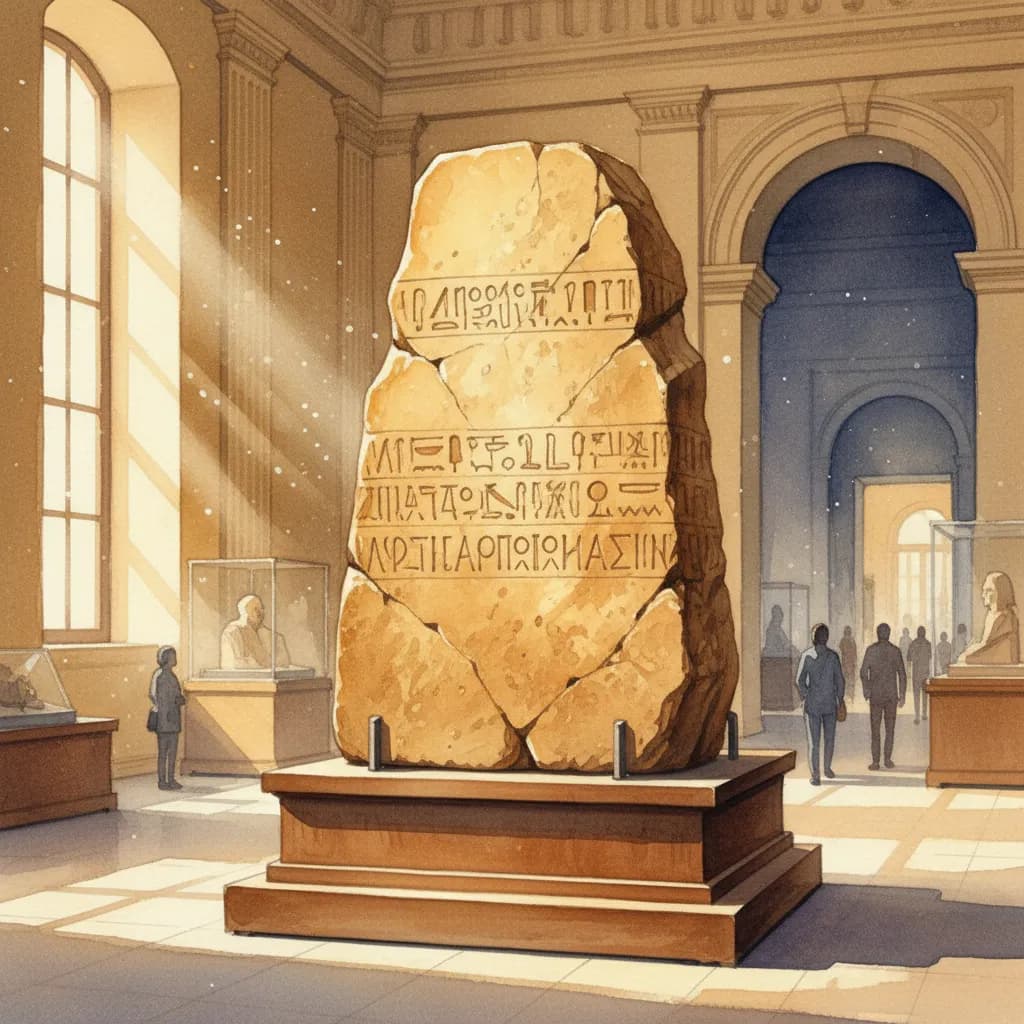
The Rosetta Stone is a broken slab of dark granodiorite, about 112 cm tall and weighing roughly 760 kilograms, carrying the same priestly decree of 196 BCE in three scripts: Egyptian hieroglyphs, Egyptian demotic and ancient Greek. It is the object that made the decipherment of hieroglyphs possible. Every sign value you use when you learn Egyptian hieroglyphs today goes back to that decipherment.
In July 1799, during Napoleon Bonaparte's military campaign in Egypt, a French officer named Pierre-François Bouchard was supervising the demolition of an old wall at Fort Julien near the town of Rashid (known to Europeans as Rosetta) in the western Nile Delta. Buried within the rubble, his team unearthed the stone, covered in three distinct bands of text.
Nobody could have predicted that this single artefact would become the most famous linguistic key in human history.
| Register | Script | Language | Lines surviving |
|---|---|---|---|
| Top | Hieroglyphic | Egyptian | 14 (badly damaged) |
| Middle | Demotic | Egyptian | 32 |
| Bottom | Greek | Greek | 54 |
Because scholars could already read Greek, this trilingual inscription offered a tantalising possibility: a way to finally crack the hieroglyphic code that had been lost for nearly 1,400 years. (For how the three Egyptian scripts relate to one another, see hieroglyphs vs. hieratic vs. demotic.)
Try it as you read: write your own name in hieroglyphs with the free translator, or take the free first lesson and learn all 25 alphabet signs on a sealed door.
Why Could Nobody Read Hieroglyphs?
Knowledge of hieroglyphs died out in late antiquity because the priests who used them did, and for over a thousand years nobody could read a single sign. To appreciate the significance of the Rosetta Stone, you need to understand how thoroughly that knowledge had vanished. The last known hieroglyphic inscription was carved in 394 CE at the Temple of Philae near Aswan. After that, the ability to read the script disappeared entirely.
For over a millennium, European scholars speculated wildly about hieroglyphs. Many believed each symbol represented a mystical concept or philosophical idea rather than sounds in a language. Horapollo, an Egyptian writing in Greek in about the fifth century CE, whose Hieroglyphica was rediscovered in 1419, reinforced the notion that hieroglyphs were purely symbolic, an error that sent researchers down the wrong path for centuries.
By the time Napoleon's expedition arrived in Egypt, hieroglyphic writing was an impenetrable mystery. Temples, tombs, and monuments across the country were covered in thousands of inscriptions that no living person could read. Three and a half millennia of literature, history, poetry, science, and religion were locked away behind a wall of beautiful but incomprehensible symbols.
Who Deciphered the Rosetta Stone: Young or Champollion?
Thomas Young made the first real progress and Jean-François Champollion completed the decipherment in 1822. After the British defeated the French in Egypt in 1801, the Rosetta Stone was surrendered under the terms of the Capitulation of Alexandria. It was shipped to London, where it has remained in the British Museum since 1802.
Copies of the inscriptions were distributed to scholars across Europe, sparking an intense competition to be the first to decipher the hieroglyphs. Two figures emerged at the forefront of this intellectual race.
Thomas Young, a brilliant English polymath, made the first significant breakthrough. Working from the Demotic section, he identified that some hieroglyphs in the cartouches (oval enclosures) on the stone represented the sounds of a royal name, specifically Ptolemy. Young proposed that hieroglyphs might be phonetic, at least when spelling foreign names. However, he didn't extend this principle further, assuming that the bulk of the script was still symbolic.
Jean-François Champollion, a young French linguist, took the decisive leap. Born in 1790, Champollion had been obsessed with Egypt since childhood and had mastered Coptic, the final stage of the Egyptian language, still used in the liturgy of the Coptic Church. This knowledge of Coptic proved to be his secret weapon.
What Was Champollion's Breakthrough?
Champollion's breakthrough was realising that hieroglyphs spelled sounds for native Egyptian words too, not just for foreign names. On 14 September 1822, he received copies of inscriptions from the temple of Abu Simbel that contained cartouches not found on the Rosetta Stone. Working rapidly, he identified the cartouche of Ramesses II by recognising the Coptic word for "sun" (ra) represented by the sun disc hieroglyph, combined with phonetic signs spelling m-s-s.
The realisation struck him like lightning: hieroglyphs were not purely symbolic. They were a sophisticated writing system that combined phonetic signs (representing sounds), logograms (representing whole words), and determinatives (silent classifiers indicating meaning categories). This mixed system was far more complex and elegant than anyone had imagined.
According to legend, Champollion burst into his brother's office shouting "Je tiens l'affaire!" ("I've got it!") before collapsing in a dead faint from the excitement.
He published his findings in the famous Lettre à M. Dacier later that month, laying the groundwork for every Egyptologist who followed.
What Is Written on the Rosetta Stone?
The inscription is a priestly decree issued in 196 BCE during the reign of Ptolemy V Epiphanes, a pharaoh of the Greek Ptolemaic dynasty that ruled Egypt after Alexander the Great's conquests. The decree was issued by a council of priests gathered at Memphis to honour Ptolemy V on the first anniversary of his coronation.
The text records tax exemptions granted to temples, describes the king's military victories, and establishes a new cult in his honour. By modern standards, it is bureaucratic and unremarkable, essentially a piece of royal propaganda. But its mundane content is precisely what made it so valuable. Because the same text appeared in three scripts, it provided the parallel needed to decode the hieroglyphs.
What Did the Decipherment Unlock?
Everything the Egyptians ever wrote. Champollion's decipherment did not happen overnight. He spent the remaining decade of his life (he died in 1832, aged just 41) refining the hieroglyphic grammar and building a comprehensive sign list. Subsequent scholars, including Karl Richard Lepsius, Heinrich Brugsch, Adolf Erman, and Alan Gardiner, expanded and corrected his work over the following century.
The consequences were staggering. Once scholars could read hieroglyphs, the entire corpus of ancient Egyptian literature, science, and history opened up:
- •The Pyramid Texts, the oldest religious writings in the world, could finally be translated.
- •Medical papyri revealed that Egyptian physicians practised sophisticated surgery and pharmacology thousands of years before Hippocrates.
- •Love poetry and wisdom literature showed that ancient Egyptians grappled with the same emotions and philosophical questions we do today.
- •Administrative records, kept by the scribes who ran the state, revealed the complex bureaucracy that built the pyramids, not with slave labour, as long believed, but with organised teams of paid workers.
Why Does the Rosetta Stone Matter for Learners Today?
The Rosetta Stone is more than a museum piece. It is a reminder that languages can be lost and recovered, that scripts carry civilisations within them, and that one determined individual with the right tools can crack a code that defeated scholars for a thousand years.
You can retrace the decipherment yourself in about twenty minutes: Decipher is a free five-chapter puzzle that hands you the Ptolemy cartouche, then Cleopatra's, then the Abu Simbel copies, and lets you deduce the sign values in the order Young and Champollion did.
When I began learning hieroglyphics, I found it inspiring to know that I was walking the path that Champollion opened. The same phonetic principles he discovered, the uniliteral signs, the determinatives, the phonetic complements, are exactly what you study in your first lessons. You have an advantage he never had: a structured curriculum, centuries of subsequent scholarship, and a complete understanding of the grammar he spent his life reconstructing.
The Rosetta Stone didn't just change Egyptology. It proved that the past is never truly lost. It simply waits for someone curious enough to learn its language.
Frequently Asked Questions
Related Articles
Hieroglyphs vs. Hieratic vs. Demotic: Egypt's Three Scripts
Hieroglyphs, hieratic and demotic compared: what each Egyptian script was, when and by whom it was used, and why one language needed three ways of writing.
Reading Your First Cartouche: A Step-by-Step Guide
How to read a royal cartouche step by step: find the reading direction, spot honorific transposition, then sound out Tutankhamun, Cleopatra and Ramesses II.
Scribes in Ancient Egypt: The Most Powerful Class
Who the scribes of ancient Egypt were, how they trained, what they did all day, the tools they used and why, with so few literate, writing meant power.
Ready to read hieroglyphics yourself?
Your first lesson starts with your own name: brush the sand off a sealed door and read it in hieroglyphs, then learn the rest of the alphabet through real Egyptian words.
Start Lesson 1 FreeNo sign-up to start, no payment. Lifetime access to all eight lessons is one payment later, if you want it.