Find your name on a sealed door
Brush the sand off a buried lintel and read your name in hieroglyphs, then meet the rest of the 25-sign alphabet through real Egyptian words. Three short sections, about ten minutes each.
Hieroglyphs vs. Hieratic vs. Demotic: Egypt's Three Scripts
Hieroglyphs, hieratic and demotic compared: what each Egyptian script was, when and by whom it was used, and why one language needed three ways of writing.
Quick answer
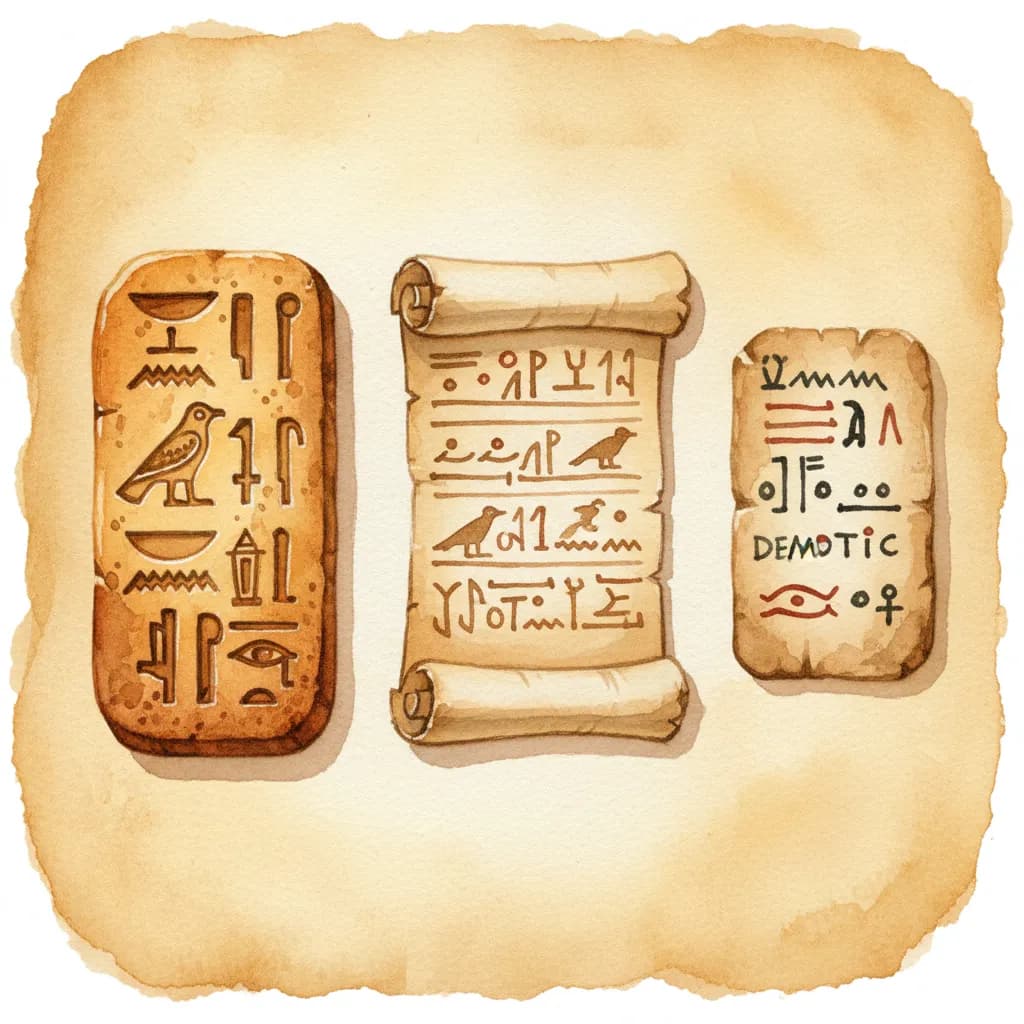
Ancient Egypt used three scripts for the same language: hieroglyphs (formal pictorial signs carved on monuments), hieratic (a cursive, pen-and-papyrus form of the same signs used for everyday documents from c. 3000 BCE) and demotic (a much more abbreviated script that replaced hieratic for daily use from c. 650 BCE). Hieroglyphs and demotic both appear on the Rosetta Stone, alongside Greek.
Want to read this for yourself? Start the free first lesson: the 25-sign hieroglyphic alphabet in about 25 minutes. Free with a Google or email sign-in.
Did Ancient Egypt Have One Writing System or Three?
Ancient Egypt had three scripts, not one, all writing the same language. One of the most common misconceptions about ancient Egypt is that the Egyptians had one writing system: hieroglyphics. In reality, they developed and used three distinct scripts over the course of their civilisation, each suited to different purposes, contexts, and materials. Understanding these three scripts, and how they relate to each other, is essential for anyone serious about studying ancient Egyptian writing. Most people learn hieroglyphics first, and that makes the other two far easier, because hieratic and demotic grew out of the same signs.
Think of it this way: modern Japanese uses three scripts simultaneously (kanji, hiragana, and katakana), and English speakers switch between print and cursive handwriting depending on context. Ancient Egyptians did something similar, but on a grander scale and over a much longer period.
Try it as you read: write your own name in hieroglyphs with the free translator, or take the free first lesson and learn all 25 alphabet signs on a sealed door.
What Are Hieroglyphs?
Period of use: c. 3200 BCE to 394 CE (approximately 3,600 years)
Hieroglyphs (medu netjer, "words of the god") are the formal pictorial script of ancient Egypt, carved and painted on monuments, and the script most people picture when they think of Egyptian writing. These are the beautifully carved and painted signs that cover temple walls, tomb chambers, obelisks, and sarcophagi.
Each hieroglyph is a miniature work of art: an owl, a reed, a human arm, a seated god, rendered in meticulous detail. The visual precision was intentional. Egyptians believed that hieroglyphic signs had magical power: writing something made it real. A hieroglyph of a bird could, in magical terms, become that bird. This is why dangerous animals depicted in tomb inscriptions were sometimes carved incomplete or with knives through them, to neutralise their magical threat.
Hieroglyphs could be written in any direction: left to right, right to left, or top to bottom. The reader determined the direction by noting which way the animal and human signs faced; they always look toward the beginning of the text.
The system included approximately 700 signs in the Middle Kingdom (the "classical" period of the language), expanding to several thousand in the Ptolemaic and Roman periods as priests created new signs for temple inscriptions. Only 25 of them write single consonants; the rest write two or three consonants, whole words, or act as silent classifiers.
Hieroglyphs were used for:
- •Temple and tomb inscriptions
- •Royal monuments and obelisks
- •Religious texts carved in stone
- •Formal state decrees
- •Decorative and ceremonial purposes
Carving hieroglyphs was slow, skilled work. A master craftsman might spend an entire day carving a single column of text. For everyday communication, a faster system was needed.
What Is Hieratic?
Period of use: c. 3200 BCE to 3rd century CE (parallel to hieroglyphs for most of Egyptian history)
Hieratic is the cursive, handwritten form of the hieroglyphic script, developed alongside hieroglyphs from the very beginning of Egyptian writing. It is not a separate language. It is a cursive version of hieroglyphs, adapted for writing quickly with a reed pen on papyrus or ostraca. The name is Greek, given by Clement of Alexandria around 200 CE, and means "priestly", because by his day it survived mainly in temple use.
The relationship between hieroglyphs and hieratic is similar to the relationship between printed letters and handwriting in English. The same signs are represented, but their forms are simplified and abstracted for speed. An owl (𓅓) in hieroglyphic becomes a few quick brush strokes in hieratic. A seated man becomes a simple squiggle.
Hieratic was always written right to left (unlike hieroglyphs, which could go in any direction). In the earliest periods, it was sometimes written in vertical columns, but by the Middle Kingdom, horizontal lines had become standard.
This script was the workhorse of Egyptian literacy. While hieroglyphs adorned temple walls, hieratic was the script of daily life:
Hieratic was used for:
- •Administrative records and tax documents
- •Letters (personal and official)
- •Literary texts (stories, poetry, wisdom literature)
- •Medical, mathematical, and scientific papyri
- •Religious texts written on papyrus (including early Books of the Dead)
- •Legal contracts and court records
- •Student exercises in scribal schools
Most of the great works of Egyptian literature that survive, the Tale of Sinuhe, the Eloquent Peasant, the Instructions of Ptahhotep, were composed and transmitted in hieratic. When scribal students practised writing, they learned hieratic first because it was the practical script they would use every day.
By the Late Period (c. 664 BCE onward), hieratic had evolved into a highly specialised script used mainly by priests for religious documents. For secular purposes, it had been largely replaced by a new, even more simplified script.
What Is Demotic?
Period of use: c. 650 BCE to 5th century CE (approximately 1,000 years)
Demotic is the heavily abbreviated everyday script that emerged in the 26th Dynasty as a further simplification of hieratic. The Egyptians called it sḫ n šꜥt, "document writing". The Greek name, from demotikos ("popular" or "of the people"), goes back to Herodotus, who distinguished the Egyptians' "sacred" and "popular" scripts.
If hieratic is like handwriting, demotic is like shorthand. The signs are so heavily abbreviated that individual hieroglyphic ancestors are often impossible to identify. Demotic developed its own conventions, ligatures (connected signs), and even some grammatical structures that differ from earlier stages of the language.
Demotic represents a later stage of the Egyptian language itself, just as Middle English differs from Old English, Demotic Egyptian differs from earlier phases. The grammar had evolved: word order shifted, the verbal system changed, and new vocabulary entered the language.
Demotic was used for:
- •Legal documents (marriage contracts, property deeds, court records)
- •Commercial transactions and receipts
- •Letters and personal correspondence
- •Literary and wisdom texts
- •Scientific texts (including the famous Demotic mathematical papyri)
- •Tax records and administrative documents
- •The middle band of the Rosetta Stone
The Rosetta Stone, in fact, provides a perfect snapshot of the situation in 196 BCE: hieroglyphs for the formal religious version, Demotic for the everyday Egyptian version, and Greek for the ruling Ptolemaic government.
How Did the Three Scripts Coexist?
They coexisted by division of labour: each script had its own users, materials and occasions. At their peak overlap (roughly 650 BCE to 394 CE), all three were in active use in Egypt, but by different people, for different purposes:
| Feature | Hieroglyphs | Hieratic | Demotic |
|---|---|---|---|
| Primary users | Priests, royal craftsmen | Priests, scribes | General literate population |
| Writing surface | Stone, wood, metal | Papyrus, ostraca | Papyrus, ostraca |
| Direction | Any direction | Right to left | Right to left |
| Speed | Very slow (carved) | Moderate (written) | Fast (written) |
| Context | Monumental, sacred | Religious, literary | Legal, commercial |
| Period | 3200 BCE to 394 CE | 3200 BCE to 3rd c. CE | 650 BCE to 5th c. CE |
This coexistence was not chaotic. It was highly organised. An Egyptian priest might read hieroglyphs on the temple wall during morning ritual, write a theological commentary in hieratic during the afternoon, and review a land lease in demotic before dinner. The script matched the context, just as a modern professional might use formal English in a legal brief, casual English in an email, and abbreviations in a text message.
When Did Egyptian Writing End?
Hieroglyphs died out at the end of the fourth century CE and demotic in the fifth; the language itself lived on as Coptic. The last known hieroglyphic inscription was carved on 24 August 394 CE at the Temple of Philae, by a priest named Esmet-Akhom. The last known demotic inscription dates to 452 CE, also from Philae. After that, knowledge of all three scripts vanished from living memory.
The Egyptian language itself did not die. It evolved into Coptic, written in the Greek alphabet with a few additional characters from demotic. Coptic survived as a spoken language until the 17th century and remains in use today as the liturgical language of the Coptic Orthodox Church. It was Champollion's knowledge of Coptic that gave him the crucial insight needed to decipher hieroglyphs in 1822.
Which Script Should a Learner Study?
Start with hieroglyphs: they are what every course and textbook teaches, and what you will meet in museums. When you study hieroglyphics, you are learning the monumental script, the most visually striking and culturally significant of the three. But knowing that hieratic and demotic exist changes how you understand the writing system. Hieroglyphs were not the everyday script of ancient Egypt. They were the formal, sacred, and deliberately beautiful form, reserved for eternity.
Understanding this distinction helps explain why hieroglyphs are so detailed and pictorial: they were meant to be seen, admired, and to last forever. The cursive scripts handled the business of daily life; hieroglyphs handled the business of the gods. If you want to begin, how to learn hieroglyphics online sets out the order, and the free first lesson covers the 25 alphabet signs.
Frequently Asked Questions
Related Articles
How the Rosetta Stone Was Deciphered and Why It Mattered
What the Rosetta Stone is, what its 196 BCE decree says, how Young and Champollion used its Greek text to decipher hieroglyphs in 1822, and why it mattered.
Scribes in Ancient Egypt: The Most Powerful Class
Who the scribes of ancient Egypt were, how they trained, what they did all day, the tools they used and why, with so few literate, writing meant power.
How to Learn Hieroglyphics Online: A Step-by-Step Guide
How to learn Egyptian hieroglyphics online in five steps: the 25 alphabet signs, the right course or book, grammar, real inscriptions and the mistakes to avoid.
Ready to read hieroglyphics yourself?
Your first lesson starts with your own name: brush the sand off a sealed door and read it in hieroglyphs, then learn the rest of the alphabet through real Egyptian words.
Start Lesson 1 FreeNo sign-up to start, no payment. Lifetime access to all eight lessons is one payment later, if you want it.