Find your name on a sealed door
Brush the sand off a buried lintel and read your name in hieroglyphs, then meet the rest of the 25-sign alphabet through real Egyptian words. Three short sections, about ten minutes each.
Scribes in Ancient Egypt: The Most Powerful Class
Who the scribes of ancient Egypt were, how they trained, what they did all day, the tools they used and why, with so few literate, writing meant power.
Quick answer
Scribes were the literate administrative class of ancient Egypt, perhaps 1 to 5 percent of the population, trained from childhood in schools attached to temples and palaces to write hieratic and hieroglyphs. Because every tax record, legal ruling, temple ritual and royal inscription passed through them, literacy was a direct route to wealth, exemption from manual labour and political power.
Want to read this for yourself? Start the free first lesson: the 25-sign hieroglyphic alphabet in about 25 minutes. Free with a Google or email sign-in.
Why Did Literacy Mean Power in Ancient Egypt?
Literacy meant power because only a tiny minority could read and write, and everything the Egyptian state did ran on written records. In a civilisation that built the Great Pyramids, developed one of the first calendar systems, and administered a kingdom stretching over a thousand kilometres along the Nile, one skill underpinned everything: the ability to read and write. Today it no longer takes a childhood at scribal school: you can learn to read hieroglyphs in a few months with a screen and some patience.
Only about 1 to 5 percent of ancient Egyptians were literate. In a population that may have numbered between 1.5 and 5 million people at various points in the kingdom's history, scribes formed a tiny but enormously influential elite. They were the administrators, accountants, lawyers, doctors, architects, and diplomats of their world. Without them, the entire apparatus of the Egyptian state would have collapsed.
The scribe's position is captured perfectly in a famous ancient text known as the Satire of the Trades, written during the Middle Kingdom (c. 2000 BCE). In it, a father brings his son to the scribal school and describes every other profession in the most miserable terms (the potter is caked in mud, the fisherman risks crocodiles, the soldier endures beatings) but the scribe "sits at ease" and commands respect. The message is clear: literacy was the path to comfort, status, and power.
Try it as you read: write your own name in hieroglyphs with the free translator, or take the free first lesson and learn all 25 alphabet signs on a sealed door.
How Were Egyptian Scribes Trained?
Scribes were trained from childhood in schools attached to temples, palaces and government offices, by copying classic texts until the signs were automatic. The most learned worked in the temple institution called the per ankh (𓉐𓋹), literally "House of Life": part library, part scriptorium, where religious, medical and astronomical texts were composed and copied. The most prestigious were at Memphis, Thebes, and Heliopolis.
Boys, and in some rare cases girls, could enter scribal training young, perhaps at five to ten years old. No source records a fixed length of training, but it is usually estimated at around a decade, making it one of the longest educational programmes in the ancient world. By comparison, a modern UK medical degree takes five to six years.
The curriculum was gruelling. Students began by learning the hieratic script, a cursive form of the signs used for everyday writing on papyrus, before progressing to the formal hieroglyphic signs used for monumental inscriptions (the three Egyptian scripts are compared here). They practised on ostraca (broken pottery shards and limestone flakes), which were cheaper than papyrus and could be reused.
Early lessons focused on copying classical texts repeatedly until the signs became automatic. Students copied wisdom literature, letters, mathematical problems, and administrative documents. Surviving ostraca from the village of Deir el-Medina (home to the workers who built the royal tombs in the Valley of the Kings) show student exercises with teacher corrections marked in red ink.
What Did Scribes Learn?
A fully trained scribe learned far more than reading and writing: the scripts, mathematics, law, and often medicine and religious literature. Specifically, a scribe was expected to master:
The writing systems. Egypt used three scripts simultaneously: hieroglyphs for formal monuments and religious texts, hieratic for daily administration and literature, and eventually demotic for legal and commercial documents. A senior scribe needed fluency in at least two of these.
Mathematics. Scribes learned arithmetic, geometry, and basic algebra. They calculated grain volumes, land areas after the annual Nile flood, the number of bricks needed for construction projects, and the wages owed to work gangs. The Rhind Mathematical Papyrus (c. 1550 BCE) preserves exactly the type of problems scribal students solved.
Law and administration. Egypt's bureaucracy was enormous. Scribes drafted contracts, recorded court proceedings, managed tax collection, conducted censuses, and maintained the granaries that fed the nation. The title sesh (𓏟, "scribe") carried legal authority; a scribe's written record was binding.
Medicine. Medical papyri such as the Edwin Smith Papyrus (surgical cases) and the Ebers Papyrus (prescriptions and diagnoses) were composed and copied by medically trained scribes. Egyptian medicine was remarkably sophisticated, including surgical techniques, pharmacology, and anatomical knowledge.
Religion and literature. Senior scribes produced copies of the Book of the Dead, temple liturgies, and hymns. They also composed original literary works: stories, poetry, and philosophical dialogues that rank among the oldest literature in the world.
What Did a Scribe Do All Day?
Most working scribes were administrators: measuring, recording and calculating for the state. Archaeological evidence and surviving texts give us a remarkably detailed picture of daily life.
A scribe working in the granary administration would arrive at the storehouse at dawn. He would oversee the measurement of grain deliveries using standardised measuring vessels, record each transaction on a papyrus roll, and calculate running totals. Every bushel of wheat and barley in the kingdom was accounted for. Egypt's tax system ran on grain, not money.
A scribe in the royal court might draft diplomatic correspondence. The Amarna Letters (c. 1350 BCE), found in Akhenaten's capital, show Egyptian scribes communicating in Akkadian cuneiform with foreign kings, evidence that elite scribes were trained in foreign scripts and languages as well.
A scribe at Deir el-Medina kept daily attendance records of tomb workers, noting who was absent and why. Reasons recorded on surviving ostraca include "bitten by a scorpion," "brewing beer," "embalming his mother," and simply "drinking with Khonsu," ancient Egypt's equivalent of calling in sick.
What Tools Did Scribes Use?
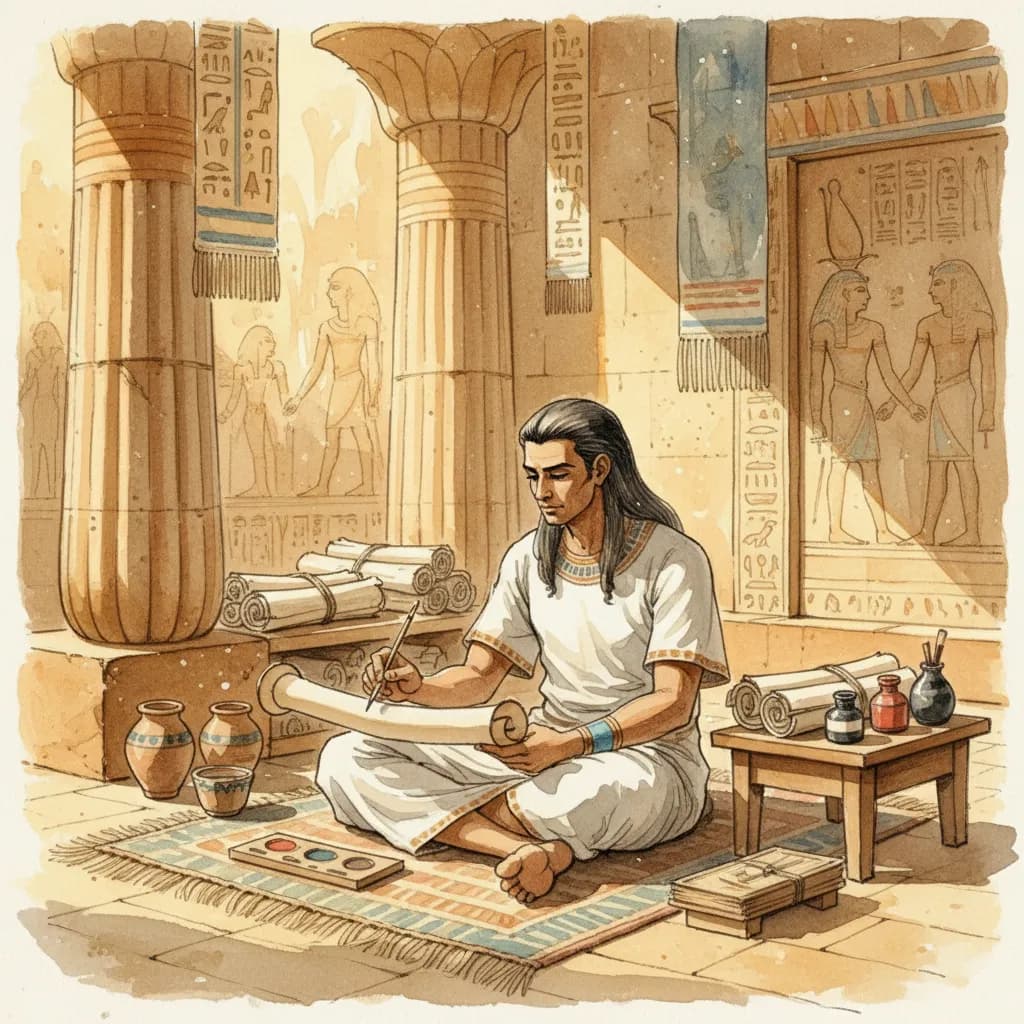
A scribe's kit was a reed pen, two cakes of ink, a wooden palette and a roll of papyrus. The tools of the trade were simple but refined:
- •Reed pens (gash), thin reeds cut to a point and frayed to create a brush-like tip
- •Ink cakes, black ink made from carbon (soot) and red ink from ochre, both mixed with gum arabic and water
- •A scribe's palette (gesty), a rectangular wooden board with two ink wells (one for black, one for red) and a central groove to hold reed pens
- •Papyrus, the famous writing material made from the pith of the papyrus plant, which grew abundantly in the Nile Delta
Red ink had a special function: it was used for headings, dates, names of dangerous entities (like the chaos serpent Apophis), and to mark corrections in student exercises. This convention is the origin of our modern practice of "red-lining" edits and corrections.
Could Women Be Scribes?
Rarely, but some women were literate. While the scribal profession was overwhelmingly male, Queen Nefertari, the wife of Ramesses II, is shown in her tomb playing senet and, more significantly, standing before Thoth, god of writing, with a scribe's palette and water pot beside her, illustrating a Book of the Dead spell for obtaining those very tools. Letters from Deir el-Medina suggest that some women in the community could read and write at a functional level, and a handful of women bear the title "scribe" in the Middle Kingdom.
The goddess Seshat, the divine patroness of writing, record-keeping, and measurement, was always depicted as female, suggesting that the Egyptians themselves associated literacy with both genders at a mythological level, even if social practice restricted access.
What Is the Scribes' Legacy?
The scribal tradition lasted for over 3,000 years, one of the longest continuous literate traditions in human history. When the last hieroglyphic inscription was carved in 394 CE and the last demotic text written in the fifth century, a chain of transmission that had begun before the pyramids were built was finally broken, and stayed broken until the Rosetta Stone was deciphered in 1822.
But the scribes' legacy endures. Every time you pick up a pen, use red ink for corrections, or consult a written record as legal evidence, you are participating in practices that Egyptian scribes established millennia ago.
Learning hieroglyphics today is, in a very real sense, resuming a conversation that was interrupted 1,600 years ago. If you want to pick it up, the first lesson is free and starts where every scribe started: with the signs for single sounds. I think the scribes would approve.
Frequently Asked Questions
Related Articles
Hieroglyphs vs. Hieratic vs. Demotic: Egypt's Three Scripts
Hieroglyphs, hieratic and demotic compared: what each Egyptian script was, when and by whom it was used, and why one language needed three ways of writing.
The Egyptian Book of the Dead: A Reader's Guide
What the Egyptian Book of the Dead really is: around 190 funerary spells chosen per owner, the weighing of the heart, the Papyrus of Ani and how to read it.
How the Rosetta Stone Was Deciphered and Why It Mattered
What the Rosetta Stone is, what its 196 BCE decree says, how Young and Champollion used its Greek text to decipher hieroglyphs in 1822, and why it mattered.
Ready to read hieroglyphics yourself?
Your first lesson starts with your own name: brush the sand off a sealed door and read it in hieroglyphs, then learn the rest of the alphabet through real Egyptian words.
Start Lesson 1 FreeNo sign-up to start, no payment. Lifetime access to all eight lessons is one payment later, if you want it.