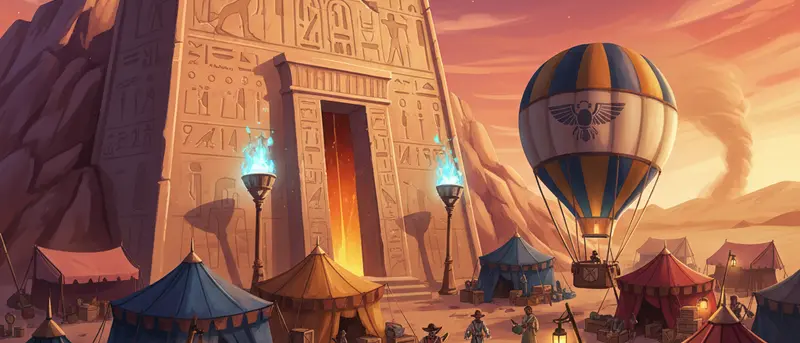
Find your name on a sealed door
Brush the sand off a buried lintel and read your name in hieroglyphs, then meet the rest of the 25-sign alphabet through real Egyptian words. Three short sections, about ten minutes each.
What Does the Ankh Symbol Mean in Egyptian Hieroglyphics?
The ankh (𓋹) is the Egyptian hieroglyph for 'life'. What it meant, why gods hold it to the pharaoh's nose, what it depicts and how it became the Coptic cross.
Quick answer
The ankh (𓋹, Gardiner sign S34) is the ancient Egyptian hieroglyph for the word ꜥnḫ, "life", meaning life as a gift granted and sustained by the gods, not merely being alive. That is why deities are shown holding it to a pharaoh's nose: the gesture means "I give you life." The loop-topped cross shape was later adopted by Egyptian Christians as the crux ansata, a form of the Coptic cross.
Want to read this for yourself? Start the free first lesson: the 25-sign hieroglyphic alphabet in about 25 minutes. Free with a Google or email sign-in.
Key Takeaways
- •The ankh (𓋹) is the hieroglyph for "life", the single most important concept in ancient Egyptian religion and culture
- •It represented divinely granted life, not just biological existence but life as participation in cosmic order (Ma'at)
- •Gods are shown offering the ankh to pharaohs, symbolising the divine gift of life and legitimising royal power
- •The physical origin of the ankh shape remains debated among Egyptologists; leading theories include a sandal strap, cloth knot, or combined male-female symbol
- •The ankh survived ancient Egypt: Egyptian Christians adopted it as the crux ansata, a form of the Coptic cross, and it remains one of the most recognised symbols worldwide
- •The ankh is one of the first signs you meet when you learn Egyptian hieroglyphs, because it spells the word ankh itself and turns up in royal names such as Tutankhamun
Try it as you read: write your own name in hieroglyphs with the free translator, or take the free first lesson and learn all 25 alphabet signs on a sealed door.
Why Is the Ankh the Most Famous Hieroglyph?
If you asked someone to draw a hieroglyph, any hieroglyph, most people would draw the ankh. It's on jewellery, tattoos, album covers, and fashion brands worldwide. But most people who wear or display the ankh have a vague sense that it means "life" or "eternal life" without understanding what that actually meant to the people who created it.
The ankh isn't just a symbol of life the way a heart emoji is a symbol of love. To the ancient Egyptians, the ankh represented something specific and profound: life as a divinely granted, cosmically sustained condition. It was inseparable from their understanding of how the universe worked, what the gods did, and what happened after death.
What Does the Ankh Symbol Mean?
The ankh (transliterated as ꜥnḫ) is the hieroglyphic sign for the word "life." It's classified as Gardiner sign S34 in Sir Alan Gardiner's standard sign list, the international reference system for hieroglyphs that every Egyptologist uses. It is one of a handful of signs, alongside the Eye of Horus and the scarab, that most people can recognise without ever having studied the script.
But "life" in the Egyptian sense was not what we mean when we say the word casually. For the Egyptians, life was not a biological accident. It was a sacred condition that existed only when the universe was in balance, when Ma'at (truth, justice, cosmic order) was upheld. Life was something the gods created, sustained, and could withdraw.
This is why the ankh appears overwhelmingly in religious contexts. You don't find it scratched into domestic pottery or scribbled in personal letters. You find it in temples, tombs, and royal inscriptions, the places where the relationship between gods, kings, and the cosmic order was made visible.
Why Do Egyptian Gods Hold the Ankh?
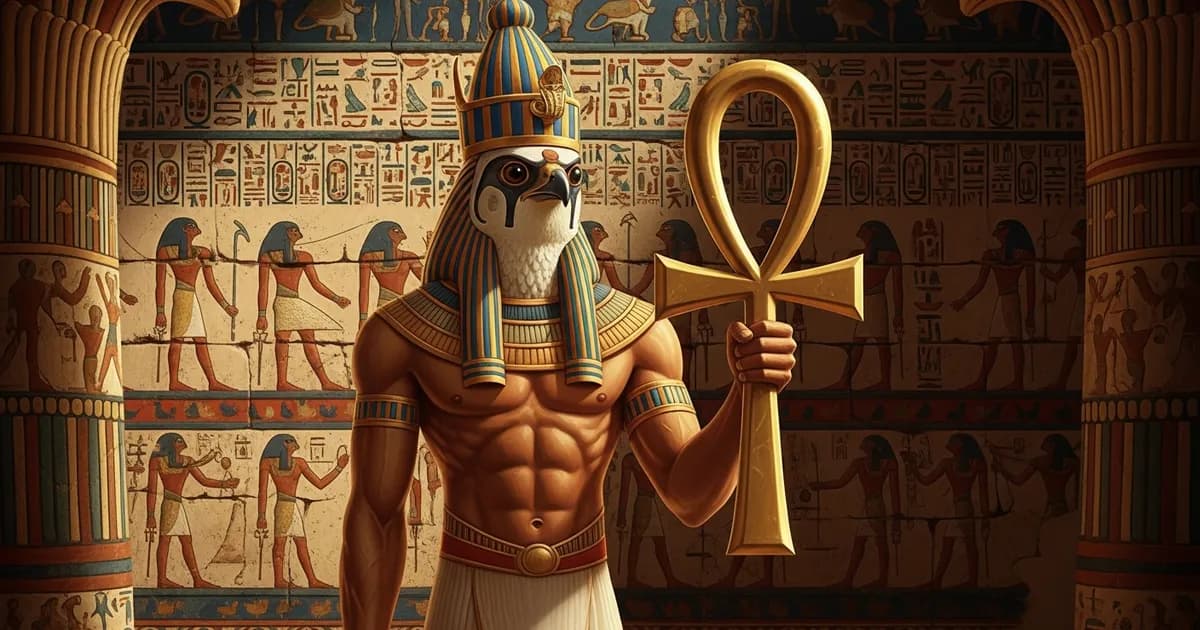
Gods hold the ankh because life was theirs to give. The most common way the ankh appears in Egyptian art is in scenes where a deity holds it out to a pharaoh. The god or goddess extends the ankh towards the king's nose or mouth, a gesture that means, quite literally, "I give you life."
This wasn't symbolic in the way we use the word. The Egyptians believed the pharaoh's authority to rule came directly from the gods, and that authority was expressed as life itself. When Amun-Ra presses the ankh to Ramesses II's face on the walls of Karnak, the scene is a political and theological statement: this king rules because the supreme god has granted him the breath of life.
In the Old and Middle Kingdoms, only gods and royalty were depicted holding the ankh. This restriction was deliberate. The ankh was not just a nice symbol; it was a marker of divine status. Ordinary people appear in tomb art, but they don't hold ankhs. That privilege belonged to beings who existed at the intersection of the human and the divine.
What Did the Ankh Mean for the Afterlife?
In funerary contexts the ankh stood for the continuity of life across death, not just life in this world. This is where I think most popular explanations fall short. The Egyptians did not believe death was an ending; they believed it was a transformation. A person who died correctly (with proper mummification, burial rites, and moral conduct) would continue to live in the afterlife, specifically in the Field of Reeds.
The ankh appears in the Book of the Dead and in funerary inscriptions because it represents this unbroken thread of existence. When you see an ankh in a tomb, it's not a memorial; it's an active agent. The Egyptians believed that the symbols carved into tomb walls had real power. The ankh carved into a burial chamber was meant to ensure continued life for the deceased.
This is fundamentally different from how we think about symbols. We see a cross on a gravestone as a marker of faith. The Egyptians saw a carved ankh as a working technology, a device that helped maintain the conditions necessary for eternal life.
What Does the Ankh Depict? The Origin Debate
The ankh's distinctive shape (a cross with a loop at the top) is immediately recognisable, but nobody knows for certain what object it originally depicted. This is one of the longest-running debates in Egyptology.
The sandal strap theory is the most widely cited in academic literature. Gardiner's sign list itself describes S34 as a sandal strap, with the loop going around the ankle. The word ꜥnḫ can mean both "life" and "sandal strap", a case of the rebus principle where a sign for a concrete object comes to represent an abstract concept that sounds the same.
The knot theory suggests the ankh is a ceremonial knot made of cloth or reeds, similar to other Egyptian tied symbols like the tyet (the "Knot of Isis"). This theory has support from the way the ankh is drawn in earliest hieroglyphic inscriptions, where the loop appears more like wrapped material than a rigid shape.
The combined symbol theory proposes the ankh combines male and female elements (the loop representing the womb and the cross representing the phallus), symbolising the union that creates life. This interpretation is popular in alternative history but has limited support in mainstream Egyptology.
My own view, for what it's worth: the sandal strap theory is the most linguistically sound, but I suspect the Egyptians themselves had long forgotten the original referent by the time of the great temple-building periods. The ankh had become a purely abstract symbol of life, much as our letter A no longer makes anyone think of the ox head it originally depicted in Proto-Sinaitic script.
How Is the Ankh Used in Hieroglyphic Writing?
In the script, the ankh is a triliteral sign writing the consonants ꜥ-n-ḫ and a logogram for the word "life" itself. It is not one of the 25 alphabet signs, but if you're learning to read hieroglyphics (and you should) it is one of the first signs you'll encounter because it appears constantly.
It shows up in:
- •Royal names and titles. The word ꜥnḫ appears in phrases like ꜥnḫ wḏꜣ snb ("life, prosperity, health"), a formulaic blessing that follows pharaoh names in inscriptions.
- •Offering formulae. The standard ḥtp-dj-nsw ("an offering which the king gives") formula in tombs often includes wishes for the deceased to have "life" in the afterlife.
- •Compound words. The ankh forms part of words like ꜥnḫ.t ("mirror", which was also loop-shaped) and names like Tutankhamun (twt-ꜥnḫ-jmn, "living image of Amun").
- •The word "oath." ꜥnḫ also means "oath" or "to swear": you swore by life.
You can try translating your own name into hieroglyphics using our free tool to see how the phonetic system works.
What Happened to the Ankh After Ancient Egypt?
The ankh didn't die with the pharaohs. When Egypt became Christian in the early centuries CE, Egyptian Christians adopted a version of the ankh, the crux ansata (Latin for "cross with a handle"), which survives as one form of the Coptic cross. This wasn't coincidence. The early Egyptian Christians drew a direct line between the ankh as a symbol of eternal life and the Christian promise of resurrection. Knowledge of the script itself was lost soon after, and was not recovered until the Rosetta Stone was deciphered in 1822.
In the 20th and 21st centuries, the ankh has been adopted by various subcultures and spiritual movements. It's a common symbol in Afrocentric art, gothic fashion, New Age spirituality, and popular culture. Whether these modern uses honour or distort the original meaning is a debate I'll leave to others, but I do think that anyone who wears an ankh should know what the people who created it actually believed.
Why I Think the Ankh Matters
The ankh is more than an aesthetic object. It's a window into how the ancient Egyptians understood existence itself. For them, life was not a given; it was a gift from the gods, maintained by cosmic order, and capable of continuing beyond death if the proper conditions were met.
When you learn to read the ankh in its original context, surrounded by offering formulae, divine speeches, and funerary texts, you start to understand the Egyptian worldview from the inside. And that's ultimately what learning hieroglyphics gives you: not just the ability to decode symbols, but the ability to think, even briefly, the way a civilisation thought 4,000 years ago.
If you're interested in going deeper, the free first lesson teaches the alphabet signs, and the full course covers the ankh and dozens of other signs in structured, interactive lessons that take you from complete beginner to reading real inscriptions.
Frequently Asked Questions
Related Articles
5 Egyptian Hieroglyphs You Already Know (and What They Mean)
Five Egyptian hieroglyphs you already recognise (ankh, Eye of Horus, scarab, djed, sun disc), what each actually meant and how it worked in the script.
The Egyptian Book of the Dead: A Reader's Guide
What the Egyptian Book of the Dead really is: around 190 funerary spells chosen per owner, the weighing of the heart, the Papyrus of Ani and how to read it.
How the Rosetta Stone Was Deciphered and Why It Mattered
What the Rosetta Stone is, what its 196 BCE decree says, how Young and Champollion used its Greek text to decipher hieroglyphs in 1822, and why it mattered.
Ready to read hieroglyphics yourself?
Your first lesson starts with your own name: brush the sand off a sealed door and read it in hieroglyphs, then learn the rest of the alphabet through real Egyptian words.
Start Lesson 1 FreeNo sign-up to start, no payment. Lifetime access to all eight lessons is one payment later, if you want it.