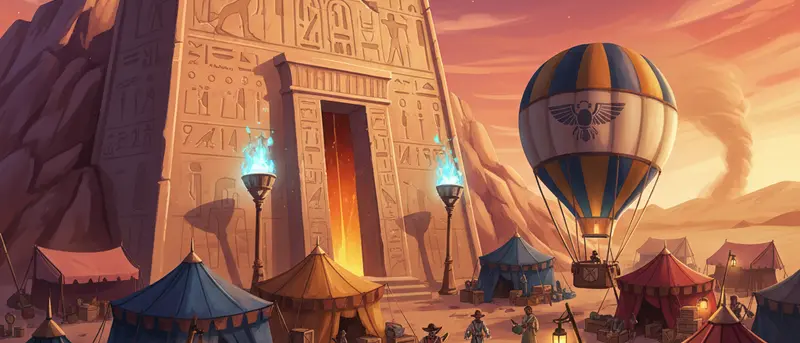
Find your name on a sealed door
Brush the sand off a buried lintel and read your name in hieroglyphs, then meet the rest of the 25-sign alphabet through real Egyptian words. Three short sections, about ten minutes each.
Is It Hard to Learn Hieroglyphics? An Honest Difficulty Guide
Is it hard to learn hieroglyphics? The alphabet takes a weekend, the sign system takes a few months and the grammar takes a year or more. Here is what is easy, what is hard, and how it compares to Latin, Chinese and Japanese.
Quick answer
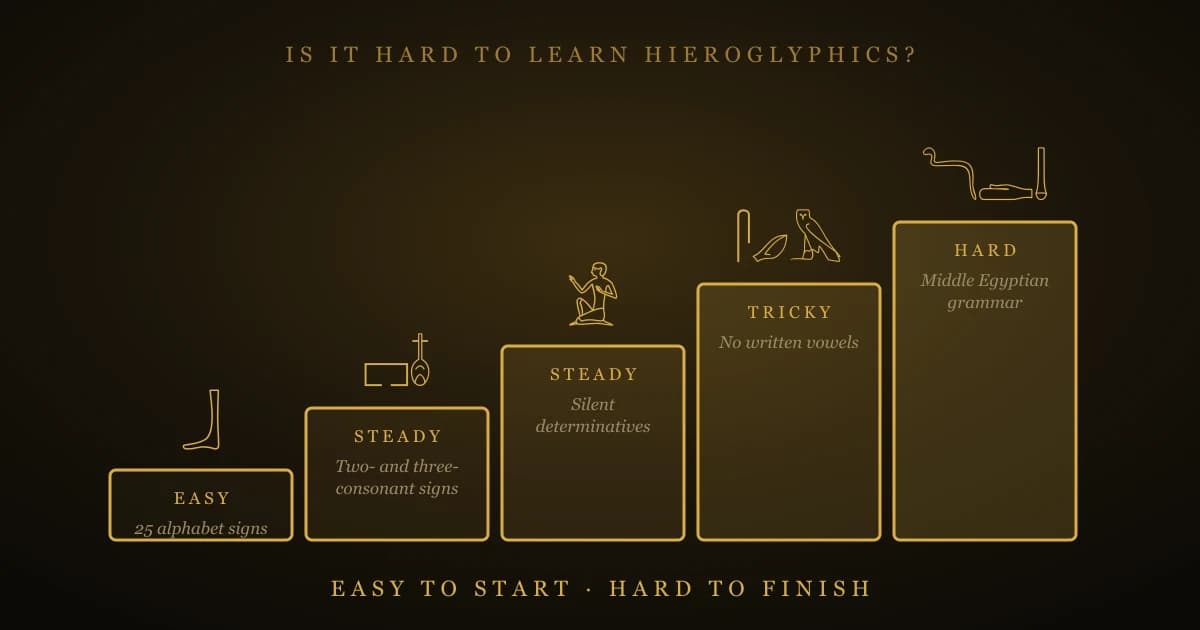
Learning hieroglyphics is easy to start and hard to finish. The 25 alphabet signs take a weekend, and with 15–20 minutes a day most people can read royal names, titles and the offering formula on a museum stela within about three months. The hard part is Middle Egyptian grammar, which has no written vowels and a verb system unlike English, and reading continuous texts takes a year or more. With around 750 signs in total, it is far less to memorise than Chinese or Japanese.
Want to read this for yourself? Start the free first lesson: the 25-sign hieroglyphic alphabet in about 25 minutes. Free with a Google or email sign-in.
The Short Answer: Easy to Start, Hard to Finish
Learning hieroglyphics is much easier to start than people expect and harder to finish than they hope. The first step, the 25 alphabet signs, takes a weekend. Reading the names, titles and prayers carved on most museum objects takes a few months. Reading a full Middle Egyptian story with a dictionary open takes a year or more, and that last stage is where the difficulty lives.
The reputation for difficulty comes from two true facts. There are hundreds of signs, and the ancient Egyptians themselves found it hard: scribes trained for years, and Egyptologists estimate that perhaps one person in a hundred could read. But you are not trying to become a temple scribe. You are an adult with a sign list, a grammar book and 4,000 years of hindsight, which makes the job very different.
The rest of this guide breaks the difficulty down layer by layer, so you can see exactly which parts are hard and decide how far you want to go. If you would rather find out by trying, you can learn hieroglyphics here one sign at a time, starting with a free lesson.
Try it as you read: write your own name in hieroglyphs with the free translator, or take the free first lesson and learn all 25 alphabet signs on a sealed door.
Why Do Hieroglyphics Look So Hard?
Hieroglyphics look hard because they look like pictures, and pictures seem to have no rules. In fact the system is highly regular. Most signs stand for sounds, not ideas, and the same few dozen signs appear again and again.
Three things make a first glance at a temple wall bewildering:
- •There are no spaces or punctuation. Words run straight into each other, so you learn to spot where one ends, often by the silent sign that closes it.
- •The direction changes. Text can run right to left, left to right or in columns. The rule is simple once you know it: read towards the faces of the people and animals.
- •Signs are stacked in blocks. Scribes arranged signs in neat squares for beauty, so a tall sign may sit beside two short ones stacked on top of each other. You read top before bottom, front before back.
Each of these costs you an afternoon of practice, not a year. None of them is the real difficulty.
The Five Layers of Difficulty
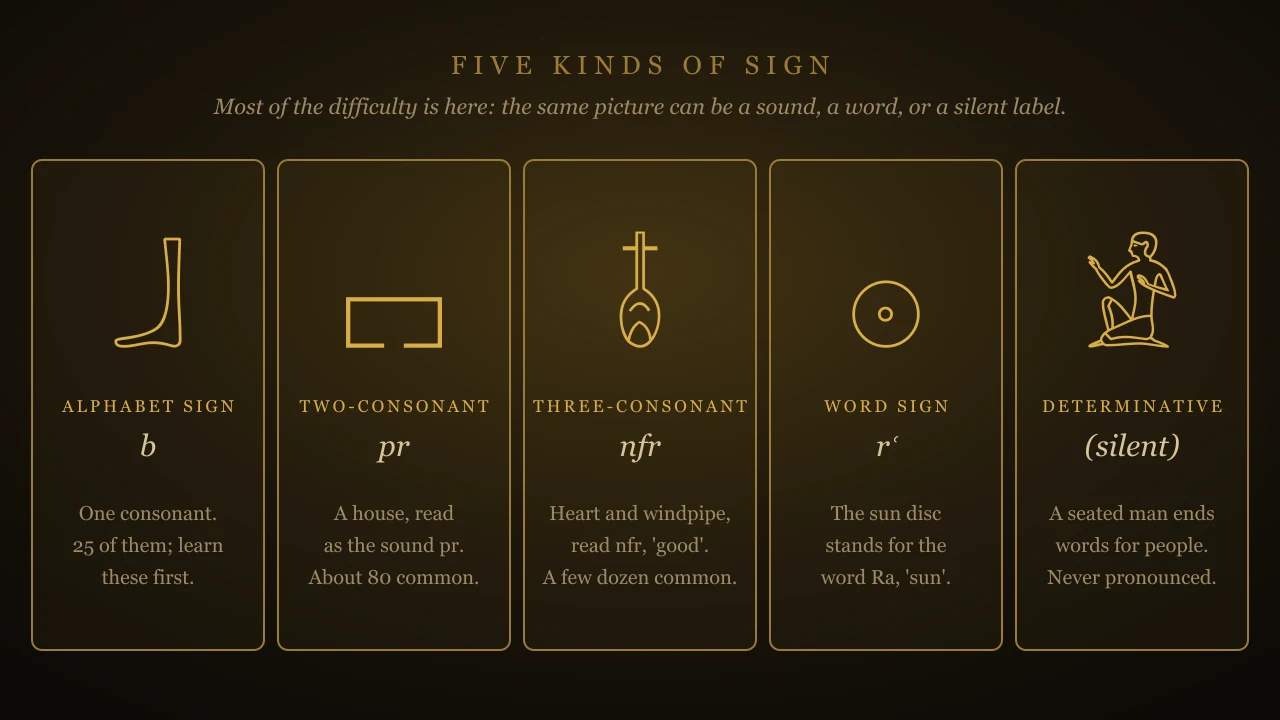
Here is how the difficulty builds, from the first sign to fluent reading:
| Layer | What you learn | Difficulty | Time at 15–20 min a day |
|---|---|---|---|
| 1. Alphabet signs | 25 signs, one consonant each | Easy | A weekend |
| 2. Two- and three-consonant signs | About 80 two-consonant and a few dozen common three-consonant signs | Steady | Weeks, learned as you meet them |
| 3. Determinatives | Silent signs that show a word's category | Steady | Weeks, alongside layer 2 |
| 4. No written vowels | Reading words as consonant skeletons in transliteration | Tricky | A few weeks to feel natural |
| 5. Middle Egyptian grammar | Verb forms, word order, set constructions | Hard | A year or more |
Layer 1: The Alphabet Signs (Easy)
Twenty-five signs each stand for a single consonant: the foot 𓃀 is b, the mouth 𓂋 is r, the water ripple 𓈖 is n. They are as easy to learn as any alphabet, and many are memorable pictures. Once you know them you can already read names written phonetically, which is how foreign rulers like Cleopatra and Ptolemy wrote theirs. You can try it on your own name in the name translator.
Layer 2: Signs for Two or Three Sounds (Steady)
This is the layer that surprises people. Many signs stand for two consonants, like the house 𓉐 pr, or three, like 𓄤 nfr "good, beautiful". Scribes usually added alphabet signs after them as a spelling check, so "good" is normally written 𓄤𓆑𓂋: nfr plus f plus r. These helpers are called phonetic complements, and they make the bigger signs much easier to learn, because the answer is written right next to them.
You do not learn these from a list. You meet them in real words and names, a few at a time.
Layer 3: Determinatives (Steady)
A determinative is a silent sign at the end of a word that tells you what kind of thing it is: a seated man 𓀀 for people, a house plan for buildings, a papyrus roll for abstract ideas. The word for "scribe" is written 𓏞𓀀, the scribe's palette and a seated man. Determinatives look like extra work but they are a gift: they mark where words end and give you a clue to the meaning before you have read the sounds.
Layer 4: No Written Vowels (Tricky)
Egyptian writing records consonants only. The word for "good" is written nfr, and nobody knows exactly how it was pronounced. Egyptologists fill the gaps with a conventional e, so nfr is said "nefer" (as in Nefertiti). This means learning a transliteration alphabet with a few unusual letters, such as ꜣ, ꜥ, ḥ and ḫ, which is fiddly for a few weeks and then becomes second nature.
Layer 5: Middle Egyptian Grammar (Hard)
Here is the honest part. Middle Egyptian, the classical form of the language used on most monuments, puts the verb first and builds tenses by adding pieces to the verb. "He heard" is sḏm.n.f: sḏm "hear", n marking the past, f "he", written 𓋴𓄔𓅓𓈖𓆑. There is no one to talk to and you are learning from books, so it takes patience.
It also has mercies. Nouns have no cases, unlike Latin or Greek, and the texts on monuments repeat the same formulae endlessly, so you see the same constructions many times over.
How Many Hieroglyphs Do You Need to Learn?
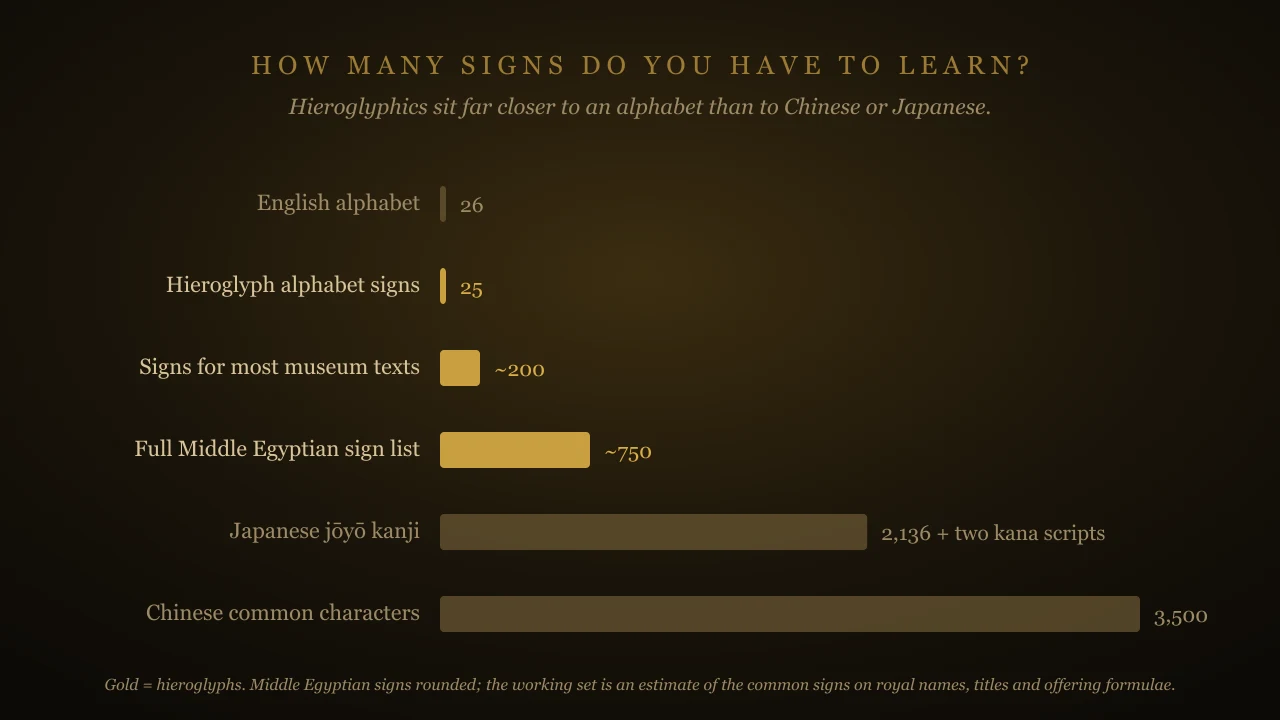
About 750 signs were in regular use in Middle Egyptian, and Alan Gardiner's standard sign list, still used by every student, catalogues around that many. But you do not need anything like all of them to start reading. The 25 alphabet signs come first, and a working set of roughly 200 common signs covers most of what appears on royal names, titles and funerary inscriptions in museums.
The figure you may have seen of "thousands of hieroglyphs" is also true, but it refers to the temples of the Greek and Roman periods, when priests invented new signs freely. That is a specialist subject you can ignore for years.
Is Hieroglyphics Harder Than Other Languages?
It depends which half of the job you mean, the script or the language.
Compared with Chinese and Japanese, the script is far lighter. Reading Japanese needs the 2,136 jōyō kanji plus two syllabaries; reading Chinese needs about 3,500 common characters. Hieroglyphic writing is mostly sound-based and sits much closer to an alphabet.
Compared with Latin, the grammar is similar in effort. Egyptian has no noun cases, which removes one of Latin's biggest hurdles, but its verb system is unfamiliar and the missing vowels mean you learn words as consonant skeletons. Latin has far more textbooks, readers and teachers, which is the bigger practical difference.
Compared with a modern language, it is easier in one crucial way. You never have to speak, listen or keep up in conversation. Hieroglyphics is a reading skill, learned at your own pace, and you decide how far to take it.
What Can You Read, and How Soon?
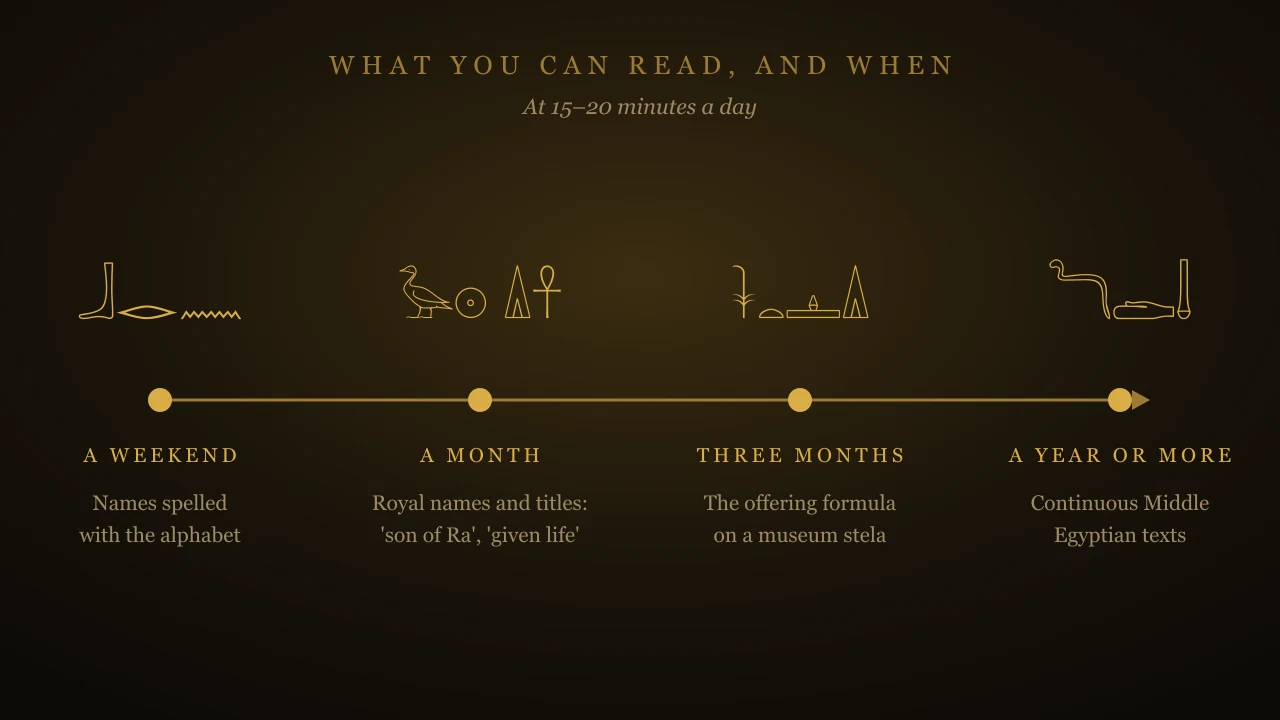
At 15–20 minutes a day, a realistic path looks like this:
- •After a weekend: names spelled with the alphabet signs, including your own and Cleopatra's.
- •After a month: common royal names and titles, like "son of Ra" 𓅭𓇳 and "given life" 𓏙𓋹, which appear on almost every royal monument. Tutankhamun's cartouche is a good milestone.
- •After three months: the offering formula 𓇓𓏏𓊵𓏙 (ḥtp-dj-nswt, "an offering which the king gives") that opens most funerary stelae, plus the names and titles that follow it. This alone unlocks a large share of the inscriptions in any Egyptian gallery.
- •After a year or more: continuous Middle Egyptian with a grammar and dictionary: tomb autobiographies, letters and literature such as the Tale of Sinuhe.
Most people who want to read museum objects are happy by the third stage, and that part is not hard at all. The fourth stage is a proper language course.
Why Do People Give Up on Hieroglyphics?
Most people who give up do so because they studied in the wrong order, not because the script is too hard. The common traps:
- •Starting with a heavy grammar. Gardiner's Egyptian Grammar is a classic reference but a brutal first book. Start with the signs and short real texts, and save full grammar for later.
- •Learning signs from a list without reading. A list of 200 signs is dull and forgettable. Meeting the same signs in names and formulae makes them stick.
- •Stopping after the alphabet. The first real inscriptions use two- and three-consonant signs, and the jump feels like a wall. Push through a few weeks of layer 2 and it becomes a pattern.
- •Studying in bursts. Two hours once a week is worse than 15 minutes a day. Short, frequent sessions and flashcards beat marathon sessions.
How to Make Learning Hieroglyphics Easier
The order matters more than the effort. This sequence keeps each step small:
- •Learn the 25 alphabet signs. The free first lesson covers them as a short game, in three sections of about ten minutes.
- •Read names. Your own, then cartouches of Cleopatra, Ptolemy and Tutankhamun.
- •Add common multi-consonant signs and determinatives as they appear in names and titles.
- •Learn the set phrases: royal titles and the offering formula. You will see them everywhere.
- •Pick up a beginner's grammar. Collier and Manley's How to Read Egyptian Hieroglyphs is the gentlest; James Allen's Middle Egyptian is the thorough one. See the best courses to learn hieroglyphics for a full comparison.
Visit a museum, or browse an online collection, as soon as you know the alphabet. Recognising a single name on a real object does more for your motivation than any worksheet. For a longer plan, how to learn hieroglyphics online sets out the steps in order, and should I learn hieroglyphics? helps you decide whether it is worth it for you.
So, Is It Hard?
Reading your first name in hieroglyphs is easy, and it happens in the first hour. Reading museum inscriptions is very achievable with a few months of short daily practice. Reading Egyptian literature is hard, rewarding work that takes a year or more. You choose the stopping point, and every stage along the way lets you read something real.
The quickest way to find out how hard it is for you is to try: learn your first signs free, and see how it feels.
Frequently Asked Questions
Related Articles
Should I Learn Hieroglyphics? An Honest Answer
Should you learn hieroglyphics? An honest look at how hard it is, how long it takes, what you can realistically read after a month or a year, and who it suits.
How to Learn Hieroglyphics Online: A Step-by-Step Guide
How to learn Egyptian hieroglyphics online in five steps: the 25 alphabet signs, the right course or book, grammar, real inscriptions and the mistakes to avoid.
Best Hieroglyphics Courses 2026: Online, Books, Uni & Free
Best courses to learn Egyptian hieroglyphs in 2026, honestly compared: the standard textbooks, tutored online classes, a university certificate, free groups and apps.
Ready to read hieroglyphics yourself?
Your first lesson starts with your own name: brush the sand off a sealed door and read it in hieroglyphs, then learn the rest of the alphabet through real Egyptian words.
Start Lesson 1 FreeNo sign-up to start, no payment. Lifetime access to all eight lessons is one payment later, if you want it.