Tutankhamun's Cartouche Explained, Sign by Sign
Tutankhamun had two cartouches: the throne name Nebkheperure and the birth name Tutankhamun. Here is what each sign says, why Amun is written first, and how the boy king's name changed.
Quick answer
Tutankhamun's birth-name cartouche reads twt-ꜥnḫ-ꞽmn, 'living image of Amun': the god's name Amun (𓇋𓏠𓈖) is written first out of respect but spoken last, then twt 'image' (𓏏𓅱𓏏) and the ankh 𓋹 'living'. His throne-name cartouche, Nebkheperure (𓇳𓎟𓆣𓏥), means 'lord of the manifestations of Ra'. He was born Tutankhaten, 'living image of the Aten', and the name was changed when Egypt returned to the old gods.
Want to read this for yourself? Start the free first lesson: the 25-sign hieroglyphic alphabet in about 25 minutes. Free with a Google or email sign-in.
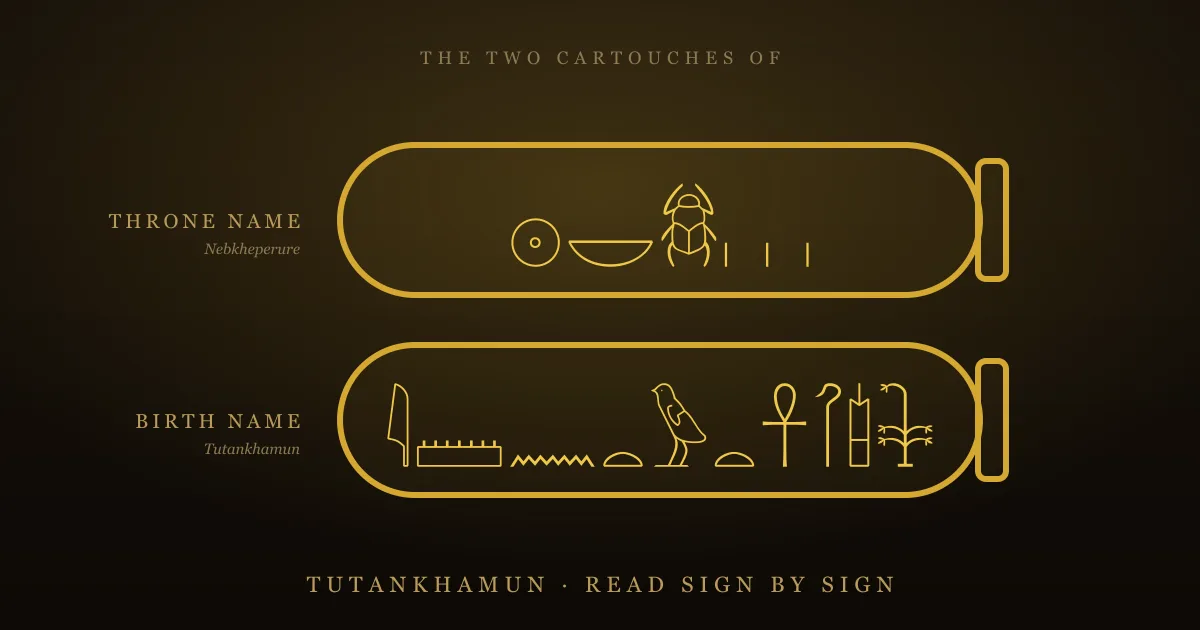
Two Names in Two Rings
Tutankhamun is the most famous pharaoh in the world and the one whose name is easiest to find. It is on the golden mask, on the shrines that nested around his coffin, on his throne, his chariots and hundreds of smaller objects from the tomb Howard Carter opened in 1922. Yet almost nobody who has stood in front of the mask can read it, because his name is not written the way it is spoken, and because there are two of them.
Every pharaoh from the Middle Kingdom onward carried two names inside cartouches: a throne name chosen at his coronation and the birth name he was given as a child. Tutankhamun's are Nebkheperure and Tutankhamun. On the mask and the shrines they sit side by side, and once you can read both you will recognise them anywhere, from a museum ring to a temple wall at Luxor.
Below is each one, sign by sign, followed by the story of the name he was born with and had to give up.
Try it as you read: write your own name in hieroglyphs with the free translator, or take the free first lesson and learn all 25 alphabet signs on a sealed door.
The Birth Name: Tutankhamun
𓇋𓏠𓈖𓏏𓅱𓏏𓋹
This is the name everyone knows, twt-ꜥnḫ-ꞽmn, "living image of Amun". Seven signs, in three groups.
- •𓇋𓏠𓈖 ꞽmn, Amun. A reed leaf (ꞽ), the game board mn and a ripple of water (n). The god's name comes first in the ring even though it is spoken last, because a god is always given the place of honour. This is called honorific transposition and it is the single most common trap in reading royal names.
- •𓏏𓅱𓏏 twt, image, likeness. Loaf (t), quail chick (w), loaf (t). Three of the 25 alphabet signs, read exactly as they sound.
- •𓋹 ꜥnḫ, living. The ankh, one sign for a whole word.
Put the groups in spoken order and you have twt + ꜥnḫ + ꞽmn: Tut-ankh-amun.
On the mask, the shrines and most of the larger objects the ring holds three more signs after the name: 𓋾𓉺𓇗, ḥqꜣ ꞽwnw šmꜥ, "ruler of Southern Heliopolis". Southern Heliopolis was a grand name for Thebes, the city of Amun, and the epithet ties the king to it. Museum labels leave it out; the objects do not, so the full ring you will see is 𓇋𓏠𓈖𓏏𓅱𓏏𓋹𓋾𓉺𓇗.
The Throne Name: Nebkheperure
𓇳𓎟𓆣𓏥
Four signs, nb-ḫprw-rꜥ, "lord of the manifestations of Ra".
- •𓇳 rꜥ, Ra. The sun disc. Written first for the same reason Amun was: the god goes at the front. Spoken last.
- •𓎟 nb, lord. A basket seen from the side. It is the same sign that writes "all" and "every" in offering texts.
- •𓆣 ḫpr, to come into being, a form or manifestation. The scarab beetle, which the Egyptians watched push a ball of dung across the sand and took as a picture of the sun being rolled across the sky each morning.
- •𓏥 three strokes, the plural mark, making it ḫprw, "manifestations".
Spoken order: nb + ḫprw + rꜥ, Neb-kheperu-re. The scarab at the heart of this name is why so many rings, pectorals and amulets from his reign carry a beetle: the beetle is his name.
If you only learn one of his cartouches, learn this one. Throne names were the official name of the reign, so on temple walls and official objects Nebkheperure often appears alone where the birth name does not.
Born Tutankhaten
He was not born Tutankhamun. His father was almost certainly Akhenaten, the king who closed the temples of Egypt's gods and replaced them with a single sun god, the Aten, and the boy was named for that god: Tutankhaten, twt-ꜥnḫ-ꞽtn, "living image of the Aten".
In hieroglyphs the change is small. The Aten's name is written 𓇋𓏏𓈖𓇳: reed leaf, loaf, water, and a sun disc as its silent picture sign. Swap those for Amun's 𓇋𓏠𓈖 and the cartouche is done. Around the third year of his reign, when the court abandoned Akhenaten's city and restored the old gods, that swap was made on every monument that could be reached. His wife's name changed the same way, from Ankhesenpaaten to Ankhesenamun.
A handful of objects in the tomb were never updated. The most famous is the golden throne, where the back panel shows the royal couple under the rays of the Aten and the king's earlier name still reads Tutankhaten. It is the clearest evidence we have that the name change happened in his own lifetime and not after his death.
How to Spot Them in a Museum
1. Look for the ring. The oval with a bar at one end is the cartouche. On the mask there are two on the back of the headdress and more along the shoulders.
2. Find the god. A sun disc 𓇳 at the front means a throne name; a reed leaf, game board and water 𓇋𓏠𓈖 means Amun and a birth name. Both signal that you move the god to the end when you read.
3. Check for the scarab. A beetle with three strokes under it, 𓆣𓏥, next to a sun disc and a basket, is Nebkheperure. No other king's throne name looks quite like it.
4. Check the direction. The reed leaf and the quail chick face the start of the text. Read into their faces.
5. Read the birth name in three chunks. Amun, then twt, then the ankh. Say it backwards from the way it is written.
Your Turn
Tutankhamun's two cartouches use one god's name, one scarab and four of the alphabet signs. If you can read them, you can read the throne names of Thutmose III and Hatshepsut, which are built the same way, and you are most of the way to reading any royal name in Egypt.
- •Read more cartouches. Reading your first cartouche covers Cleopatra, Ramesses II, Khufu and Akhenaten with the same sign-by-sign method.
- •Write your own. The free name translator spells your name with the alphabet signs Tutankhamun's scribes used for twt, and lets you forge it into a cartouche of your own.
- •Learn the alphabet properly. The free first lesson starts with your name on a sealed door and teaches all 25 signs through real Egyptian words in about 25 minutes.
Frequently Asked Questions
Related Articles
Reading Your First Cartouche: A Step-by-Step Guide
How to read a royal cartouche step by step: find the reading direction, spot honorific transposition, then sound out Tutankhamun, Cleopatra and Ramesses II.
What Does the Ankh Symbol Mean in Egyptian Hieroglyphics?
The ankh (𓋹) is the Egyptian hieroglyph for 'life'. What it meant, why gods hold it to the pharaoh's nose, what it depicts and how it became the Coptic cross.
5 Egyptian Hieroglyphs You Already Know (and What They Mean)
Five Egyptian hieroglyphs you already recognise (ankh, Eye of Horus, scarab, djed, sun disc), what each actually meant and how it worked in the script.
Ready to read hieroglyphics yourself?
Your first lesson is free. Learn all 25 alphabet signs with audio and quick checks, then decode your first royal cartouche.
No payment needed. Lifetime access to all eight lessons is one payment later, if you want it.