Did the Alphabet Come From Hieroglyphs? 12 Letters That Still Show It
A is an ox head, M is a ripple of water, O is an eye and R is a head in profile. How workers in the Sinai mines turned Egyptian hieroglyphs into the first alphabet around 1800 BC, and which of our letters still show the picture.
Quick answer
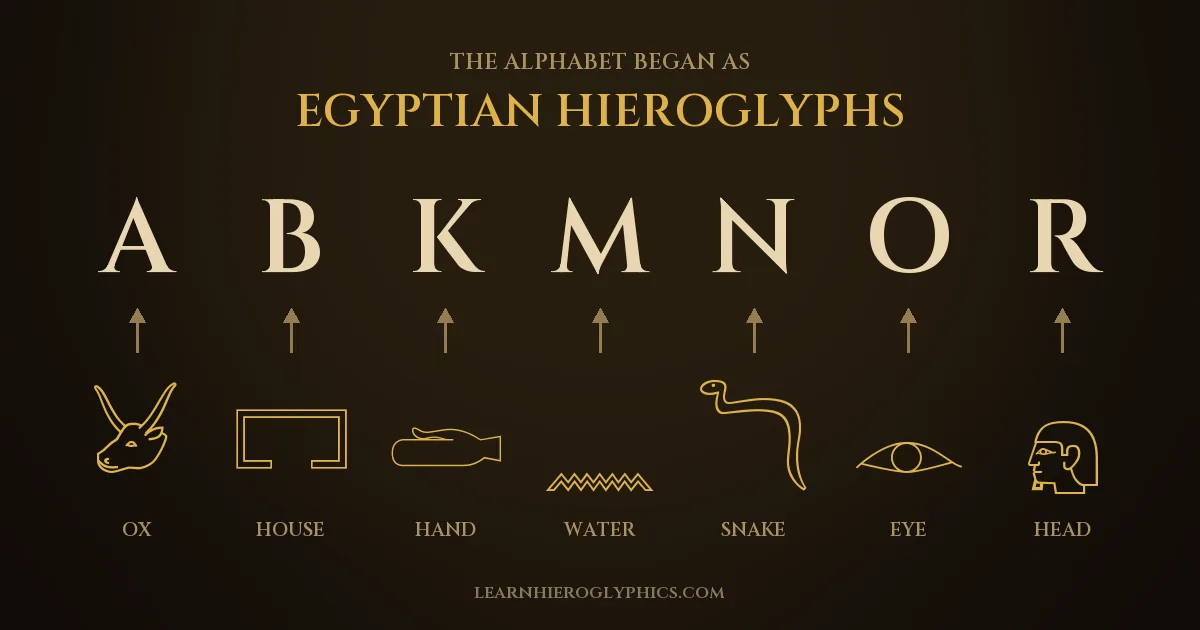
Yes. Our alphabet descends from Egyptian hieroglyphs. Around 1900 to 1800 BC, Semitic-speaking workers in Egypt and Sinai borrowed about two dozen hieroglyphic pictures and used each for the first sound of its name in their own language. That script became Phoenician, then Greek, then Latin. Many capitals still show the picture: A is an ox head 𓃾 turned upside down, M is a ripple of water 𓈖, O is an eye 𓁹, R is a head in profile 𓁶 and K is an open hand 𓂧.
Want to read this for yourself? Start the first lesson: the 25-sign hieroglyphic alphabet in about 25 minutes. Free to start with a Google or email sign-in.
Is the Alphabet Really Descended From Hieroglyphs?
Yes. The letters on this page are the worn-down great-grandchildren of Egyptian hieroglyphs. The line runs hieroglyphs → Proto-Sinaitic → Phoenician → Greek → Latin, and it took about 1,200 years.
One correction to a claim you will often see: people say A is an ox head "with its horns in the air". In the letter as we write it the horns point down. The two legs of A are the horns, so you have to turn the letter over (∀) to see the animal the right way up.
Try it as you read: write your own name in hieroglyphs with the free translator, or start the first lesson free and uncover your name on a sealed door.
Which Letters Still Show Their Hieroglyph?
These twelve are the clearest. The first column is the letter, the second the Egyptian sign it was drawn from.
| Letter | Hieroglyph | The picture | Its Semitic name | How to see it today |
|---|---|---|---|---|
| A | 𓃾 | Ox head | ʾalp, "ox" | Turn A upside down: two horns and a muzzle |
| B | 𓉐 | House (a floor plan) | bayt, "house" | An enclosure, closed up into two rooms |
| E | 𓀠 | Man with raised arms | hē, a shout | Tip E on its back: two arms and a head |
| H | 𓉗 | Courtyard or fence | ḥēt, "fence" | Two posts and one rail |
| K | 𓂧 | Hand | kap, "palm" | Fingers spreading from the palm |
| L | 𓋿 | Herdsman's crook | lamd, "goad" | A stick with a bend |
| M | 𓈖 | Ripple of water | mēm, "water" | The zigzag, with fewer waves |
| N | 𓆓 | Cobra | naḥš, "snake" | One bend of the snake's body |
| O | 𓁹 | Eye | ʿayn, "eye" | The outline of the eye, pupil gone |
| R | 𓁶 | Head in profile | raʾš, "head" | The loop is the head, the upright the neck |
| T | 𓏴 | Crossed strokes | taw, "mark" | A cross, hardly changed in 4,000 years |
| Y | 𓌉 | Mace | waw, "hook" | A head on a shaft |
The mace was the most productive sign of all: through Greek it also gave us F, U, V and W. In the same way J split off from I, which began as a forearm and hand 𓂝 (yad), and G was made by the Romans from C.
The disputed ones
Not every letter has an agreed picture, and an honest list says so:
- •D (dalet): a door 𓉿, or possibly a fish.
- •P (pe): the name means "mouth", but the early shape may be a corner.
- •S (shin): the name means "tooth", but the sign looks more like a bow. It was shaped like our W until the Greeks turned it on its side as Σ.
- •Q (qoph): a monkey with its tail hanging down, or a knotted cord. Either way, the tail is still there.
Why Is A an Ox and M Water?
Because of one clever trick, called acrophony: a picture stands for the first sound of its name.
The inventors did not read Egyptian. They looked at a hieroglyph, named it in their own Semitic language, and kept only the first sound of that name:
- •The Egyptian sign 𓈖 is a ripple of water.
- •Their word for water was mēm.
- •So the ripple meant the sound m.
That is why the letter names of Hebrew, Arabic and Greek are still the old picture words: aleph (ox), bet (house), mem (water), ayin (eye), resh (head). Alpha and beta, "ox" and "house", gave us the word alphabet.
It also explains something that surprises people who learn hieroglyphs: the sounds do not match Egyptian. To an Egyptian scribe 𓈖 was n, the hand 𓂧 was d, the cobra 𓆓 was dj, the eye 𓁹 wrote ir and the house 𓉐 wrote pr. The borrowers took the shapes and ignored the Egyptian readings.
How Hieroglyphs Became the Alphabet: A Timeline
- •About 1900 to 1800 BC, Sinai and Egypt. Semitic-speaking miners, soldiers and caravan workers employed by the Egyptians scratch the first alphabetic inscriptions. Each of about two dozen pictures stands for one consonant.
- •By about 1050 BC, Phoenicia. The pictures have been simplified into 22 abstract consonant signs, written right to left. The ox head is now lying on its side.
- •About 800 BC, Greece. The Greeks borrow the Phoenician letters and turn consonants they have no use for into vowels: aleph becomes alpha, he becomes epsilon, ayin becomes omicron. As Greek settles on writing left to right, letters flip and rotate, which is how the ox ended up standing on its horns.
- •About 700 to 600 BC, Italy. The Etruscans take the alphabet from Greek colonists and pass it to the Romans. Latin keeps most of the shapes and adds the leg on R to tell it from P.
- •Late ninth century AD, Bulgaria. Followers of the missionaries Cyril and Methodius adapt Greek capitals for the Slavic languages and add letters for sounds Greek lacked, such as ш and ж. That is Cyrillic. (Cyril himself most likely devised a different script, Glagolitic.)
Where Was the First Alphabet Found?
Serabit el-Khadim is a plateau in south-west Sinai where the Egyptians mined turquoise and built a temple to Hathor, "Lady of Turquoise". In the winter of 1904 to 1905 the archaeologist Flinders Petrie found short inscriptions there in signs that looked like hieroglyphs but could not be read as Egyptian. There were too few different signs for a script like Egyptian, which meant they had to be an alphabet.
In 1916 the Egyptologist Alan Gardiner read the first word. A small sandstone sphinx from the temple, now in the British Museum, carries a group of signs he read as baʿalat, "the Lady", the Semitic title of Hathor. House, eye, crook, cross: b, ʿ, l, t.
In the 1990s John and Deborah Darnell found two more inscriptions of the same kind at Wadi el-Hol, on an ancient desert road west of Thebes. They showed that the alphabet was in use in Egypt itself, and most scholars now date its invention to the Middle Kingdom, about 1900 to 1800 BC.
Did the Egyptians Have an Alphabet of Their Own?
Almost. Egyptian hieroglyphs include about 25 single-consonant signs, often called the hieroglyphic alphabet: the owl 𓅓 for m, the mouth 𓂋 for r, the water ripple 𓈖 for n. A scribe could have written anything with those alone.
They never did. For 3,000 years Egyptians kept the full system of several hundred signs, mixing sound signs with word signs and silent picture signs. The breakthrough of the Sinai workers was not a new kind of sign. It was leaving everything else out.
Egypt met its own invention again much later. Coptic, the last stage of the Egyptian language, is written in the Greek alphabet plus six or seven letters taken from Demotic, the everyday script descended from hieroglyphs. So Egyptian signs entered the alphabet twice. Our guide to hieroglyphs, hieratic and Demotic follows that side of the story.
Your Turn
You have been writing with Egyptian pictures your whole life. Reading the originals is a smaller step than it sounds.
- •See your name in the original signs. The free name translator writes it in hieroglyphs and shows which of your letters began as one.
- •Learn the 25 Egyptian sound signs. The hieroglyphic alphabet chart has every one, with its sound and what it draws.
- •Read real words. The first lesson starts free with your name on a sealed door, then teaches the alphabet through real Egyptian words, starting with 𓂋𓈖 rn, "name": the mouth, and the ripple that became our M.
- •Compare the other great script. Cuneiform and hieroglyphs were invented within a few centuries of each other, and only one of them has descendants on your keyboard.
Frequently Asked Questions
Related Articles
Hieroglyphs vs. Hieratic vs. Demotic: Egypt's Three Scripts
Hieroglyphs, hieratic and demotic compared: what each Egyptian script was, when and by whom it was used, and why one language needed three ways of writing.
Cuneiform vs. Hieroglyphs: The World's Two Oldest Scripts
Cuneiform and Egyptian hieroglyphs were invented within a century or two of each other. Which came first, how differently they work, and the moments the two scripts met.
How the Rosetta Stone Was Deciphered and Why It Mattered
What the Rosetta Stone is, what its 196 BCE decree says, how Young and Champollion used its Greek text to decipher hieroglyphs in 1822, and why it mattered.
Ready to read hieroglyphics yourself?
Your first lesson starts with your own name: brush the sand off a sealed door and read it in hieroglyphs, then learn the rest of the alphabet through real Egyptian words.
Start Lesson 1 FreeNo sign-up to start, no payment. Lifetime access to all eight lessons is one payment later, if you want it.
The Store
Their name in hieroglyphs, to keep
Prints for the wall, framed names, pictures by email and the course as a gift. Postage included, 14-day guarantee.
Visit the Store