Cuneiform vs. Hieroglyphs: The World's Two Oldest Scripts
Cuneiform and Egyptian hieroglyphs were invented within a century or two of each other. Which came first, how differently they work, and the moments the two scripts met.
Quick answer
Cuneiform and Egyptian hieroglyphs are the two oldest writing systems we know, and they appeared at almost the same time: cuneiform in Sumer (southern Iraq) around 3400–3200 BCE, hieroglyphs in Egypt around 3250 BCE. Neither is clearly first. Cuneiform is wedges pressed into clay, with signs for syllables; hieroglyphs are pictures carved or painted, with signs for consonants. Both also use word signs and silent classifiers.
Want to read this for yourself? Start the first lesson: the 25-sign hieroglyphic alphabet in about 25 minutes. Free to start with a Google or email sign-in.
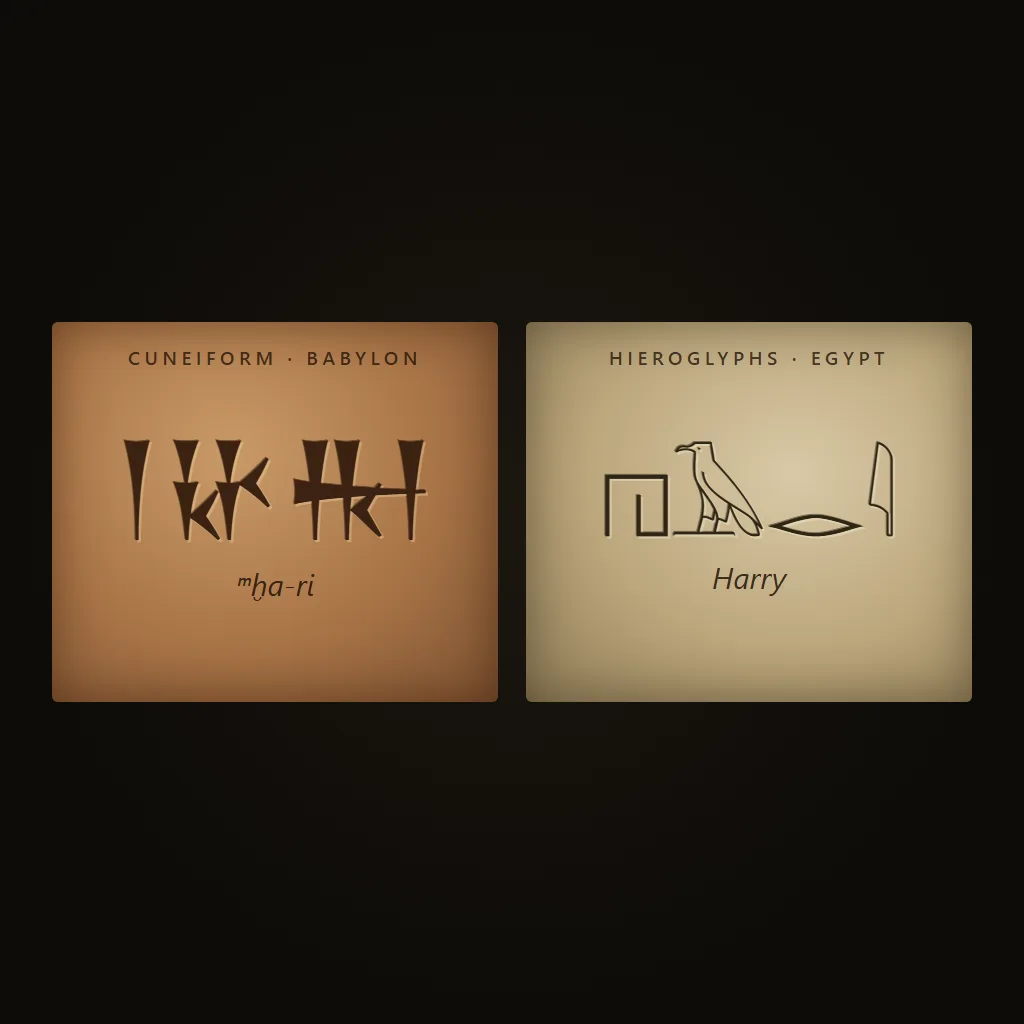
Cuneiform vs. Hieroglyphs at a Glance
Cuneiform and hieroglyphs are the world's two oldest scripts, born a century or two apart, about 1,500 kilometres from each other, and built on the same three kinds of sign. What separates them is the clay, the wedge and, above all, the vowels.
| Cuneiform | Egyptian hieroglyphs | |
|---|---|---|
| First written | c. 3400–3200 BCE, Uruk (Iraq) | c. 3250 BCE, Abydos (Egypt) |
| Looks like | Wedge-shaped marks | Pictures: birds, people, reeds |
| Written on | Clay, pressed with a reed | Stone, wood, papyrus |
| Sound signs stand for | Syllables, vowels included | Consonants only |
| Signs in use | About 600 | About 700 (Middle Egyptian) |
| Languages | Sumerian, Akkadian, Hittite and more | Egyptian only |
| Direction | Left to right | Usually right to left |
| Last used | c. 75 CE | 394 CE |
| Deciphered | 1850s (Behistun inscription) | 1822 (Rosetta Stone) |
You can see the difference on your own name: the cuneiform name converter writes it in Babylonian syllables, and the name translator writes it in Egyptian hieroglyphs in a cartouche.
Try it as you read: write your own name in hieroglyphs with the free translator, or start the first lesson free and uncover your name on a sealed door.
Which Came First, Cuneiform or Hieroglyphs?
Neither, clearly. The oldest cuneiform tablets come from the temple district of Eanna at Uruk, a city of perhaps 40,000 people in what is now southern Iraq, and are dated to about 3400–3200 BCE. They are lists: sheep, grain, beer rations, workers, written in signs that are still mostly pictures.
In Egypt, German excavators working at Abydos in 1988 found more than 150 small bone and ivory labels in tomb U-j, once tied to goods buried with an early ruler. Their signs are already hieroglyphs, some of them sound signs spelling place names, and the tomb is dated to about 3250 BCE.
The two date ranges overlap. Anyone who tells you confidently which script is older is going further than the evidence. What is certain is that writing was invented in Mesopotamia and Egypt first, and later, quite separately, in China and in Mesoamerica.
Did Egypt Borrow the Idea of Writing?
It is possible but unproven. Late Predynastic Egypt was in touch with Mesopotamia: Mesopotamian-style cylinder seals, a hero taming two lions on the ivory handle of the Gebel el-Arak knife, and niched brick walls all appear in Egypt around this time. So some scholars think Egyptians heard that the Sumerians wrote, and invented their own way of doing it, which is called stimulus diffusion.
Against that, nothing in the Egyptian system looks borrowed. The signs are Egyptian things (the Nile's reeds, Egyptian birds and tools), the materials are different, and the rules are different: hieroglyphs spell with consonants, cuneiform with syllables. Since the Abydos labels pushed Egyptian writing back to about the same date as Uruk, most Egyptologists see two independent inventions.
How Do the Two Scripts Work?
Both mix three kinds of sign, and that shared design is the most striking thing about them.
Word signs (logograms). A single sign writes a whole word. In Egyptian the flag on a pole 𓊹 is nṯr, "god". In Sumerian the star 𒀭 is dingir, "god", and in Akkadian it reads ilum.
Sound signs (phonograms). Signs used for their sound alone, to spell. Here the scripts part ways. Egyptian sound signs write consonants and ignore vowels: there are 25 signs for single consonants and more for pairs and triples. Cuneiform sound signs write syllables with their vowels, such as ba, ri or ak, and there are no signs for a consonant alone. So Egyptian nfr, "good", gives you no vowels at all, while a Babylonian spelling like ḫa-am-mu-ra-bi gives you every one.
Silent classifiers (determinatives). Signs that are not read but tell you what kind of word you are looking at. Egyptian puts them after the word: a man's name ends with a seated man 𓀀, a word for walking with a pair of legs. Cuneiform usually puts them before: the star 𒀭 before a god's name, a single upright wedge 𒁹 before a man's name, the sign for "wood" before anything wooden, and the sign for "place" 𒆠 after a city.
Pictures that stayed pictures. Cuneiform signs began as drawings scratched in clay, but pressing a reed into clay makes wedges, not curves, and within a few centuries the pictures became abstract groups of wedges. Hieroglyphs on monuments stayed recognisable pictures for 3,500 years; Egyptian scribes got their speed from a separate pen script, hieratic, instead.
Why Did Cuneiform Spread and Hieroglyphs Not?
Because cuneiform was written by many peoples and hieroglyphs by one. Cuneiform was made for Sumerian, but the Akkadians who lived alongside the Sumerians adapted it to their own language, and from Akkadian it spread to the Hittites in Anatolia, the Elamites in Iran, the Hurrians and Urartians, and to every royal chancery of the Near East. A syllable script carries over to a new language more easily than one that writes only consonants and leans on the reader to know the words.
Hieroglyphs, by contrast, were bound to Egyptian and to Egyptian temples and tombs. Their great descendant is indirect: workers in Sinai borrowed a handful of Egyptian signs to write their own Semitic language around 1800 BCE, and that experiment became the ancestor of the alphabet you are reading now.
Where Did Cuneiform and Hieroglyphs Meet?
At the courts of the pharaohs. In 1887 a local woman digging at Amarna, Akhenaten's short-lived capital, found clay tablets that turned out to be the Egyptian foreign office's archive: about 380 cuneiform letters from around 1360 to 1330 BCE. Kings of Babylon, Assyria, Mitanni and the Hittites write to the pharaoh as "my brother", haggle over gold and marriages, and complain about slow messengers, while the rulers of Canaanite cities beg for troops. All of it is in Akkadian, the diplomatic language of the age, and Egyptian scribes learned it: copies of Babylonian myths used for practice were found among the letters.
A century later, around 1259 BCE, Ramesses II and the Hittite king Hattusili III made peace after decades of war that included the battle of Kadesh. Both versions survive: the Hittite copy in Akkadian cuneiform on clay tablets from the Hittite capital, Hattusa, and the Egyptian version in hieroglyphs on the walls of Karnak and the Ramesseum. It is the oldest peace treaty we can read from both sides.
How Were Cuneiform and Hieroglyphs Deciphered?
Both died out, and both were read again through inscriptions that repeated a text in several scripts. The last cuneiform tablets, astronomical records from Babylonia, date to around 75 CE; the last hieroglyphic inscription was carved at Philae in 394 CE.
For hieroglyphs the key was the Rosetta Stone, with Greek alongside two Egyptian scripts, and Champollion announced the breakthrough in 1822. For cuneiform it was a cliff face: the inscription of the Persian king Darius I at Behistun in western Iran, carved around 520 BCE in Old Persian, Elamite and Babylonian. Henry Rawlinson copied it, sometimes hanging from ropes, and Old Persian, the simplest of the three, gave the way into the others.
Babylonian proved so complicated, one sign with many readings, that many doubted it had really been read. So in 1857 the Royal Asiatic Society sent a newly found inscription of the Assyrian king Tiglath-Pileser I to four scholars, Rawlinson, Edward Hincks, William Henry Fox Talbot and Julius Oppert, to translate without consulting one another. Their versions agreed closely, and cuneiform was declared deciphered.
Which Should You Learn First?
For most people, hieroglyphs. The 25 single-consonant signs let you spell names and read short words in your first hour, the signs are pictures you can remember, and museums everywhere are full of them. Cuneiform asks for more up front: you need a hundred or more syllable signs, and the habit of choosing between their readings, before a Babylonian sentence opens up.
If you want to try both, start with your own name: in cuneiform and in hieroglyphs. Then the first lesson, free to start, teaches you the Egyptian alphabet sign by sign, starting with the signs of that name.
Frequently Asked Questions
Related Articles
Hieroglyphs vs. Hieratic vs. Demotic: Egypt's Three Scripts
Hieroglyphs, hieratic and demotic compared: what each Egyptian script was, when and by whom it was used, and why one language needed three ways of writing.
How the Rosetta Stone Was Deciphered and Why It Mattered
What the Rosetta Stone is, what its 196 BCE decree says, how Young and Champollion used its Greek text to decipher hieroglyphs in 1822, and why it mattered.
Is It Hard to Learn Hieroglyphics? An Honest Difficulty Guide
Is it hard to learn hieroglyphics? The alphabet takes a weekend, the sign system takes a few months and the grammar takes a year or more. Here is what is easy, what is hard, and how it compares to Latin, Chinese and Japanese.
Ready to read hieroglyphics yourself?
Your first lesson starts with your own name: brush the sand off a sealed door and read it in hieroglyphs, then learn the rest of the alphabet through real Egyptian words.
Start Lesson 1 FreeNo sign-up to start, no payment. Lifetime access to all eight lessons is one payment later, if you want it.
The Store
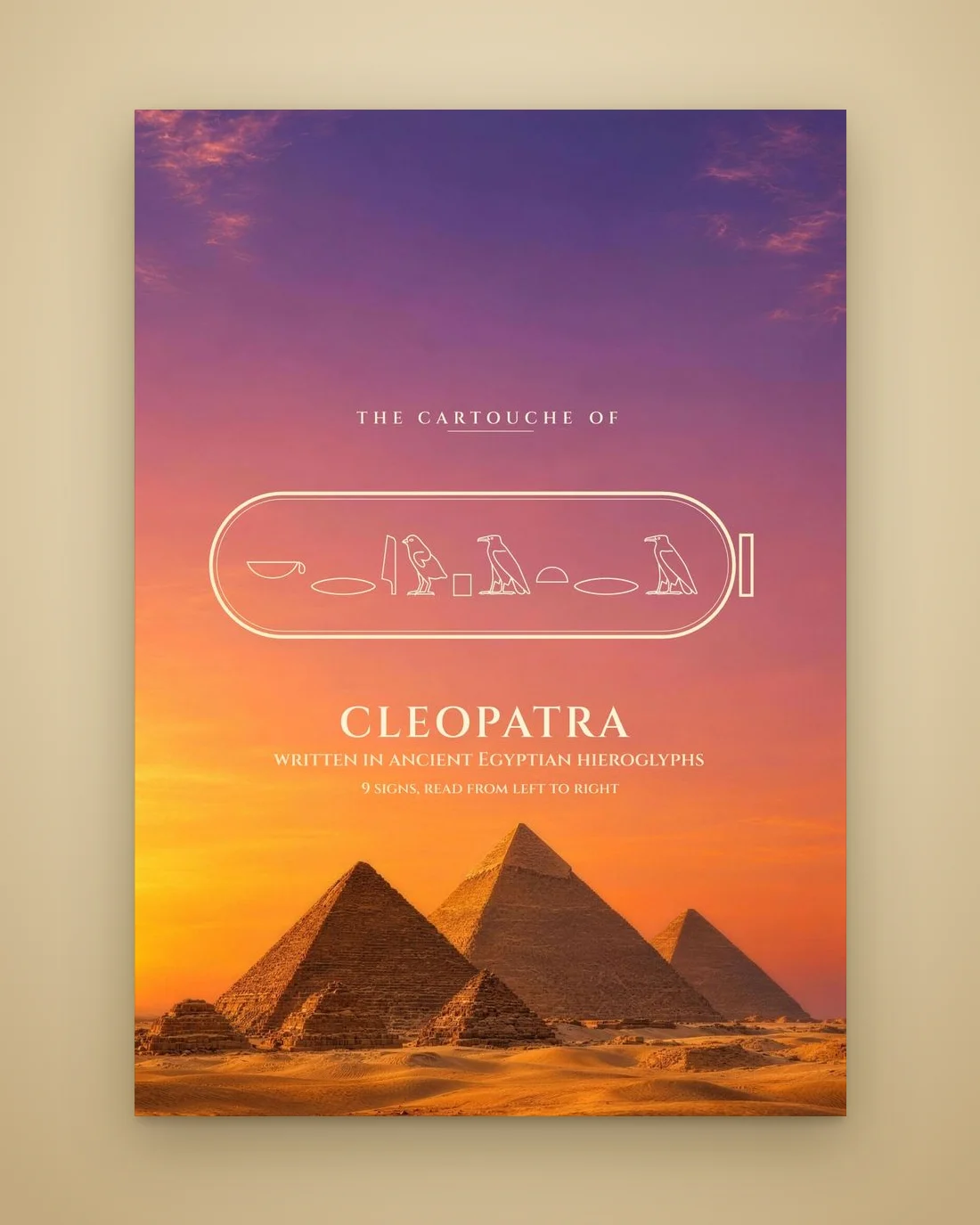
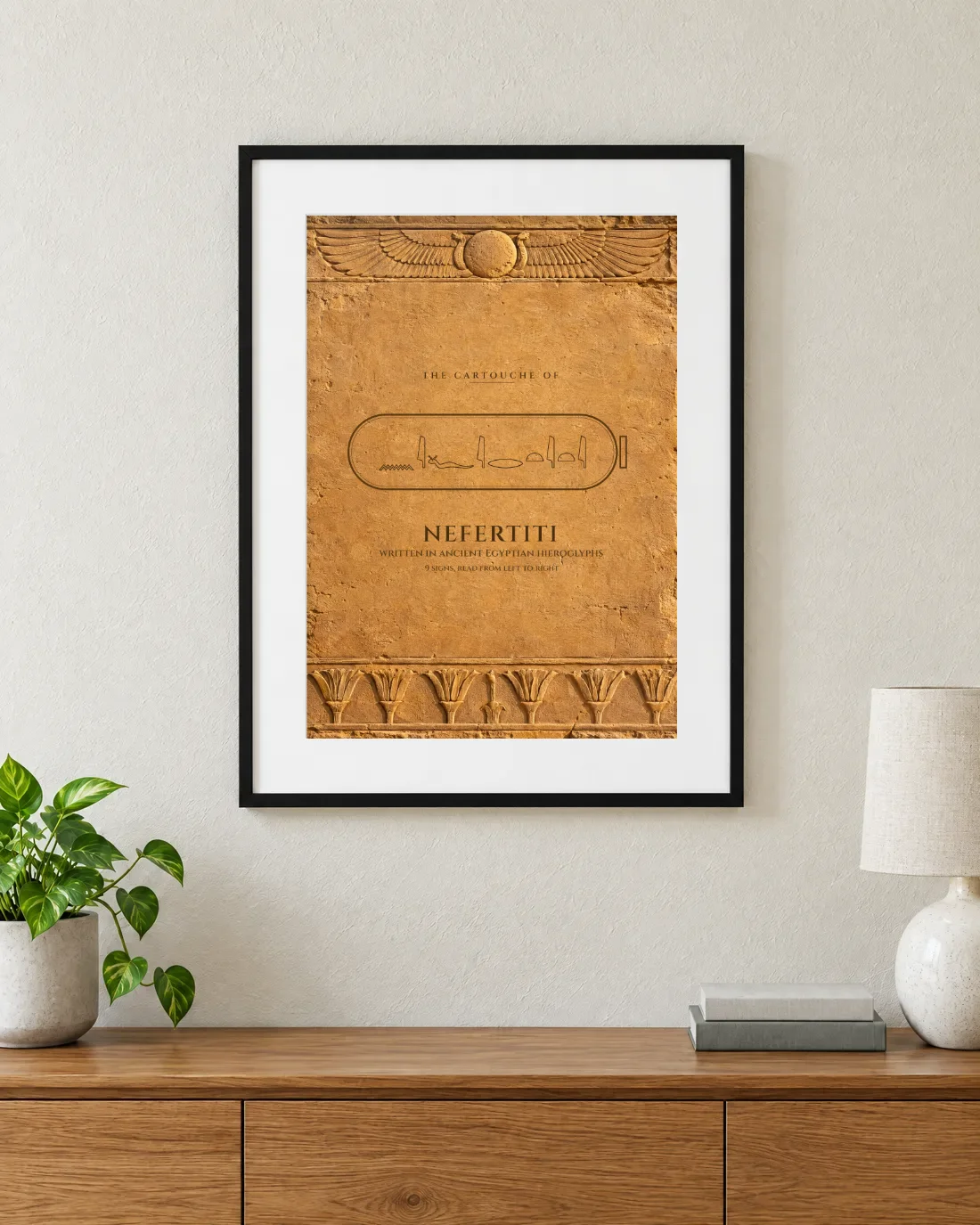
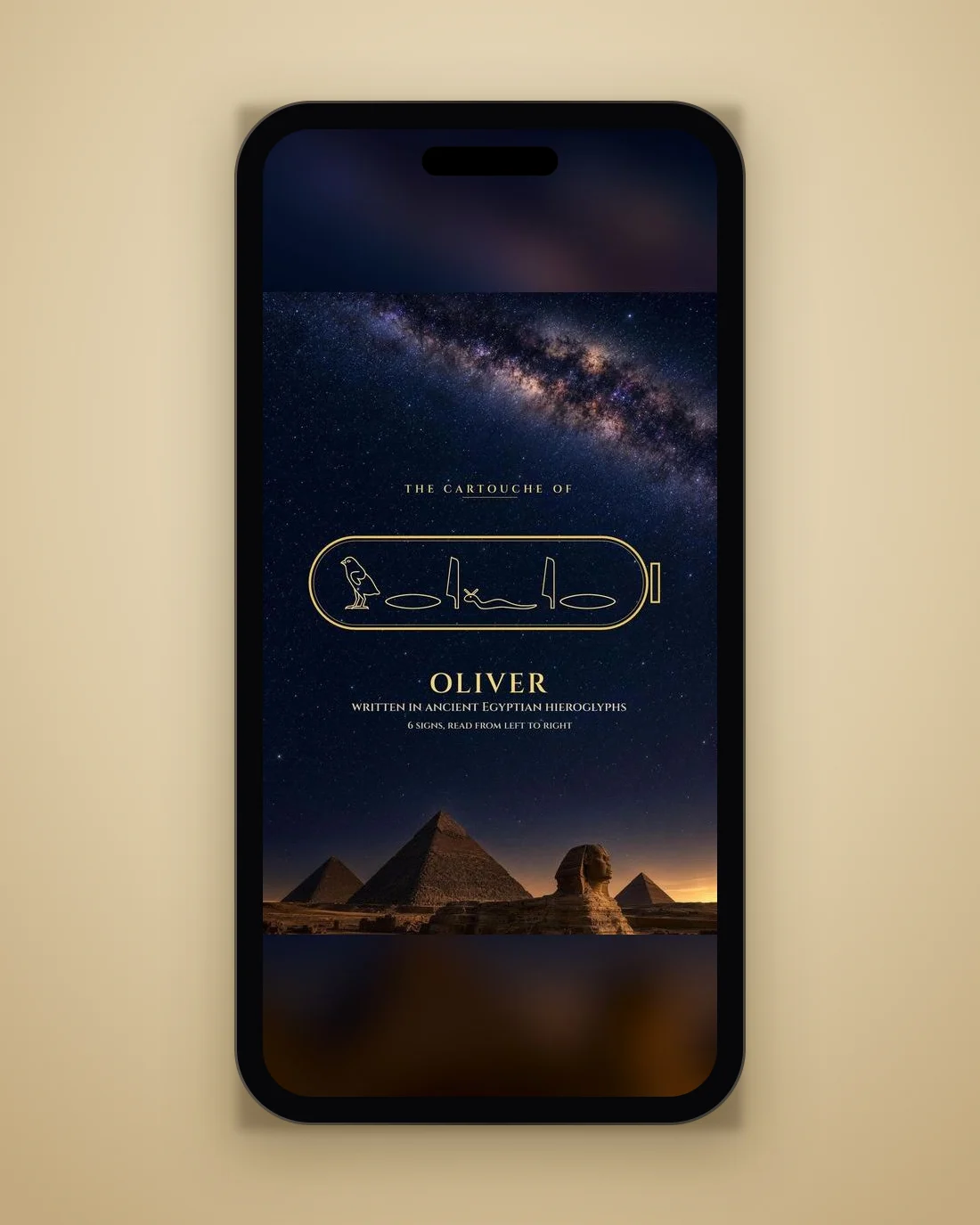
Their name in hieroglyphs, to keep
Prints for the wall, framed names, pictures by email and the course as a gift. Postage included, 14-day guarantee.
Visit the Store