Before your trip
Read the hieroglyphs on your Egypt trip
Most visitors walk past thousands of carved signs as decoration. With three weeks of short practice you can stand in Karnak and read the names of the kings who built it. Here is what to learn, and where you will see it.
Quick answer
Before a trip to Egypt, learn the 25 one-sound signs, how a cartouche works, the two royal titles that come before cartouches (nswt bity, “King of Upper and Lower Egypt”, and sꜣ rꜥ, “Son of Ra”) and a few stock phrases such as 𓋹𓊽𓌀 “life, stability, dominion”. Read towards the faces of the signs. That is enough to read royal names at Karnak, Luxor, Abu Simbel and in the Valley of the Kings, and it takes two to three weeks at 15 minutes a day.
The six phrases carved everywhere
Temple walls repeat the same royal formulas thousands of times. Learn these and whole bands of text suddenly make sense.
- ꜥnḫ ḏd wꜣs: life, stability, dominionCarved in rows along the bottom of temple walls and on columns. Gods hold the ankh and the was-sceptre out to the king.
- di ꜥnḫ: given lifeStraight after a king's name: "…given life, like Ra, for ever". Once you know it you will see it everywhere.
- nswt bity: King of Upper and Lower Egypt (the sedge and the bee)Just before the first cartouche, the king's throne name.
- sꜣ rꜥ: Son of Ra (a duck and the sun)Just before the second cartouche, the king's birth name. Two cartouches side by side are one king, not two.
- nb tꜣwy: Lord of the Two LandsAnother royal title, often above or before a cartouche.
- ḥtp di nswt: an offering which the king givesThe first words of the offering formula on tomb walls, false doors and stelae, followed by the god's name and the food, drink and linen asked for the dead.
One trap: gods' and kings' names jump to the front out of respect. The offering formula starts with the sign for “king” even though it is read later, and “beloved of Amun” is written 𓇋𓏠𓈖𓌸, Amun first.
How to read a cartouche on a temple wall
- Find the faces. Birds, people and animals face the start of the line. Read towards them, top to bottom inside a vertical cartouche.
- Look for a pair. Most kings have two cartouches: the throne name after 𓇓𓏏𓆤𓏏 and the birth name after 𓅭𓇳.
- Spot the sun. The disc 𓇳 (Ra) sits at the top of many throne names, such as Menkheperre 𓇳𓏠𓆣 (Thutmose III), but it is read last.
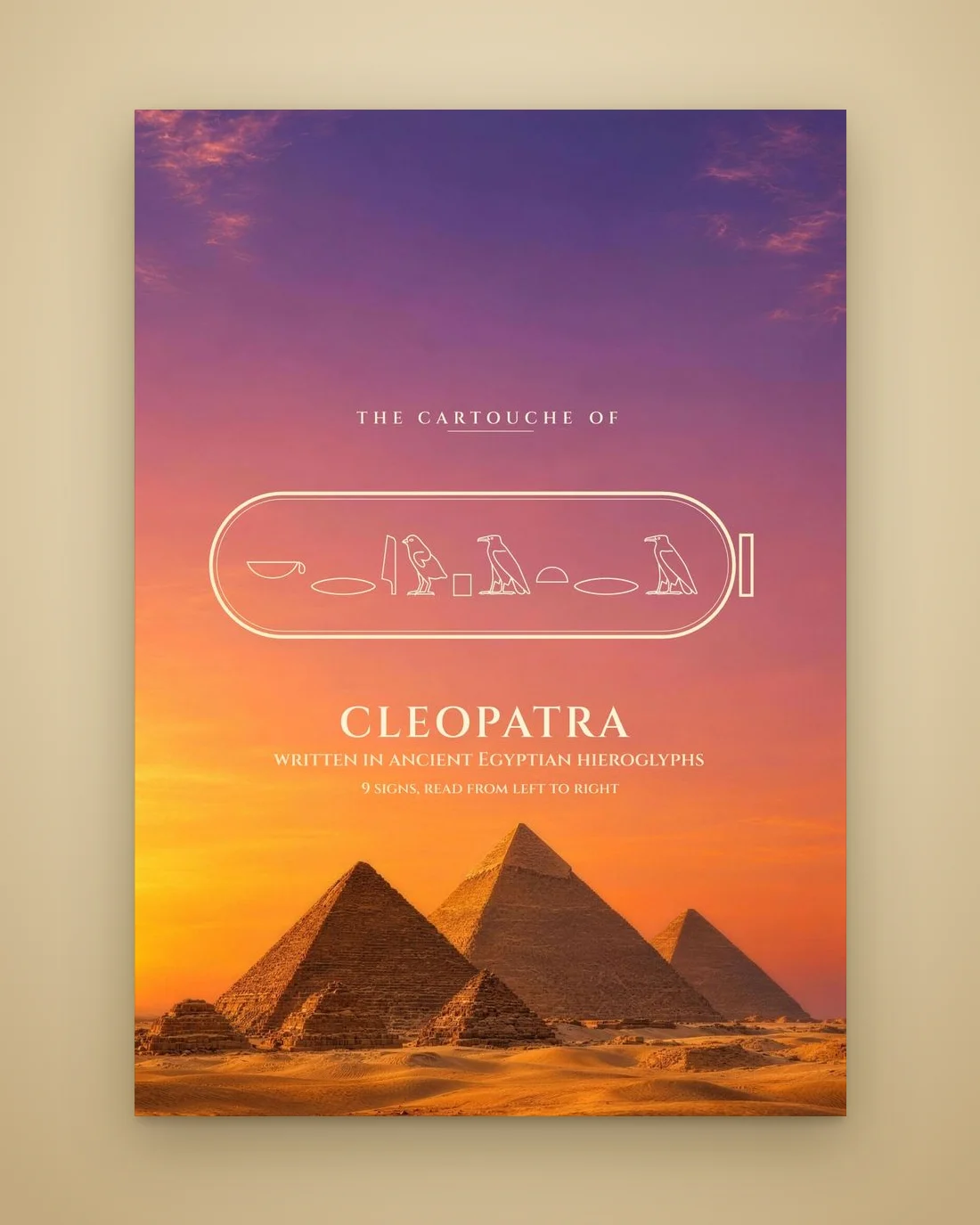
- Sound out the rest. The one-sound signs spell the remaining syllables. A step-by-step cartouche guide and worked examples for Tutankhamun and Cleopatra will get you started.
What to look for, site by site
Karnak
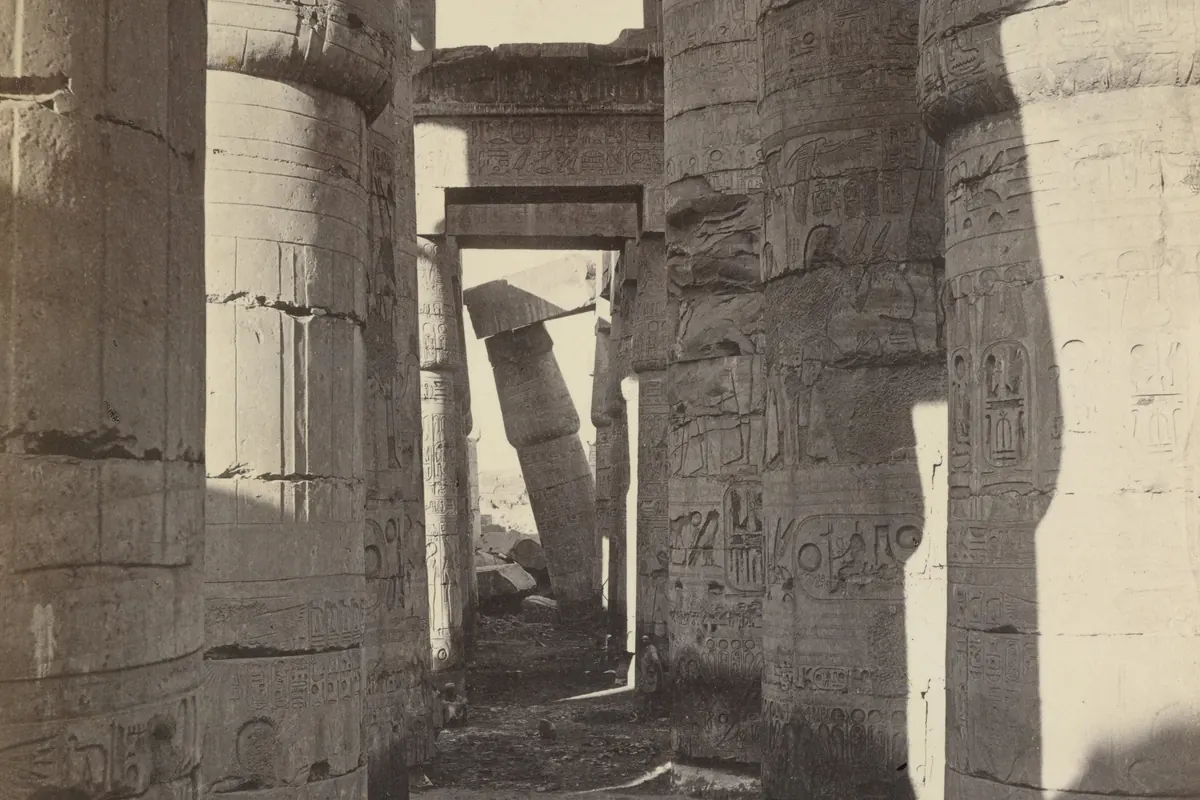
The Great Hypostyle Hall's 134 columns are covered in the cartouches of Seti I and his son Ramesses II. Look for the two-cartouche pattern above, then for Thutmose III's throne name, Menkheperre 𓇳𓏠𓆣, one of the most-carved royal names in Egypt. Hatshepsut's standing obelisk is here too.
Luxor Temple
Built mainly by Amenhotep III and Ramesses II. Ramesses' cartouches cover the entrance pylon, beside the single obelisk still standing; its twin has been in the Place de la Concorde in Paris since the 1830s.
Valley of the Kings
Painted tomb walls, mostly in columns read from the direction the figures face, with long religious books such as the Amduat and the Book of Gates. You won't read whole passages, but the king's two cartouches, the gods' names and di ꜥnḫ appear again and again.
Deir el-Bahari
Hatshepsut's terraced temple. Many of her names and figures were cut out after her death, so look for the chiselled gaps where a cartouche used to be; spotting them is one of the most striking things you can do on a visit.
Abu Simbel
Ramesses II's great temple. His cartouches are carved on the colossal statues themselves, and inside, the Battle of Kadesh reliefs come with captions you can start to pick apart.
Edfu, Dendera and Philae
Late temples from the Ptolemaic and Roman periods, the best preserved in Egypt. Their texts use hundreds of extra signs and are hard even for students, but the cartouches (Ptolemy, Cleopatra and even Roman emperors) read the same way. Philae holds the last known hieroglyphic inscription, dated AD 394.
Giza and Saqqara
The Giza pyramids are almost bare of inscriptions inside, but the tombs of officials around them have offering formulas. At Saqqara, the burial chamber of the pyramid of Unas carries the oldest known Pyramid Texts, spells carved for the king around 2350 BC.
The museums in Cairo and Giza
Stelae, coffins and statues at eye level, with labels to check yourself against: the best place to practise. The Grand Egyptian Museum at Giza now holds Tutankhamun's treasures; the Egyptian Museum on Tahrir Square is still worth a morning.
Tip: photograph every cartouche you find, close up and straight on. Decoding them in the hotel in the evening is half the fun, and early or late light brings out carved relief best.
A three-week plan before you fly
Week 1
The 25 sound signs
The "alphabet" scribes used to spell names and foreign words. Learn them by spelling your own name and the names of the kings you will see. Ten to fifteen minutes a day is enough.
Week 2
Cartouches and royal titles
The two-cartouche pattern, nswt bity and sꜣ rꜥ, and the throne names of Ramesses II, Seti I, Thutmose III, Hatshepsut and Tutankhamun, the kings whose names cover the big sites.
Week 3
Gods' names and the stock phrases
Amun, Ra, Osiris, Horus, Isis and Hathor, the six phrases above, and the habit of reading towards the faces of the signs. Then practise on photos of the walls you are going to see.
Our course follows the same order: the alphabet first, then animal and plant signs, the signs that carry meaning, pharaohs' names, and real temple and tomb texts. Short lessons work on a phone, so you can keep going on the plane. Not sure how much work it is? Read how hard hieroglyphics really are.
Your first lesson
Start before you pack
Open a sealed temple door by reading your own name on it. By the time you land, the cartouches at Karnak will be names, not decoration.
- 8 short lessons, phone-friendly
- Real temple and tomb texts
- 14-day money-back guarantee
Questions travellers ask
Can I learn to read hieroglyphs before a trip to Egypt?
Yes, enough to read royal names, titles and the most common phrases. Two to three weeks of short daily practice gets most people to the point where they can pick out a king's cartouches, read his names and recognise phrases like "given life" on temple walls. Reading full sentences takes months.
Which hieroglyphs should I learn before visiting Egypt?
The 25 one-sound signs, the cartouche, the two royal titles nswt bity (King of Upper and Lower Egypt) and sꜣ rꜥ (Son of Ra), and a handful of stock phrases: ꜥnḫ ḏd wꜣs (life, stability, dominion), di ꜥnḫ (given life), nb tꜣwy (Lord of the Two Lands) and ḥtp di nswt (the offering formula). These cover a surprising share of what is on temple and tomb walls.
Which direction do you read hieroglyphs on a temple wall?
Towards the faces. People, animals and birds face the start of the line, so if they look left you read from left to right, and if they look right you read from right to left. Columns are read from top to bottom. On doorways the text often runs in both directions from the middle, so it faces the person walking through.
Will my tour guide translate the hieroglyphs?
Good Egyptologist guides will point out names and scenes, but there is rarely time to go sign by sign, and on your own in a tomb or a museum you have no one to ask. Being able to read a cartouche yourself turns a wall of pictures into names of real people.
Are the hieroglyphs at Edfu and Dendera harder to read?
Yes. These temples were decorated under the Ptolemies and Romans, when priests used hundreds of extra signs and playful spellings. Cartouches and titles still work the same way, so you can read the names, but long passages are hard even for specialists.
Bring a piece of it home
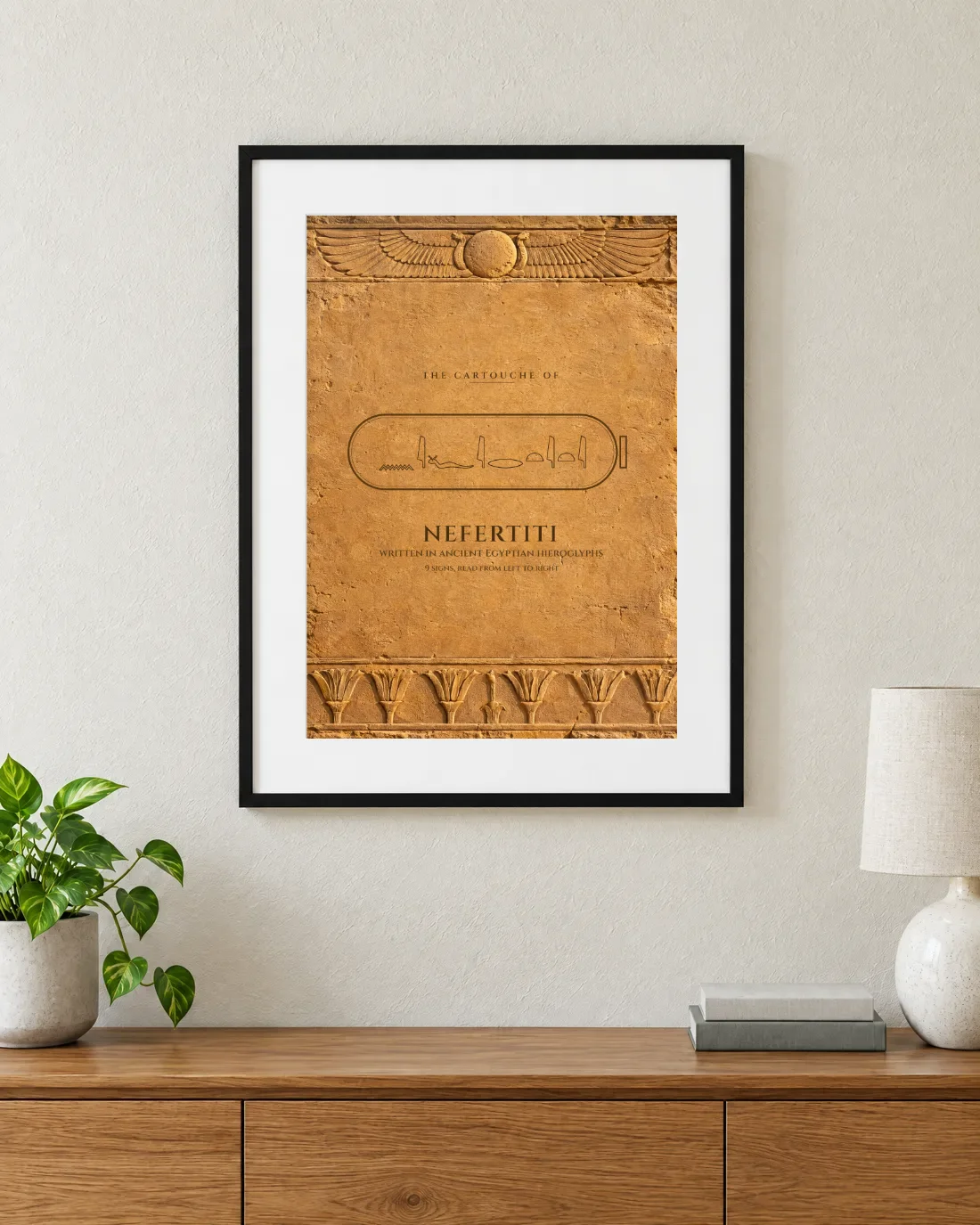
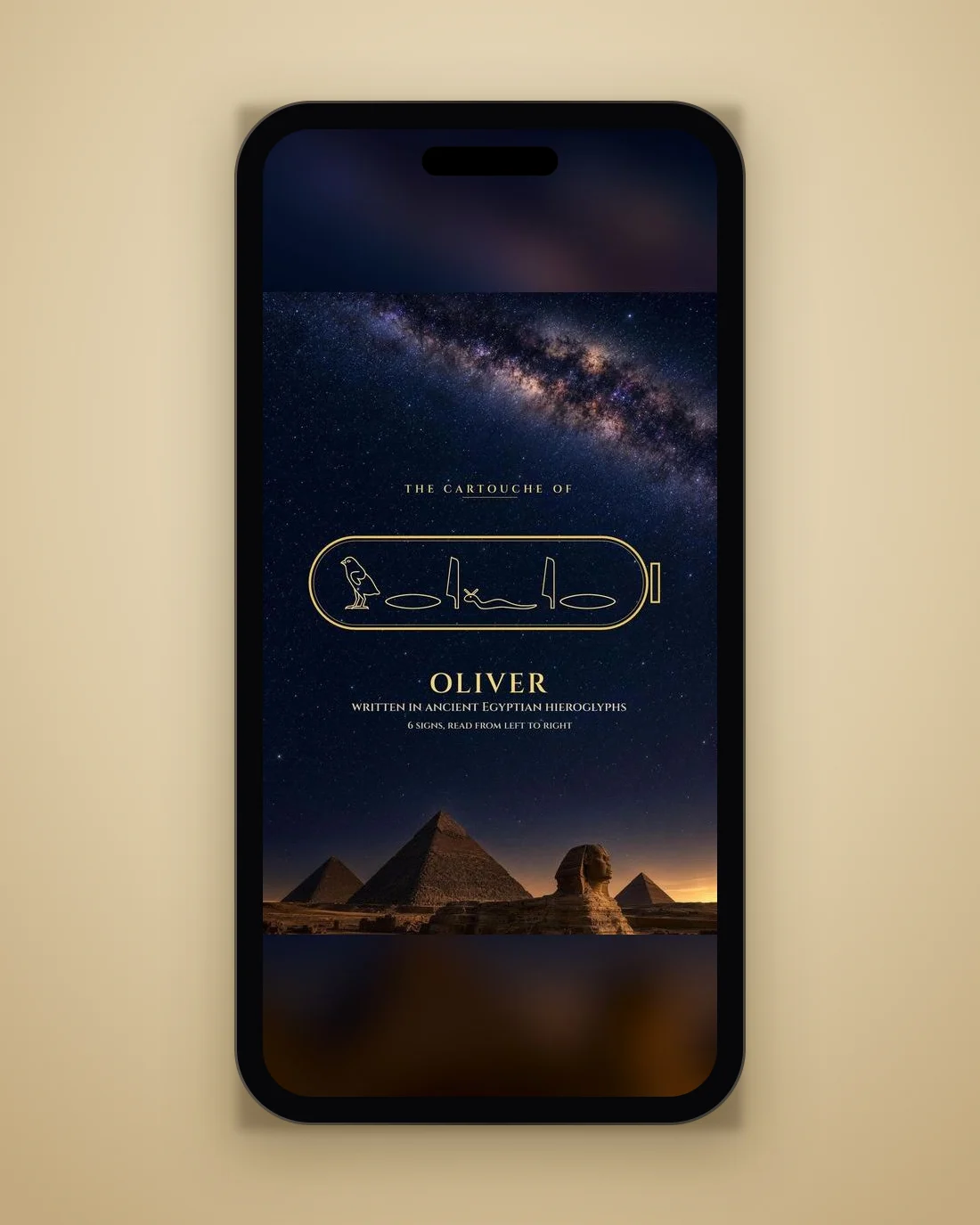
A name in a royal cartouche is the classic Egypt souvenir. You can have one made properly spelled, sign by sign, as a gold cartouche necklace or a fine-art print, or try the spelling first in the name translator.
The Store
Their name in hieroglyphs, to keep
Prints for the wall, framed names, pictures by email and the course as a gift. Postage included, 14-day guarantee.
Visit the Store