4 November 1922: The Day Tutankhamun's Tomb Was Found
On 4 November 1922 a single step cut into the rock of the Valley of the Kings led Howard Carter to the only royal tomb found almost intact. Here is the discovery day by day, and what the seals on its door said.
Quick answer
Tutankhamun's tomb (KV62) was found on 4 November 1922, when Howard Carter's workmen uncovered a step cut into the bedrock of the Valley of the Kings. Carter first looked inside on 26 November 1922, and the burial chamber was officially opened on 16 February 1923. It is the only royal tomb of the New Kingdom found with its treasure largely intact, and Carter knew whose it was before he went in: the king's name was stamped in hieroglyphs on the plaster of the sealed door.
Want to read this for yourself? Start the first lesson: the 25-sign hieroglyphic alphabet in about 25 minutes. Free to start with a Google or email sign-in.
One Step in the Rock
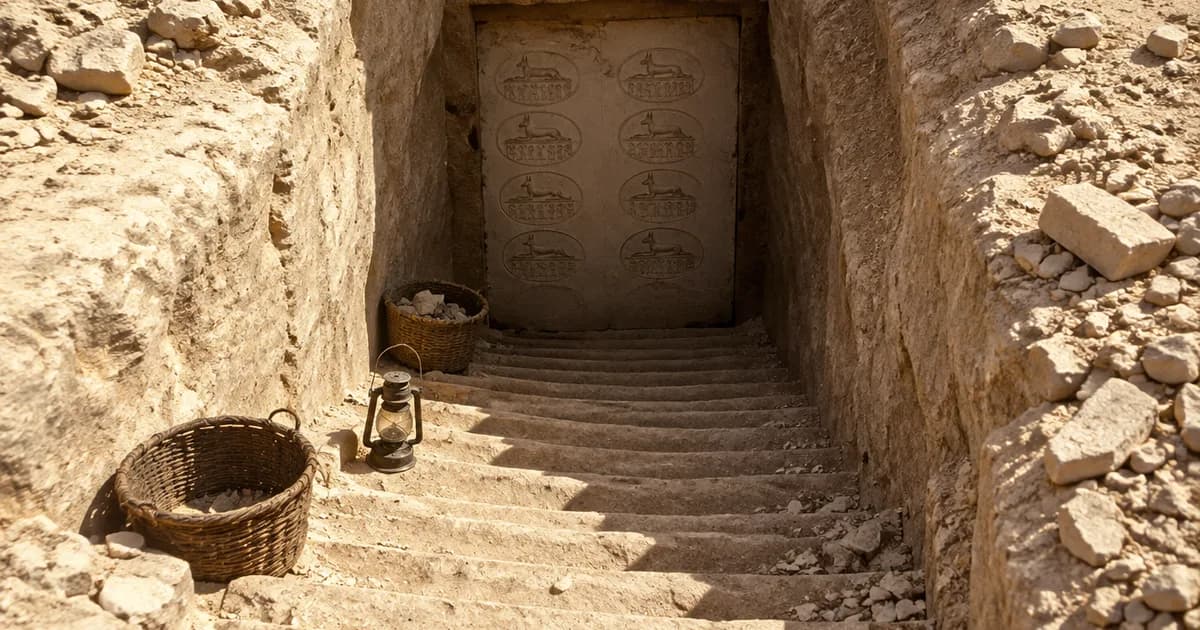
On the morning of 4 November 1922, the men of Howard Carter's team were clearing the stone footings of some ancient workmen's huts below the tomb of Ramesses VI, in the Valley of the Kings. Under the first hut they found a step cut into the bedrock.
It was the last season Carter's patron, Lord Carnarvon, had agreed to pay for. Carter had been searching the valley since 1917 and had found nothing worth the money. Most Egyptologists believed the valley was exhausted: every royal tomb in it had been found, and every one had been robbed in antiquity.
The step led down. By the next evening the workmen had cleared twelve of them and reached the top of a doorway, blocked with stones and sealed with plaster. This year marks 104 years since that first step, and the tomb at the bottom of it is still the most famous archaeological discovery ever made.
Try it as you read: write your own name in hieroglyphs with the free translator, or start the first lesson free and uncover your name on a sealed door.
The Discovery, Day by Day
- •4 November 1922: the first step is found under the huts.
- •5 November: the staircase is cleared to the top of a plastered doorway stamped with seals.
- •6 November: Carter refills the staircase and cables Carnarvon in England: "At last have made wonderful discovery in Valley; a magnificent tomb with seals intact; re-covered same for your arrival; congratulations."
- •23 November: Carnarvon arrives in Luxor with his daughter, Lady Evelyn Herbert.
- •24 November: all sixteen steps are cleared. On the lower part of the door, seals carry the king's name.
- •25 November: the first doorway is taken down. Behind it is a sloping corridor packed with rubble.
- •26 November: at the end of the corridor is a second sealed door. Carter makes a small hole, holds up a candle and looks in. Carnarvon asks if he can see anything. In Carter's published words: "Yes, wonderful things."
- •29 November: the antechamber is officially opened to officials and the press.
- •16 February 1923: the sealed burial chamber is officially opened. Inside is a gilded shrine almost filling the room.
- •5 April 1923: Lord Carnarvon dies in Cairo from an infected mosquito bite, and the legend of the "curse" is born in the newspapers.
- •28 October 1925: the lid of the innermost coffin, of solid gold, is lifted, and the golden mask is seen for the first time in more than 3,200 years.
Clearing the four small rooms took ten years. Carter and his team recorded, photographed and conserved more than 5,000 objects before the last of them left the tomb in 1932.
What the Seals Said
Carter did not need to open the door to know whose tomb he had found. He could read it.
The plaster over the blocked doorway had been stamped, while still wet, with oval seals, over and over. There were two kinds.
The necropolis seal. A jackal lying on a shrine, 𓃣, above nine bound captives. The jackal is Anubis, guardian of the dead and of the cemetery; the nine captives are the "Nine Bows", the traditional enemies of Egypt, held down beneath him. This was the seal of the officials who guarded the royal tombs. It said: this tomb is closed and under protection. It is the same jackal sign that writes the god's name in the offering formula, as on the false door of Neferiu in our Stela Reader.
The king's own seals. Lower on the door were seals with a cartouche, and inside it four signs: 𓇳𓎟𓆣𓏥. The sun disc of Ra, a basket, a scarab beetle and three strokes: nb-ḫprw-rꜥ, Nebkheperure, the throne name of Tutankhamun. Carter knew it at once; the name had turned up on a few small objects found in the valley years before, which is part of why he believed the king's tomb was still there to be found.
Those two seals, the jackal and the cartouche, are the whole story of the tomb in miniature: a king's name, and a promise that the dead would be left alone. The sign-by-sign guide to Tutankhamun's cartouches shows how to read both of his names.
A Tomb That Had Been Robbed, and Saved
The seals told Carter something else, less welcome. In places the plaster had been broken through and patched, and the patches carried only the necropolis seal. Robbers had got in, probably within a few years of the burial, and the guards had tidied up after them and closed the door again.
The robbers were caught or disturbed early, and took mostly small things: metals, oils, linen. Then the entrance disappeared. When Ramesses VI's tomb was cut into the hillside above, about two hundred years later, its workmen built their huts right over Tutankhamun's staircase and buried it under their debris. That is why every other royal tomb in the valley was emptied and this one was not.
Why It Still Matters
Tutankhamun was not an important king. He came to the throne as a boy, ruled for about ten years in the 14th century BCE, and died at around nineteen. His tomb is small and was finished in a hurry.
That is exactly what makes it astonishing. If this is what Egypt buried with a minor king in a small tomb, the burials of Ramesses II or Thutmose III must have been beyond imagining. The tomb gave Egyptology a complete royal burial to study for the first time: the coffins nested inside each other, the shrines, the chariots, the beds, the food, the clothes, the texts painted on the walls and written on the objects.
And almost all of those objects are labelled. The king's two cartouches appear hundreds of times, on the mask, the shrines, the throne and the smallest boxes. Once you can read a cartouche, a visit to the treasures stops being a walk past gold and becomes a conversation with the people who made them.
Read It Like Carter Did
You do not need years of study to read what Carter read on that door. A royal name is spelled with a handful of signs, and most of them come from the same small alphabet.
- •Read his names. Tutankhamun's Cartouche Explained takes both rings apart sign by sign.
- •See your own name in a cartouche. The free name translator spells any name with the alphabet signs Tutankhamun's scribes used.
- •Learn the signs. The first lesson starts free with your own name on a sealed door, fittingly, and teaches all 25 alphabet signs through real Egyptian words.
Frequently Asked Questions
Related Articles
Tutankhamun's Cartouche Explained, Sign by Sign
Tutankhamun had two cartouches: the throne name Nebkheperure and the birth name Tutankhamun. Here is what each sign says, why Amun is written first, and how the boy king's name changed.
Egyptian Cartouches: Meaning, Royal Names and How to Read One
How to read a royal cartouche step by step: find the reading direction, spot honorific transposition, then sound out Tutankhamun, Cleopatra and Ramesses II.
How the Rosetta Stone Was Deciphered and Why It Mattered
What the Rosetta Stone is, what its 196 BCE decree says, how Young and Champollion used its Greek text to decipher hieroglyphs in 1822, and why it mattered.
Ready to read hieroglyphics yourself?
Your first lesson starts with your own name: brush the sand off a sealed door and read it in hieroglyphs, then learn the rest of the alphabet through real Egyptian words.
Start Lesson 1 FreeNo sign-up to start, no payment. Lifetime access to all eight lessons is one payment later, if you want it.
The Store
Their name in hieroglyphs, to keep
Prints for the wall, framed names, pictures by email and the course as a gift. Postage included, 14-day guarantee.
Visit the Store