Cleopatra's Cartouche Explained, Sign by Sign
Cleopatra's name is spelled out sound by sound in eleven hieroglyphs. Here is what each sign is, why it ends with an egg, and how her cartouche helped Champollion crack the code.
Quick answer
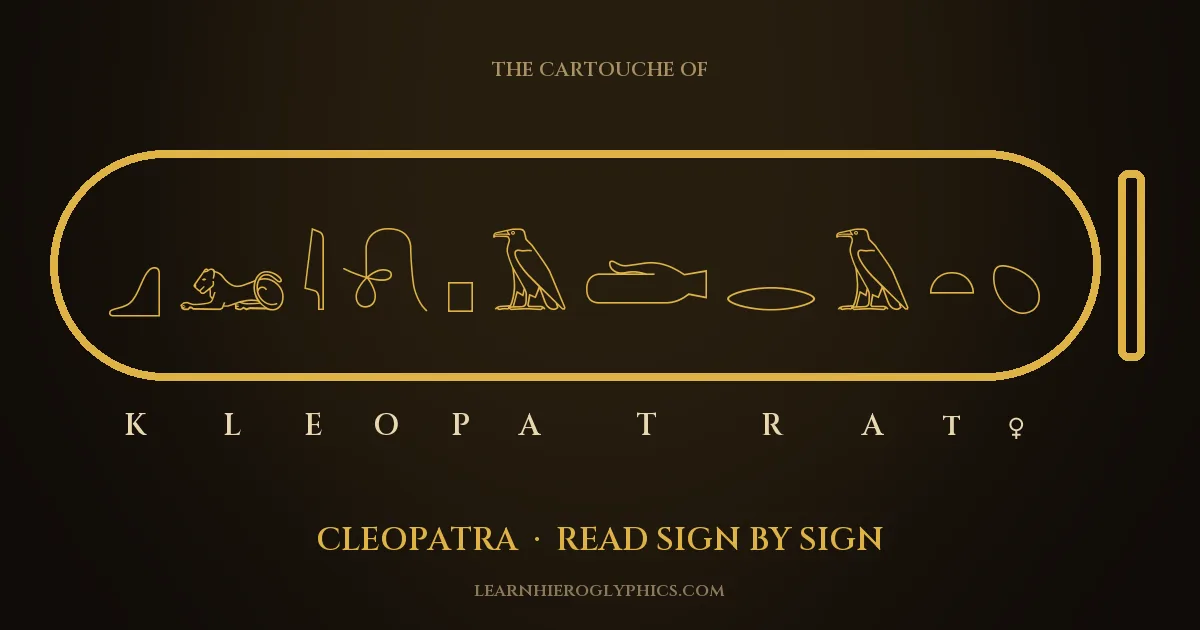
Cleopatra's cartouche spells her Greek name sound by sound: 𓈎𓃭𓇋𓍯𓊪𓄿𓂧𓂋𓄿𓏏𓆇, read q-l-ꞽ-o-p-ꜣ-d-r-ꜣ-t, "Kleopatra". Hill slope q, lion l, reed i, lasso o, stool p, vulture a, hand d (for the Greek t), mouth r and vulture a, then a loaf t and an egg that mark it as a woman's name. Because it shares p, o and l with Ptolemy's cartouche, Champollion used the two together to prove in 1822 that hieroglyphs could spell sounds.
Want to read this for yourself? Start the first lesson: the 25-sign hieroglyphic alphabet in about 25 minutes. Free to start with a Google or email sign-in.
A Greek Name in Egyptian Signs
Cleopatra VII was the last ruler of the Ptolemaic dynasty, a family of Macedonian Greeks who had ruled Egypt since the death of Alexander the Great. She spoke Greek at court, and according to Plutarch she was the first of her family to learn Egyptian. On the walls of Egypt's temples, though, she appears as a pharaoh, and her name sits in a cartouche like any king's.
Egyptian had no ready-made word for "Kleopatra", so the scribes did what they did with every foreign name: they spelled it out sound by sound with the alphabet signs. That makes her cartouche the friendliest royal name in Egypt for a beginner. There is no god's name moved to the front, as in Tutankhamun's, and no picture standing for a whole word. Just eleven signs in a row.
Try it as you read: write your own name in hieroglyphs with the free translator, or start the first lesson free and uncover your name on a sealed door.
The Cartouche, Sign by Sign
𓈎𓃭𓇋𓍯𓊪𓄿𓂧𓂋𓄿𓏏𓆇
Read it from the side the animals face, one sound at a time.
- •𓈎 q, a hill slope. The K of Kleopatra.
- •𓃭 l, a lion lying down. Egyptian had no separate L, and by Ptolemaic times scribes used the lion for the Greek l.
- •𓇋 ꞽ, a reed leaf. Here the E.
- •𓍯 o, a lasso, a loop of rope. The O.
- •𓊪 p, a stool.
- •𓄿 ꜣ, a vulture. The first A.
- •𓂧 d, a hand. Greek t is written with the Egyptian d; this is the sign that taught Champollion one sound could have two spellings (see below).
- •𓂋 r, a mouth.
- •𓄿 ꜣ, the vulture again: the final A.
- •𓏏 t, a loaf of bread, the feminine ending.
- •𓆇 an egg, a determinative. It is not pronounced; it tells you this is a woman's (or goddess's) name.
Sounding it out: Q-L-I-O-P-A-D-R-A + feminine t = Kleopatra, "glory of her father" in Greek.
You will also meet a spelling with the quail chick 𓅱 in place of the lasso for the o (that is the version in our guide to Egyptian cartouches), and some inscriptions add a seated woman 𓁐 after the egg. Scribes varied the spelling of foreign names; all of these read the same.
The Cartouche That Cracked the Code
In 1815 the collector William Bankes came across a small obelisk on the island of Philae, near Aswan. Giovanni Belzoni had it moved for him, and it reached England in 1821; it still stands in the garden of Bankes's house at Kingston Lacy in Dorset. Its base carried a Greek inscription naming a king Ptolemy and a queen Cleopatra, and the shaft carried two cartouches. Bankes guessed one was Cleopatra and pencilled the name in the margin of a copy.
When Champollion saw a printed copy in early 1822, he laid it next to the Ptolemy cartouche from the Rosetta Stone:
| Sound | Ptolemy | Cleopatra |
|---|---|---|
| p | 𓊪 stool, 1st sign | 𓊪 stool, 5th sign |
| o | 𓍯 lasso, 3rd | 𓍯 lasso, 4th |
| l | 𓃭 lion, 4th | 𓃭 lion, 2nd |
| t | 𓏏 loaf | 𓂧 hand |
Three signs sat exactly where the letters should be in both names. The t was the clue that made it convincing rather than lucky: Ptolemy's was a loaf, Cleopatra's a hand, so Egyptian clearly had more than one sign for a similar sound. From there Champollion read Alexander, Berenice and the Roman emperors, and in September 1822 the native names Ramesses and Thutmose, which proved the system was Egyptian, not a Greek-era invention. You can retrace those steps yourself in Decipher, a free five-chapter puzzle.
One footnote: the Philae obelisk names an earlier Cleopatra, a queen of Ptolemy VIII, not the famous Cleopatra VII. The spelling is the same for all of them.
Where to See Her Cartouche
The best place is the Temple of Hathor at Dendera, north of Luxor. On the outside of the back wall, Cleopatra VII and her son Ptolemy XV Caesarion are carved making offerings to the gods, a huge relief with their cartouches beside them. Her name also appears on stelae and statues of her reign in museum collections, and the same spelling is used for the earlier Cleopatras on the Ptolemaic temples of Upper Egypt.
How to Spot It
1. Find the ring. The oval with a bar at one end is the cartouche.
2. Look for the lion near the start. A lion lying down, followed by a reed leaf, is the l and e of Kleopatra.
3. Count two vultures. One in the middle and one near the end, with a hand and a mouth between them.
4. Check the end. A loaf and an egg: a woman's name.
Your Turn
If you can read Cleopatra, you can read Ptolemy, Alexander and Berenice, all spelled the same way, and you know the signs that started the whole decipherment.
- •Write your own. The free name translator spells your name with the same alphabet signs Cleopatra's scribes used, inside a cartouche.
- •Read a harder one. Tutankhamun's cartouche adds a god's name written first and a whole word in one sign.
- •Give one as a gift. A name in a cartouche makes a personal present: see the hieroglyphics gifts.
- •Learn the alphabet properly. The first lesson teaches all 25 signs through real Egyptian words, in three sections of about ten minutes, and it's free to start.
Frequently Asked Questions
Related Articles
Tutankhamun's Cartouche Explained, Sign by Sign
Tutankhamun had two cartouches: the throne name Nebkheperure and the birth name Tutankhamun. Here is what each sign says, why Amun is written first, and how the boy king's name changed.
Egyptian Cartouches: Meaning, Royal Names and How to Read One
How to read a royal cartouche step by step: find the reading direction, spot honorific transposition, then sound out Tutankhamun, Cleopatra and Ramesses II.
How the Rosetta Stone Was Deciphered and Why It Mattered
What the Rosetta Stone is, what its 196 BCE decree says, how Young and Champollion used its Greek text to decipher hieroglyphs in 1822, and why it mattered.
Ready to read hieroglyphics yourself?
Your first lesson starts with your own name: brush the sand off a sealed door and read it in hieroglyphs, then learn the rest of the alphabet through real Egyptian words.
Start Lesson 1 FreeNo sign-up to start, no payment. Lifetime access to all eight lessons is one payment later, if you want it.
The Store
Their name in hieroglyphs, to keep
Prints for the wall, framed names, pictures by email and the course as a gift. Postage included, 14-day guarantee.
Visit the Store