Hieroglyph meaning
𓍷Cartouche meaning: the ring around a royal name
By Harry Harrison · Published
Quick answer
𓍷 is the cartouche, the oval loop of rope that ancient Egyptians drew around the name of a king or queen. Its Egyptian name was šnw (shenu), from the verb šni, "to encircle": it grew out of the round shen ring and stood for the king ruling everything the sun encircles. Cartouches marked the royal names out on every monument, which is how Thomas Young and Champollion found the names that unlocked hieroglyphs.
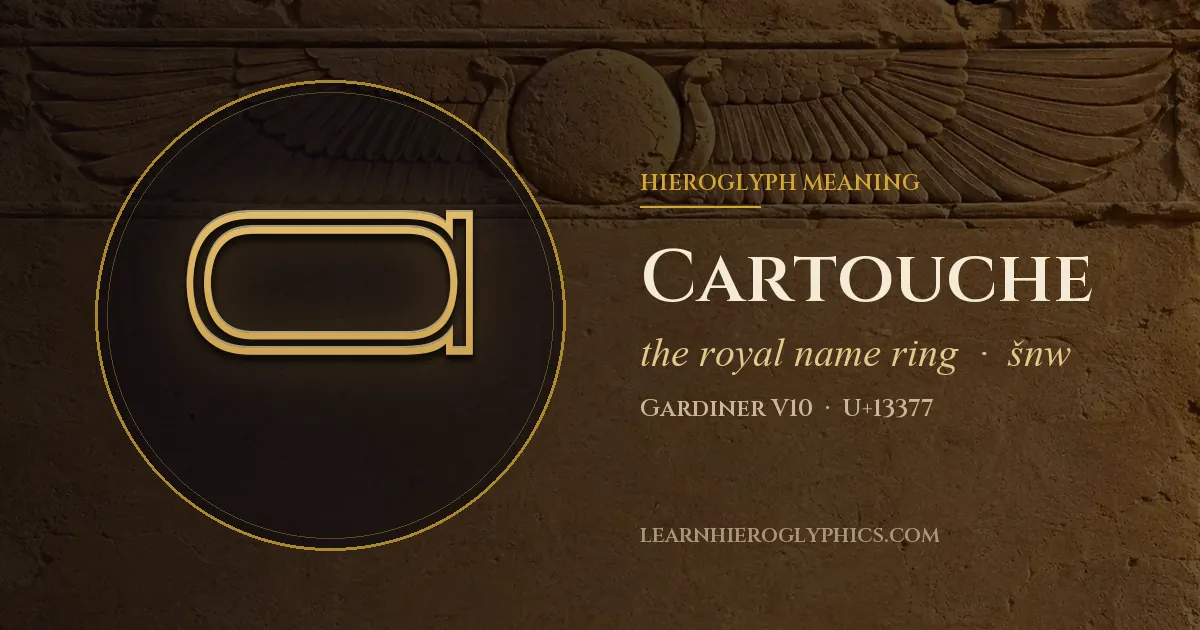
- Unicode
- U+13377 (EGYPTIAN HIEROGLYPH V010)
- Gardiner sign
- V10, cartouche
- Transliteration
- šnw
- Said
- “shenu”
- How it was read
- Not read aloud: the ring encloses a royal name, and on its own the sign can stand for the word šnw, "cartouche", or for "name".
What does 𓍷 depict?
A loop of rope, stretched into a long oval, with its two ends tied together in a knot that shows as the straight bar at one end. It is the round shen ring 𓍶 (Gardiner V9) drawn out long enough to hold a name. In Gardiner's sign list it is V10, in the section for rope, baskets and cloth.
The Egyptians called it šnw (shenu), from šni, "to encircle". The bar marks the end of the name: in a horizontal cartouche it sits on the side the name ends, and in a vertical one it sits at the bottom.
What did the cartouche mean?
Like the shen ring, the cartouche meant encircling and eternity: a loop with no break in it. Around a king's name it said that he ruled all that the sun encircles, and it wrapped the name in protection. A name was part of a person in Egyptian belief, so guarding the name guarded the king.
It first appears around the end of the Third Dynasty and is in regular use from Sneferu, at the start of the Fourth (about 2600 BCE). From the Middle Kingdom on, every king had two names in cartouches out of his five: the throne name, after the title nswt-bꞽtꞽ "King of Upper and Lower Egypt", and the birth name, after sꜣ-Rꜥ "Son of Ra". Queens and some royal women had their names in cartouches too, Nefertiti and Cleopatra among them.
Find your name on a sealed door
Brush the sand off a buried lintel and read your name in hieroglyphs, then meet the rest of the 25-sign alphabet through real Egyptian words. Three short sections, about ten minutes each.
Why is it called a cartouche?
The word is French. Soldiers on Napoleon's expedition to Egypt (1798–1801) thought the oval looked like the paper cartridges they loaded their muskets with, a cartouche, and the nickname stuck in every European language.
The ring turned out to matter more than anyone guessed. Because only royal names sat inside it, scholars could match the cartouche on the Rosetta Stone with the Greek name Ptolemy. Thomas Young worked out part of it around 1819, and Champollion put the Ptolemy and Cleopatra cartouches side by side to read the sound-signs in 1822. You can read Cleopatra's cartouche sign by sign the way he did, or try it as a puzzle in Decipher.
How do you read a cartouche?
Read towards the faces: the birds and people inside look towards the start of the name. Then watch for a god's name written first out of respect but spoken last. That is why Tutankhamun's cartouche seems to begin with Amun. Foreign rulers such as Ptolemy and Cleopatra were spelled out sound by sound with the 25 alphabet signs, so theirs are the easiest to start with. The full method, with the five royal names, Ramesses II and Khufu, is in our guide to Egyptian cartouches.
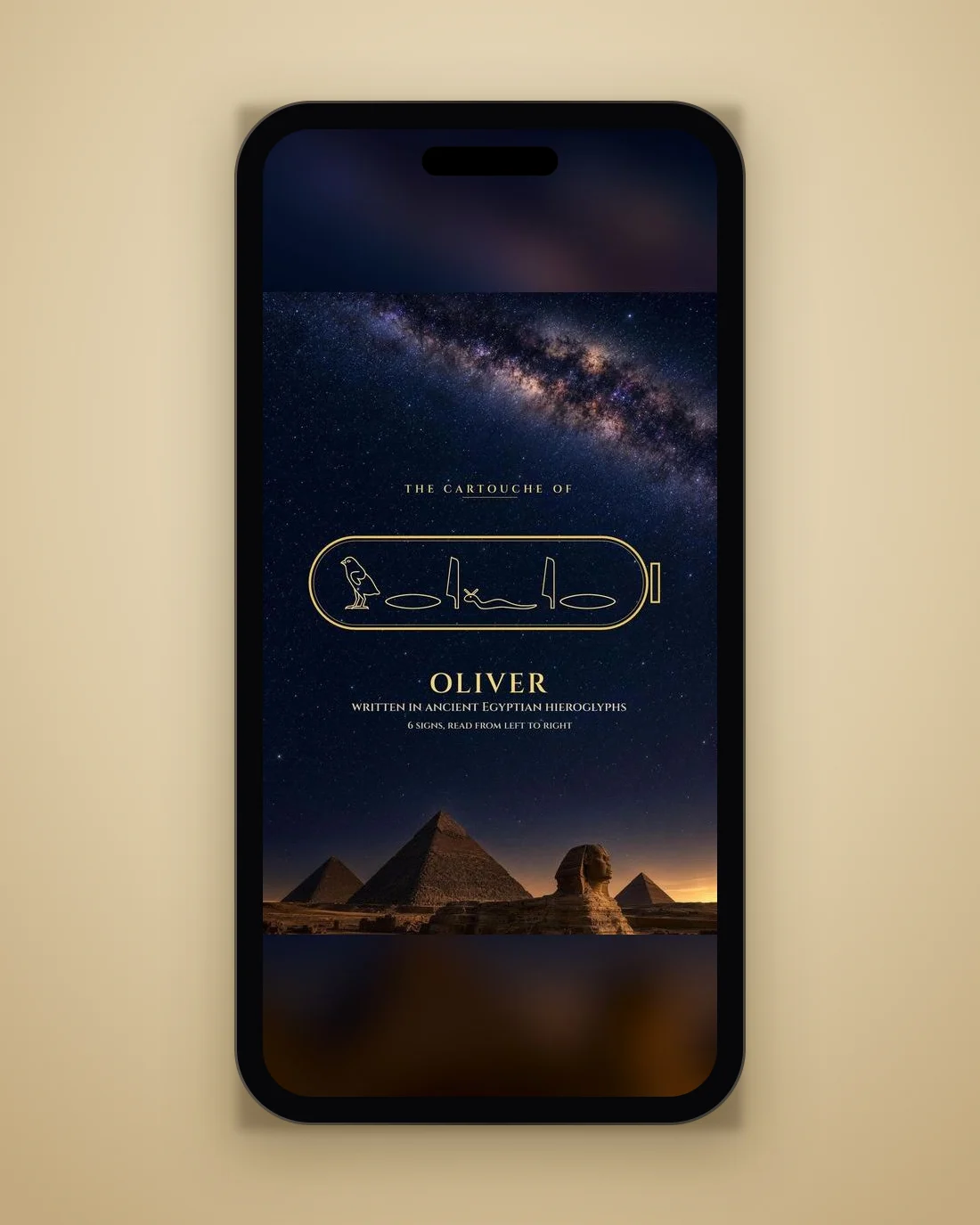
Cartouches are also the most popular way to put a modern name in hieroglyphs, on jewellery, prints and tattoos. Type yours into the name translator to see it inside a cartouche, spelled sign by sign.
Where do you see cartouches?
On almost every royal monument: temple walls, obelisks, statues and tomb walls, often in pairs. On objects: Tutankhamun's tomb held a wooden box shaped like a cartouche, and cartouche-shaped rings, plaques and scarabs carried the king's name. Today: gold and silver cartouche pendants with a name in hieroglyphs are a classic souvenir from Egypt.
How to type or copy 𓍷
𓍷 is a real character, not a picture: Unicode added the Egyptian hieroglyphs in 2009, and this one is U+13377, EGYPTIAN HIEROGLYPH V010. Press Copy above and it pastes into messages, documents and social posts like any letter. In HTML you can write 𓍷.
If it shows as an empty box, the device has no hieroglyph font: Windows includes Segoe UI Historic, and Noto Sans Egyptian Hieroglyphs is free for everything else. To spell words with sound signs, try the hieroglyphics keyboard.
Frequently asked questions
What does 𓍷 mean?
𓍷 is the cartouche, Gardiner V10: the oval rope ring Egyptians drew around a royal name. Its Egyptian name was šnw (shenu), "that which encircles", and it stood for the king ruling all that the sun encircles, and for protecting his name.
Why is it called a cartouche?
French soldiers on Napoleon's expedition to Egypt (1798–1801) thought the oval looked like a paper gunpowder cartridge, a cartouche in French. The Egyptians themselves called it šnw (shenu), from the verb "to encircle".
Who was allowed a cartouche?
Kings, from around the end of the Third Dynasty, and some queens and royal women, such as Nefertiti and Cleopatra. From the Middle Kingdom on a king had two names in cartouches: his throne name and his birth name. Ordinary people's names were never written in one.
What is the difference between a cartouche and a shen ring?
The shen ring 𓍶 (V9) is a short circle of rope tied at the bottom, a symbol of eternity and protection held by gods and the falcon of Horus. The cartouche 𓍷 (V10) is the same ring stretched into an oval so a royal name fits inside.
How do I copy and paste the cartouche symbol?
Press Copy on this page, or copy this character: 𓍷. It is Unicode U+13377, EGYPTIAN HIEROGLYPH V010, and pastes as text. If it shows as a box, install a hieroglyph font such as the free Noto Sans Egyptian Hieroglyphs.
Read the signs around it
Cartouche is one sign among hundreds. The quickest way in is the 25-sign alphabet: see your own name written in it, then learn to read it in the first lesson, free to start.
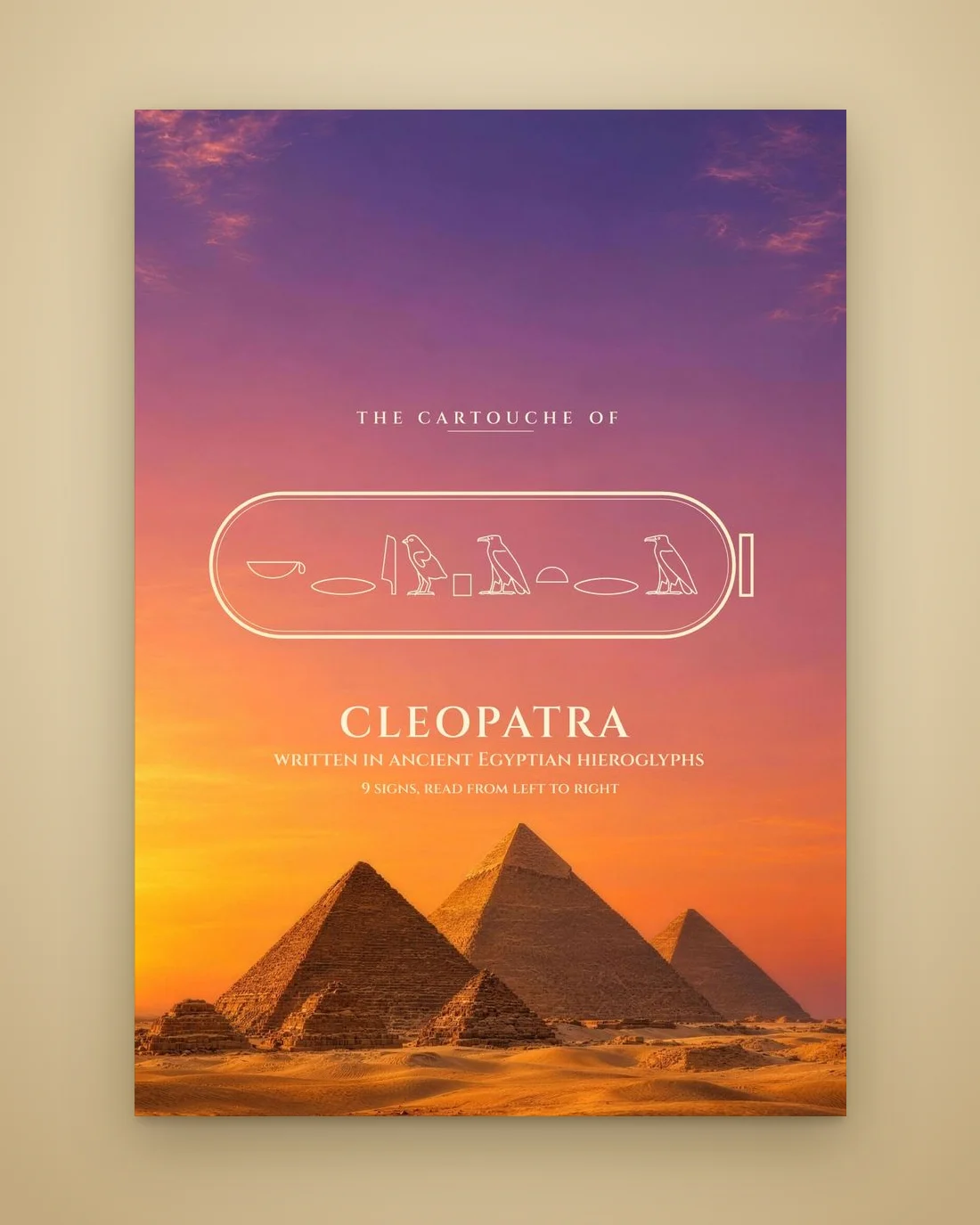
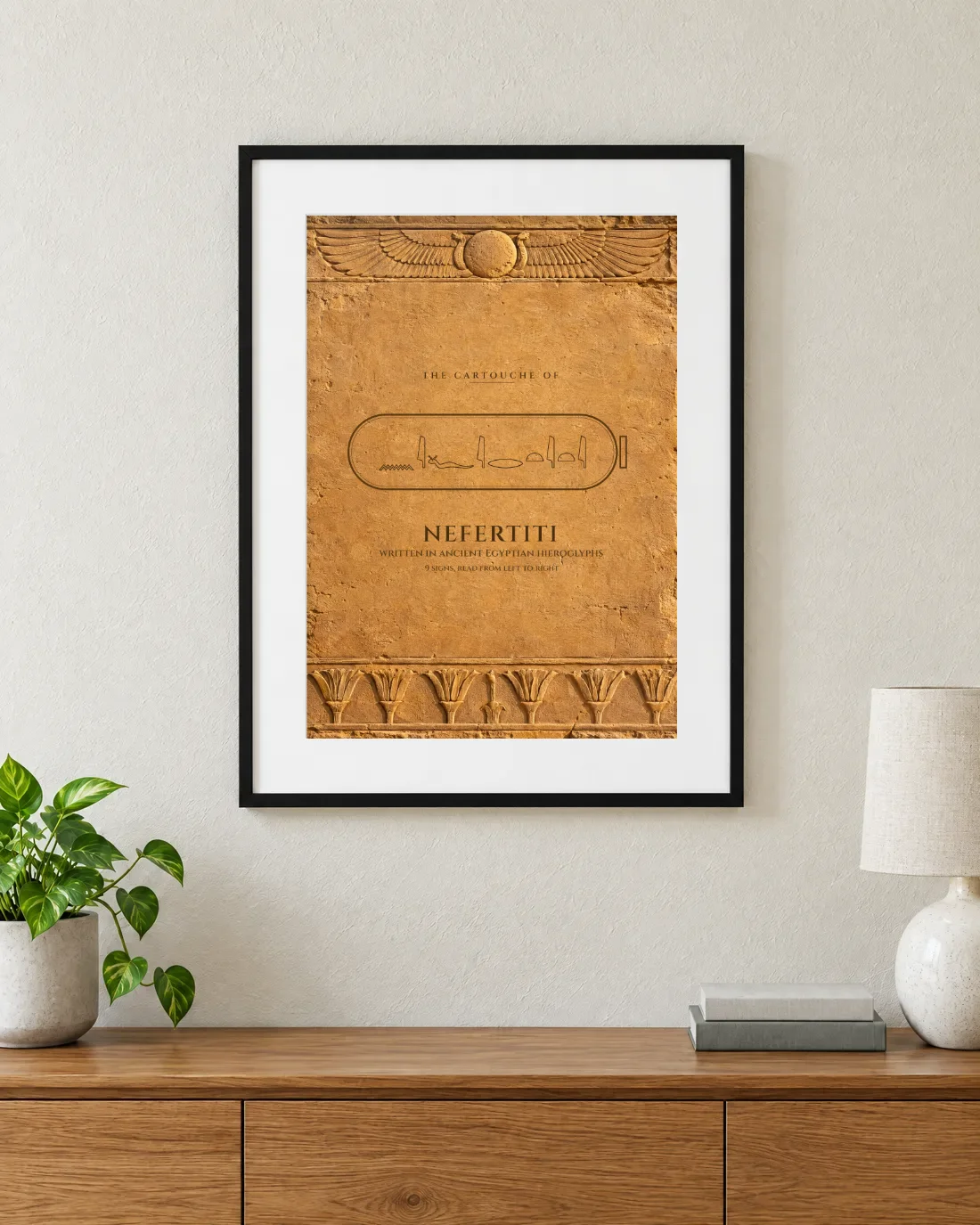
The Store
Their name in hieroglyphs, to keep
Prints for the wall, framed names, pictures by email and the course as a gift. Postage included, 14-day guarantee.
Visit the Store