Hieroglyph meaning
𓂀Eye of Horus meaning: the wedjat
By Harry Harrison · Published · Updated
Quick answer
𓂀 is the Eye of Horus, which the Egyptians called the wedjat (wḏꜣt), "the sound one" or "the one made whole". It stands for protection, healing and restoration, because in myth the falcon god Horus had his eye damaged by Seth and then made whole again. It was one of the most popular amulets in ancient Egypt, worn by the living and placed with the dead.
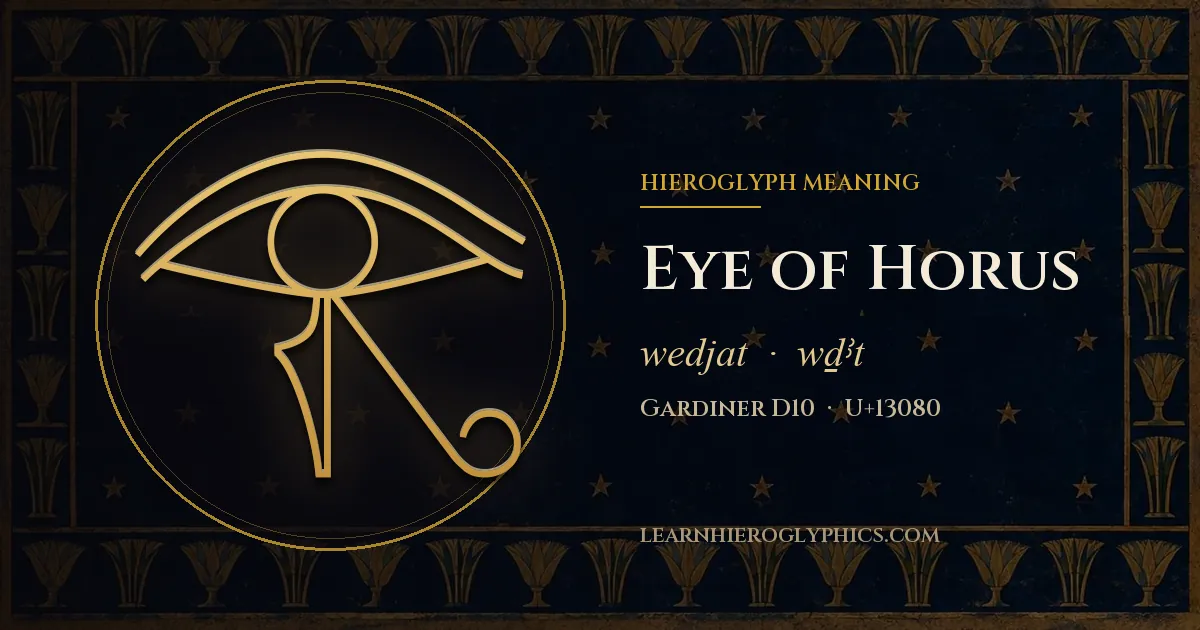
- Unicode
- U+13080 (EGYPTIAN HIEROGLYPH D010)
- Gardiner sign
- D10, human eye with the markings of a falcon
- Transliteration
- wḏꜣt
- Said
- “wedjat”
- How it was read
- A word-sign for wḏꜣt, "the sound (whole) eye"; the same picture also served as a protective emblem in its own right.
What does 𓂀 depict?
A human eye and eyebrow with two markings underneath: a straight stripe hanging down and a curl that sweeps back. Those markings are the dark cheek patches of a falcon, the bird of Horus, so the sign is both a person's eye and a falcon's at once. In Gardiner's sign list it is D10, in the section for parts of the human body.
Its Egyptian name, wḏꜣt, comes from the verb wḏꜣ, "to be whole, sound, unharmed". It is the same root as wḏꜣ in the blessing ꜥnḫ wḏꜣ snb, "life, prosperity, health", that follows a king's name.
What did the Eye of Horus mean?
The meaning comes from the struggle between Horus and his uncle Seth for the throne of Osiris, whom Seth had murdered. In the fighting Seth damages or tears out Horus's eye. In most versions the god Thoth heals it; in the New Kingdom story known as The Contendings of Horus and Seth it is Hathor who restores it, with gazelle milk. Either way, the eye that was broken is made whole, and that is what wedjat means.
So the sign stands for protection, healing and things restored to their proper state. Horus then offers his restored eye to his dead father Osiris, and in the Pyramid Texts "the Eye of Horus" becomes a name for any offering presented to the dead. Many Egyptologists also link the injured and healed eye with the moon, which wanes and returns each month, though the texts are not consistent about which eye is which.
You will often read that the parts of the eye were the signs for the fractions 1/2 to 1/64, adding up to 63/64. That idea goes back to Georg Möller in 1911, but later study of the hieratic fraction signs has undermined it, and most specialists now treat it as a modern story rather than an ancient one.
Find your name on a sealed door
Brush the sand off a buried lintel and read your name in hieroglyphs, then meet the rest of the 25-sign alphabet through real Egyptian words. Three short sections, about ten minutes each.
Where do you see the Eye of Horus?
Amulets. Wedjat amulets in faience, stone and gold are among the most common amulets ever found in Egypt, made for well over two thousand years. They were worn in life and wrapped into mummy bandages.
Coffins and tombs. Middle Kingdom coffins often have a pair of eyes painted on the side by the head, so the dead person, lying on their side, could look out at the rising sun and the offerings brought to them.
Jewellery and tattoos today. It is one of the most popular Egyptian designs for necklaces, rings and tattoos. There is no official Eye of Horus emoji, so people paste the Unicode sign 𓂀 instead, which is why so many people end up searching for it.
Eye of Horus or Eye of Ra?
The two are easy to mix up because Egyptian art often draws them the same way. The Eye of Horus is about healing and wholeness. The Eye of Ra is the sun god's eye as a fierce, often female, power that goes out into the world and punishes his enemies, personified by goddesses such as Sekhmet, Hathor and the cobra Wadjet. Some modern writers say the right eye is Ra's and the left is Horus's; that is a useful rule of thumb, but the ancient sources do not keep to it, and the difference shows up more in the texts than in the pictures.
Two more look-alikes: the goddess Wadjet (wꜣḏyt) sounds like wedjat but is a different word; and the blue-and-white nazar bead 🧿 against the evil eye comes from Turkey and the eastern Mediterranean, not from Egypt.
How to type or copy 𓂀
𓂀 is a real character, not a picture: Unicode added the Egyptian hieroglyphs in 2009, and this one is U+13080, EGYPTIAN HIEROGLYPH D010. Press Copy above and it pastes into messages, documents and social posts like any letter. In HTML you can write 𓂀.
If it shows as an empty box, the device has no hieroglyph font: Windows includes Segoe UI Historic, and Noto Sans Egyptian Hieroglyphs is free for everything else. To spell words with sound signs, try the hieroglyphics keyboard.
Frequently asked questions
What does 𓂀 mean?
𓂀 is the Eye of Horus, the ancient Egyptian wedjat (wḏꜣt), meaning "the sound one" or "the one made whole". It stands for protection, healing and restoration, from the myth in which Horus's eye was damaged by Seth and made whole again by Thoth (or, in one version, Hathor). It was worn as an amulet by the living and placed with the dead.
Is the Eye of Horus good or evil?
Good. In ancient Egypt it was a protective and healing sign, worn for safety and good health and buried with the dead to keep them whole. The idea that it is sinister comes from modern conspiracy theories and films, not from Egyptian sources.
Is the Eye of Horus the left or right eye?
Usually described as the left eye, linked with the moon, while the right eye is linked with the sun and Ra. The ancient texts are not consistent about this, though, and wedjat amulets were made facing both ways, so either is authentic.
How do I copy and paste the Eye of Horus symbol?
Press Copy on this page, or copy this character: 𓂀. It is Unicode U+13080, EGYPTIAN HIEROGLYPH D010, so it pastes as text into messages and documents. If it shows as a box, the device lacks a hieroglyph font; Noto Sans Egyptian Hieroglyphs is free.
Read the signs around it
Eye of Horus is one sign among hundreds. The quickest way in is the 25-sign alphabet: see your own name written in it, then learn to read it in the first lesson, free to start.
The Store
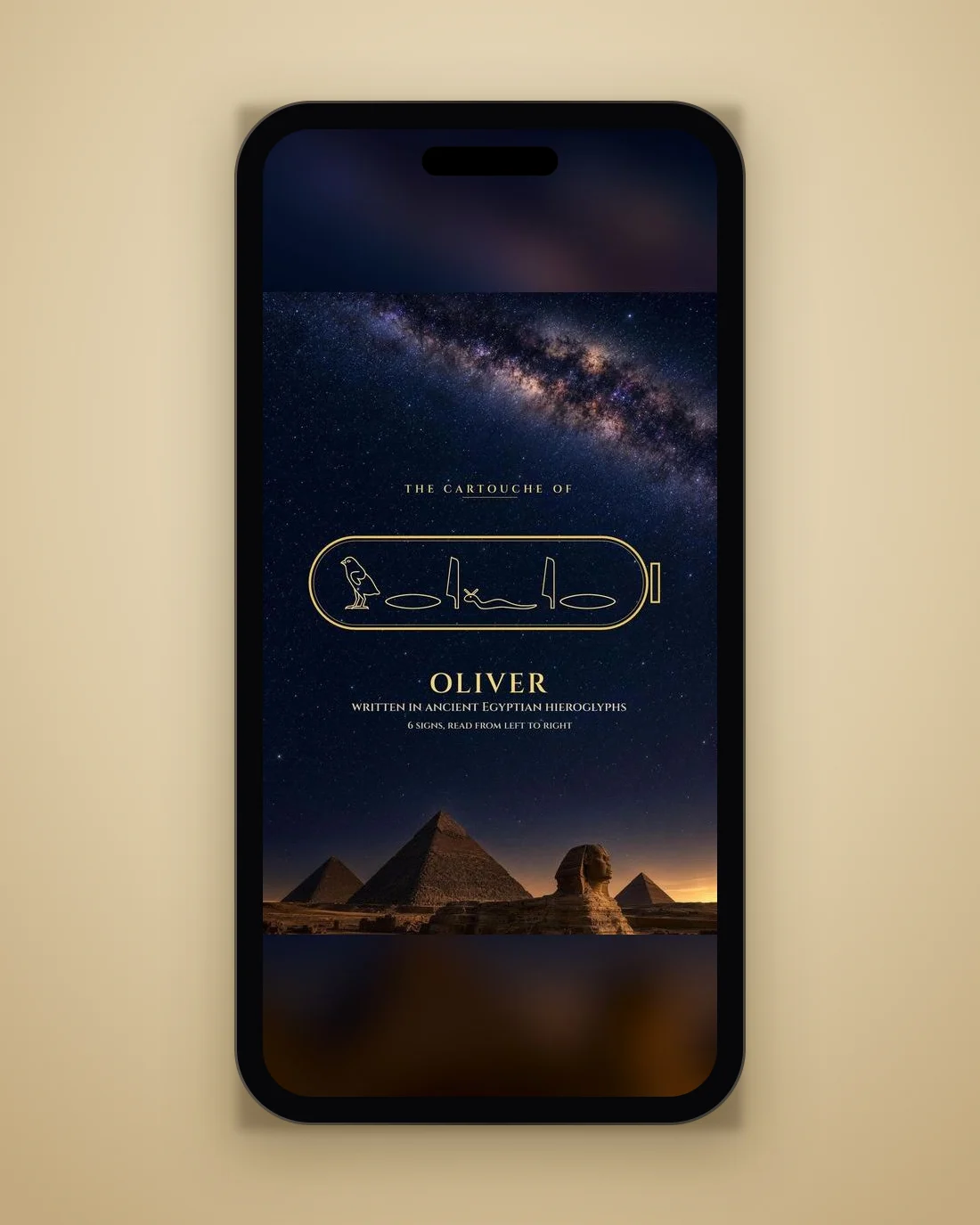
Their name in hieroglyphs, to keep
Prints for the wall, framed names, pictures by email and the course as a gift. Postage included, 14-day guarantee.
Visit the Store