Hieroglyph meaning
𓆣Scarab meaning: the beetle that means "to become"
By Harry Harrison · Published · Updated
Quick answer
𓆣 is the scarab beetle, the hieroglyph that spells ḫpr (kheper), the Egyptian verb "to come into being", "to become" or "to transform". The Egyptians linked the dung beetle rolling its ball with the sun rolled across the sky, so the scarab was also Khepri, the god of the sun at dawn. It became a symbol of creation, renewal and new life, and the most common amulet and seal in Egypt.
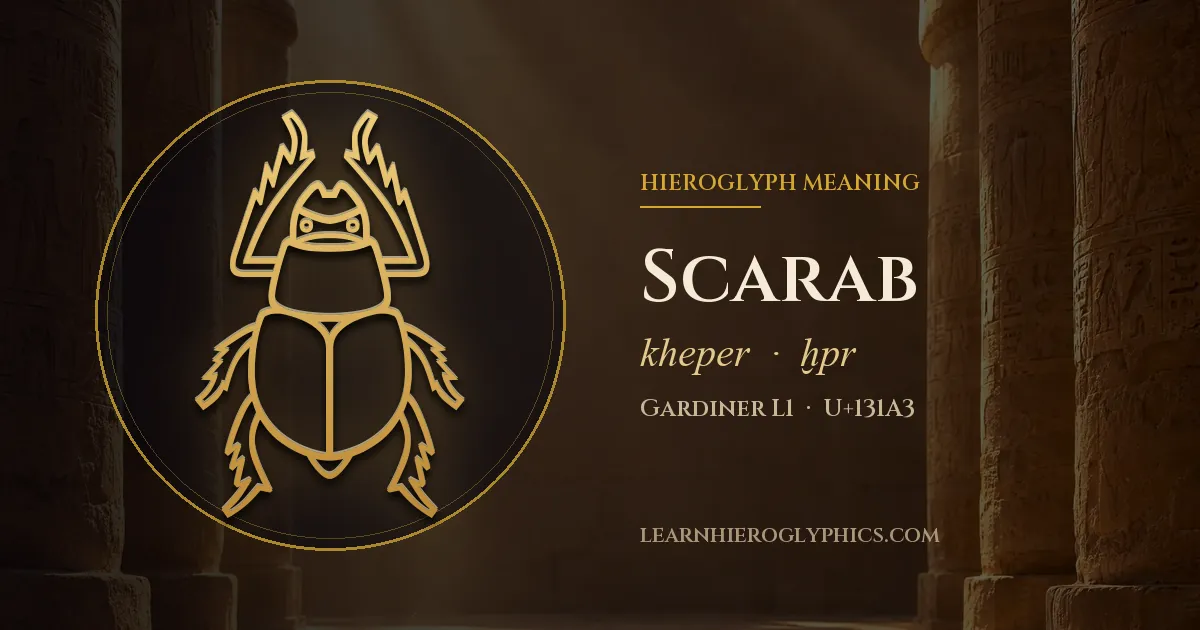
- Unicode
- U+131A3 (EGYPTIAN HIEROGLYPH L001)
- Gardiner sign
- L1, dung beetle
- Transliteration
- ḫpr
- Said
- “kheper”
- How it was read
- A three-consonant sign spelling ḫ-p-r, the verb "to come into being, to become", and the name of the god Khepri.
What does 𓆣 depict?
A dung beetle seen from above: the broad head with its toothed edge, the body and wing cases, and the legs. The species is usually identified as the sacred scarab, Scarabaeus sacer, which still lives in Egypt. It is L1, the first sign in Gardiner's section for invertebrates.
In writing it is a triliteral: one sign standing for three consonants, ḫ-p-r. It writes the verb ḫpr "to come into being, become, happen", the noun ḫprw "forms, transformations", and the name of the god Ḫprj, Khepri.
What did the scarab mean?
The beetle rolls a ball of dung far larger than itself and buries it, and its young later dig their way out of the ground. The Egyptians saw the sun in this: a great ball pushed across the sky each day by an unseen force, and new life appearing, apparently by itself, out of the earth. Whether they truly thought beetles had no mothers is debated, but the image of self-creation is everywhere in their texts.
So the scarab is Khepri, the sun at sunrise: Ra in the morning, newly born. The meaning widened from there to coming into being, transformation and renewal, including the renewal the dead hoped for. Kings used it in their names: Tutankhamun's throne name, Nebkheperure, means "lord of the manifestations of Ra", and Thutmose III's, Menkheperre, "the manifestation of Ra endures".
Find your name on a sealed door
Brush the sand off a buried lintel and read your name in hieroglyphs, then meet the rest of the 25-sign alphabet through real Egyptian words. Three short sections, about ten minutes each.
Where do you see the scarab?
Scarab seals and amulets. From the end of the Old Kingdom, a little before 2000 BCE, small stone and faience scarabs with a flat base were made in their hundreds of thousands. The underside carried a name, a title, a good-luck design or a king's name, and they were stamped into clay as seals or worn as charms. Amenhotep III even issued large "commemorative scarabs" announcing his marriage to Queen Tiye and his lion hunts.
Heart scarabs. A larger scarab, usually of dark green stone, was laid on the chest of a mummy. Its base carried a version of Spell 30B of the Book of the Dead, asking the heart not to stand up as a witness against its owner when it was weighed in the judgement.
Royal jewellery and art. Winged scarabs pushing the sun disc appear on pectorals (Tutankhamun's tomb has several), on tomb ceilings and over temple doors. Today the scarab is a favourite for rings, pendants and tattoos.
Scarab or just a beetle?
In jewellery shops "scarab" can mean any oval, beetle-backed bead, often a modern souvenir with made-up signs on the base. The ancient scarab is specifically the dung beetle, and real scarab seals have a carved flat underside. A few other beetles do appear in early Egyptian jewellery, such as the click beetle linked with the goddess Neith, but they are not scarabs and do not carry the meaning ḫpr.
Two more mix-ups: the winged scarab is not the same as the winged sun disc (a sun with falcon wings, the emblem of Horus of Behdet), though the two are often shown together; and the god Khepri, shown with a scarab for a head, is not the same as the scarab amulet, which works on its own.
How to type or copy 𓆣
𓆣 is a real character, not a picture: Unicode added the Egyptian hieroglyphs in 2009, and this one is U+131A3, EGYPTIAN HIEROGLYPH L001. Press Copy above and it pastes into messages, documents and social posts like any letter. In HTML you can write 𓆣.
If it shows as an empty box, the device has no hieroglyph font: Windows includes Segoe UI Historic, and Noto Sans Egyptian Hieroglyphs is free for everything else. To spell words with sound signs, try the hieroglyphics keyboard.
Frequently asked questions
What does 𓆣 mean?
𓆣 is the scarab beetle hieroglyph, Gardiner L1. It spells ḫpr (kheper), the Egyptian verb "to come into being", "to become" or "to transform", and stands for Khepri, the god of the rising sun. As an amulet it meant creation, renewal and new life.
Why did the Egyptians worship the scarab beetle?
They did not worship beetles as such; they saw in the dung beetle an image of the sun god. The beetle rolling its ball suggested the sun rolled across the sky, and young beetles emerging from the ground suggested life creating itself. That made the scarab the form of Khepri, the sun at dawn.
What is a heart scarab?
A large stone scarab placed on the chest of a mummy, inscribed with Spell 30B of the Book of the Dead. The spell asks the dead person's heart not to testify against them when it is weighed against the feather of Maat in the judgement of the dead.
How do I copy and paste the scarab symbol?
Press Copy on this page, or copy this character: 𓆣. It is Unicode U+131A3, EGYPTIAN HIEROGLYPH L001, and pastes as text. If it shows as a box, install a hieroglyph font such as the free Noto Sans Egyptian Hieroglyphs.
Read the signs around it
Scarab is one sign among hundreds. The quickest way in is the 25-sign alphabet: see your own name written in it, then learn to read it in the first lesson, free to start.
The Store
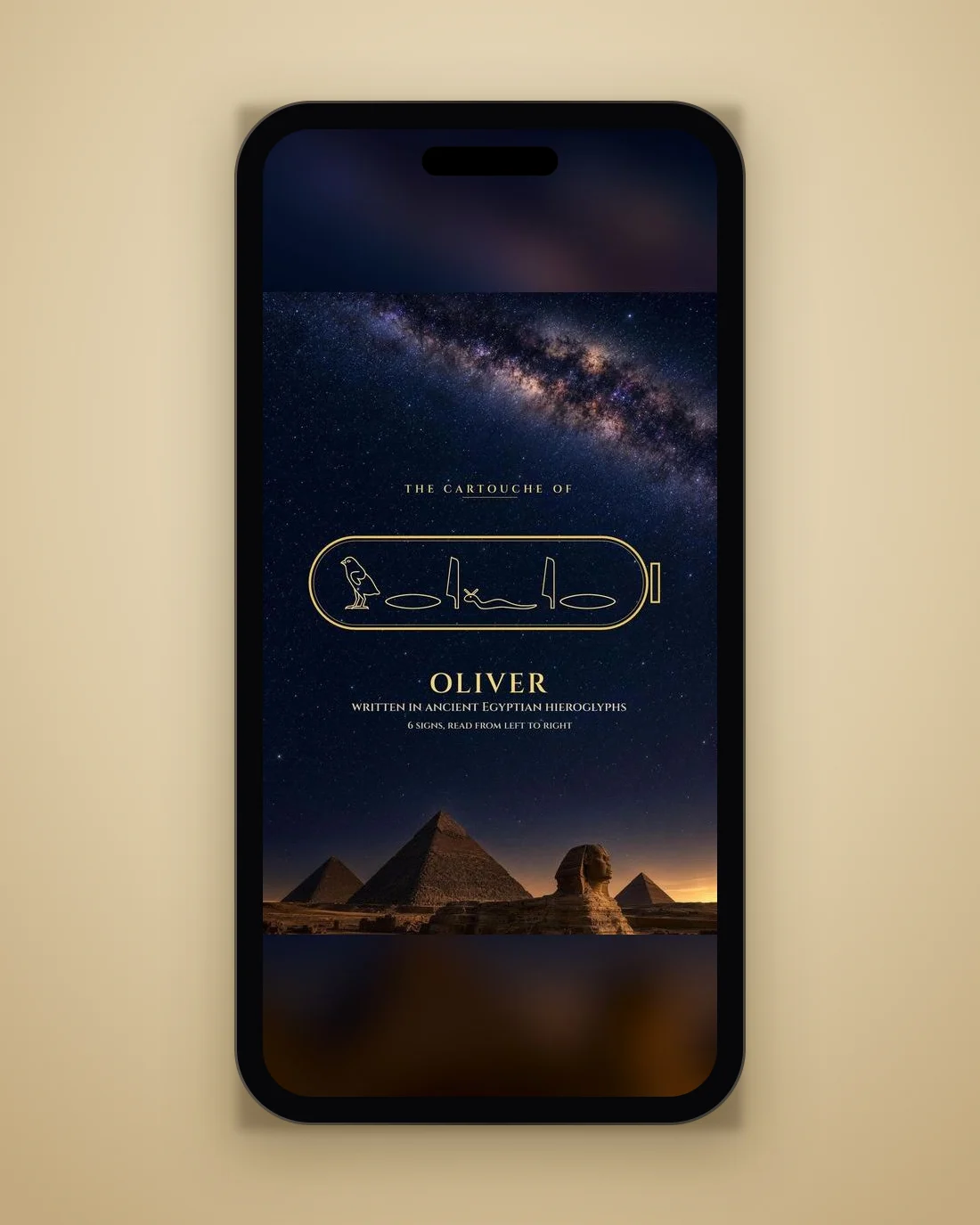
Their name in hieroglyphs, to keep
Prints for the wall, framed names, pictures by email and the course as a gift. Postage included, 14-day guarantee.
Visit the Store